
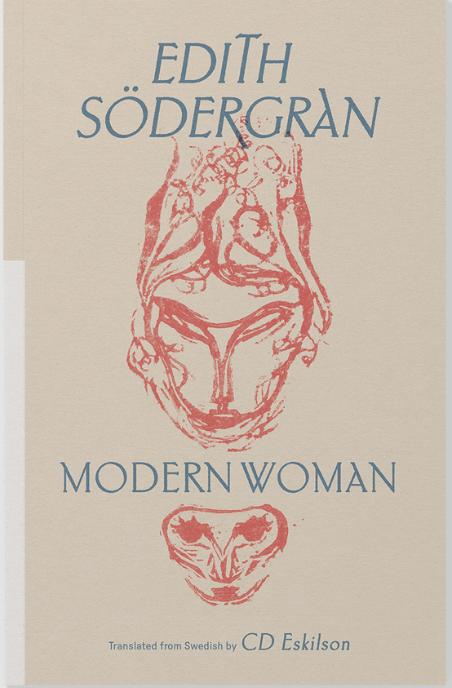
By the time she died at the age of thirty-one, Edith Södergran’s five collections of poetry had been largely ridiculed and relegated into obscurity. Södergran herself was hard to characterize; born to Finnish parents in St. Petersburg, and writing predominately in Swedish although she was proficient in multiple languages and educated in German primary schools, Södergran perhaps invited obscurity because the composition of her ethnic and linguistic identity were themselves obscure. Her childhood was marked by setbacks from tuberculosis, which also claimed the life of her father, and forced Södergran and her mother to seek convalescence in Switzerland. It was during her time in the sanatorium, isolated and inspired by German expressionists, that Södergran began to find a poetic voice, fusing an existentialist read of pastoral elements with a discomfited personal agency.
To read Södergran’s work today is to easily contextualize her voice within a feminist discourse, but it also defies being so neatly categorized. What makes her poems feel timeless is exactly their resistance to any niche delineation of time’s cultural productions.
In her latest translation of Södergran’s poems, Modern Woman, CD Eskilson has made this contextualization fairly easy. Take, for instance, the poem “We Women,” which severely bifurcates an ethics of gender:
We women––we are so close to this rich earth.
We ask the cuckoo what to expect of spring,
we throw our arms around a bare pine,
we search the sunset for signs and counsel.
I once loved a man: he believed nothing––
he came one cold day with his vacant eyes,
he left one heavy day with his forgetful brow.
If my child does not live, it is his––
Eskilson breaks the poem into two quatrains, whereas Södergran’s original composition is one octave. By doing so, Eskilson accentuates a Manichaean duality––women on the side of light and men on the side of darkness. Södergran’s poem likely doesn’t need this separation to demonstrate an oppositional depiction of gender (and an earlier publication of this same poem stays true to the original octave), but Eskilson’s decision thematically dramatizes this conflict and, in doing so, inverts the biblical narrative of Adam and Eve’s expulsion from the Garden. Here, it is women, free and unperturbed, who existed in harmony with the natural world before the introduction of man. It is interesting how love and man’s nihilism are fused into the same source of desire, as if desire for the singular outside of the collective is itself a form of nihilism.
The speaker’s preference for love, as a departure from a natural harmony, is threatened with a failure of her own nature––the death of her child. The logic of Södergran’s final line is astounding, implying that death is patrilineal. And, of course, it is. If woman, through a Manichaean binary, is the creator of life, then that leaves man no other option than to be the destroyer. Any rudimentary history of violence would not contradict this, albeit simplified, binary.
Södergran’s power lies in the fact that her poems are deceptively simple. Many of them are fewer than ten lines, which allows for a swift read without immediate reflection of their compression. However, what may appear at first glance as the imagistic or pastoral mimesis of so much modernist poetry, is, through a deeper read, subverted by a tense, recalcitrant humanism.
Perhaps the deception is not with Södergran’s work at all, but with the connotative expectation of capital-M Modernism. Just as Fredric Jameson delineates a multiplicity of postmodernisms, perhaps it is useful to delineate Södergran’s work through a larger dialectic of modernisms. It is possible that Södergran could have encountered the work of Georg Trakl, whose tendency towards the pastoral as representation of harsh emotional states feels salient. It is known that she took to the works of Thomas Mann while convalescing in Switzerland, but these influences, real or projected, do not serve the originality of Södergran, whose genius seems to operate in a kind of quiet legerdemain. Her work delicately and mysteriously flips the axes of representation, so that the imagistic elements are suddenly siphoned into the confessional.
In her poem, “Black and White,” Södergran’s tact feels apparent:
Rivers run below bridges,
flowers dot roadsides,
trees bend with whispers to the ground.
There’s no up or down for me,
no black or white,
not since I saw the bride
in my love’s arms.
The first tercet, which reads like any anodyne blank verse from the early twentieth century, is ostensibly set up as such to be subverted. Södergran’s shift in the following quatrain sees the previous natural world disappear entirely as her logical relation to that reality has been upended by a traumatic heartbreak. Eskilson deftly provides a clean separation between these two realities, whereas in Södergran’s original they are merged as one septet.
Between “Black and White” and “We Women,” one can already notice a theme developing––the sanctity of the pastoral is destroyed by the pollution of love. It is through her inversion of our deeper emotional spaces (i.e., love depicted in the negative) that Södergran belies a simple read. If love is not the resounding universal spirit that wrests us from crisis and moves us towards creation, but in fact a miasma that obstructs our clarity, then so many of us have been living in its toxic shadow. Södergran’s world offers a parallax around the rote and systemized emotional states, around our collective memory of positive and negative.
Nowhere else is this more apparent than in her poem “Hell,” which opens, “Ah, hell is wonderful!” At first glance, one feels compelled to read this line ironically. However, the arguments that follow depict this mythical inferno in an almost aspirational light. In hell, Södergran notes, “no one speaks of death … no one says an empty word … no one drinks, no one sleeps / and no one rests or stands still.” Hell is a space that negates the categorical binaries of positive and negative so that neither can form a salient moral relationship to its reality. In hell, Södergran notes, “tears aren’t tears––and grief is powerless.” Hell becomes the great neutralizer, neither exalting nor catastrophizing a sensationalist eternity, but paving an almost dharmic acceptance where the feared and erratic emotional states of the mortal plane are made instantly obsolete.
This is Södergran’s power, to subtly restructure the ontological fabric of earthly and eternal states of existence with a swift, insouciant motion. Perhaps her apologia for hell is also a rejection of modern expressions of righteousness, especially as they might be sexually delineated. As Eskilson makes abundantly clear in her introduction, Södergran’s “attempt to deconstruct gender was manifestly avant-garde in 1916,” and this becomes apparent in her attempt to subvert, manipulate, or obliterate all modes of binary construction.
In one of her most frequently quoted poems, “Vierge Moderne,” Södergran writes, “Jag är ingen kvinna. Jag är ett neutrum.” Previous translators have rendered the Swedish “neutrum” to its more literal “neuter;” however, Eskilson’s version of the first line reads, “I am not a woman. I am neutrosis.” In doing so, Eskilson has updated Södergran’s work with a more contemporary lexicon regarding gender expression, thus demonstrating how the work of translation is often political. One could choose to ignore the genderqueer elements of Södergran’s work, but to do so would also ignore the full extent by which she ostensibly disdains the fractious binaries of social organization. Eskilson’s decision also demonstrates how the role of the translator is not only to reimagine languages across their own incommensurable chasms (i.e., all that is lost between the Swedish and English), but also between disparate periods of time.
The language in “Vierge Moderne” vacillates wildly between concrete and qualitative states, never fully landing anywhere until the poem’s final line, “I am fire and water in a free and honest union.” Here Södergran merges these problematic polarities as evidence of their inherently dialectical dependency; through their union, one achieves liberation from the arbitrary systems of power. Södergran begins with a rejection of a single codified role and then immediately opens to multitudes, which, while surreal, reflect a more honest impression of one’s own capacity.
This new translation of Södergran’s work comes at a time when many of us are looking for creative expressions outside of the calcified and cancerous diagnostics of cultural recognition. They are poems that refuse all matters of hegemony, that reorganize the ontic materials of body, land, and spirit, and push for small, attainable revolutions. Södergran asks more of us in the same breath that she asks more of the world––not to rely on beauty, or happiness, or love, or miracles, but making the unseen world suddenly visible and permissible.
“All day and night,” Södergran says “I sit thinking / about things that never were, / my thirsty self allowed just one drink.” Let those of us who thirst for another world find a brief oasis in her work.
✶✶✶✶

Eric Tyler Benick is a writer from Tennessee currently based in Brooklyn. His poetry collections include Terracotta Fragments (Antiphony, 2026) and the fox hunts (Beautiful Days, 2023). He is a founding editor of Ursus Americanus Press, a publisher of shorter poetics. His work has appeared in APARTMENT, Bennington Review, The Brooklyn Review, Chicago Review, Copper Nickel, The Harvard Advocate, Puerto del Sol, Tyger Quarterly and elsewhere.
✶

