
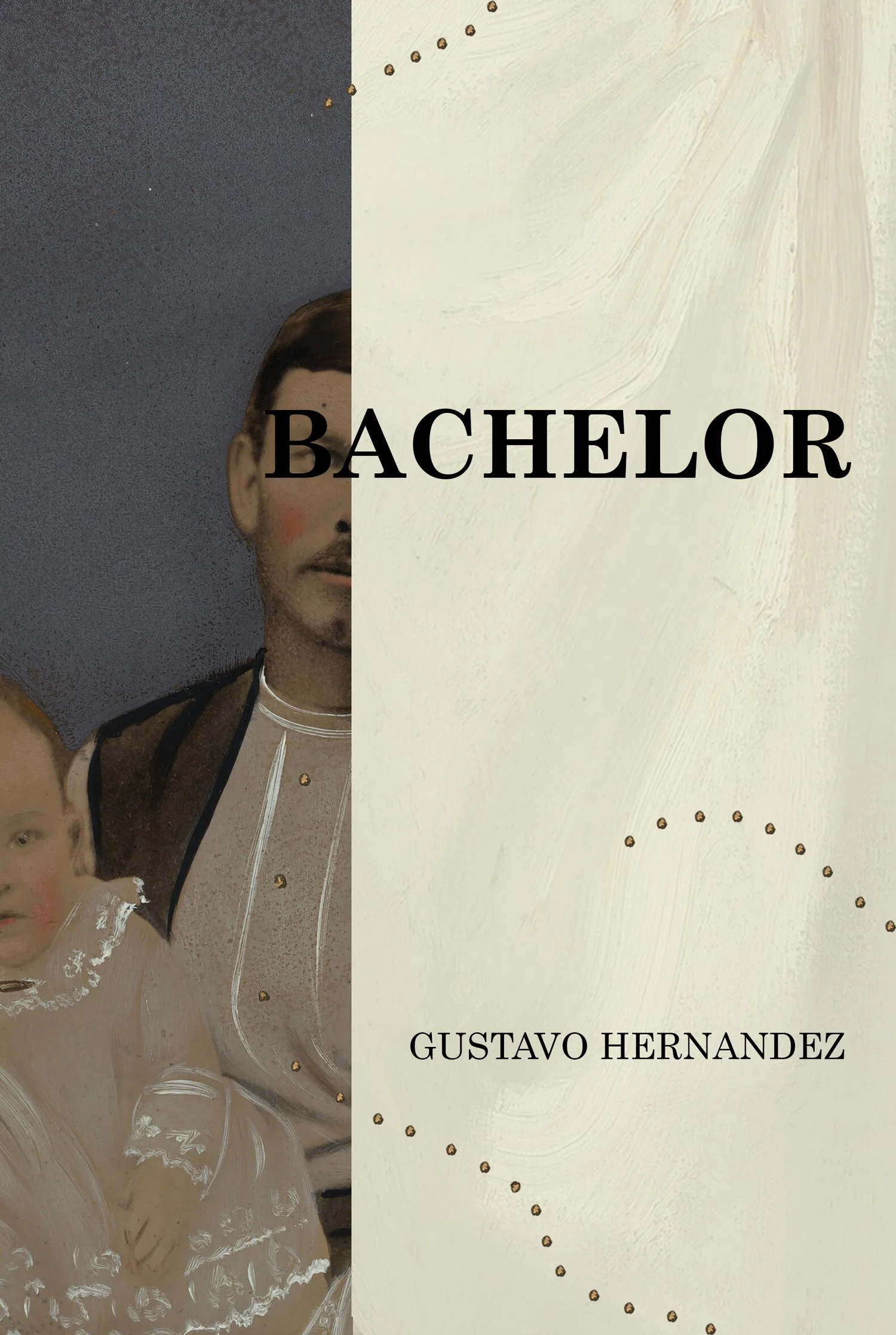
FlowerSong Press, 2025, 96 pp.
I want to live inside these poems.
Gustavo Hernandez had a good father. I didn’t. The grief in Bachelor is loss I never experienced. Consolation I never received. But I want to stay here anyway. These poems are built carefully enough to hold me.
Hernandez has described Bachelor—a finalist for the 2026 Lambda Literary Award for Gay Poetry—as a vase turned slowly in the hands, examined from every angle. Reading the book, I understood—each poem is not a departure but a rotation. The light shifts, the surface changes, but the object remains.
Sustaining a single voice across more than seventy poems takes Herculean effort. Hernandez achieves it not through spectacle, but through restraint—through building walls strong enough to peer over. The world is visible from here, but at a distance. Safe.
The repeated titles (“Bachelor,” “Husband,” “Son,” “Nocturne,” “Conclusion,” “I Can’t Settle on One Figure for a Sunset”) create that distance. The same words return like windows opening into different seasons. The speaker is not reinventing himself so much as re-seeing himself, testing how the same form weathers through time, love, faith, family, and loss. Within that posture, he is both subject and artifact. Early in the book, this stance is made explicit in “Baritone”: “Me in the third person. Him. / What I can hold—and the way I hold him—in my hands.”
That distance is the gift: space to look without being consumed.
The poems refuse to dramatize feeling when intimacy is already present, letting proximity, stillness, and ordinary action carry the weight. Moments of connection are often pared down rather than heightened. After intimacy is established through shared gestures—errand talk, side-by-side movement, unremarkable speech—“Greenlight” concludes simply: “Nothing much happened. Some dirt. Some sun. Some tread.” The book is focused and deliberate, its patience almost sculptural. Nothing extraneous enters.
Bachelor is written under enormous control, but it’s never inert. What keeps the book alive is the way moments of intensity surface unexpectedly—small cracks where the pressure of restraint briefly releases. Hernandez allows lyric force to break through sparingly, so when it does, lines like “You think and mouth and wait to be acted upon” feel charged precisely because they emerge from such careful containment. They don’t undo the book’s restraint; they prove it.
The poems feel repaired rather than broken open, built from inherited fragments Hernandez recombines and remakes. When, in “Nocturne [The kind where the horses have been hitched to the trees],” he writes, “I mess with the syntax—live / in the belongings—of the dead,” he names both his method and his inheritance. The alterations are acts of assembly. The poems endure. Throughout the book, language itself becomes the clay.The cultural intimacy is exact. Hernandez uses Spanish sparingly, but when it appears—most notably with the repeated hermano—it is not decorative. In “Cienega,” the word brackets ghosts, colonial labor, and dispossession:
We know our fathers were ordered to tame that land and grass, hermano.
Everywhere the hands and blades and bricks of ghosts,
and I want to be real—I’m lost
in the development and reconfiguration. In the dead, hermano.
As a Spanish speaker, I felt my guard drop, not because the language softened anything, but because it named what was shared. The vase here is handled by someone who knows its weight. Because he knows how to carry it, I can inhabit it.
Reading Bachelor as a gay, Mexican American poet, I found myself in a hall of mirrors—familiar, refracted, clarifying. In the poems where Hernandez’s father consoles him—even dead, even as memory—I felt a sharper loneliness. Hernandez had what I didn’t, yet what he built from that grief is sturdy enough to shelter someone whose father left damage.
Bachelorhood in this book is not merely personal; it is molded by what one inherits, and what one does not. The same vessel can hold different histories.
At its core, Bachelor is a book about learning how to see clearly—yourself, others, love, time—without being destroyed by clarity. The speaker is “old enough now / to demand a sunset mean something,” old enough to look directly at sadness and turn watching into meaning, not rescue. Lovers pass through the book almost interchangeably—“the outline of one man / replaces the outline of another.”
In another poem, “Yuzuko Finds Out What the Rest of the Family Already Knew,” the speaker sees himself plainly: “I was someone who would / only be with you when I had someone else to love.” For the speaker, connection to only one person is not desirable, or even possible, and he embraces that condition. Loss becomes story; loneliness becomes an identity chosen rather than denied.
This accumulation leads to the book’s quiet, devastating honesty about loneliness: “There are years where to a parent you’re a dotted outline.” “So many of us / gone, but lovers still / showed up at my front door.” Bachelorhood here is neither freedom nor failure; it is a condition of awareness, a place to watch from once the world has proven unsafe. The speaker understands himself as something shaped and reshaped, admitting finally, in “Bachelor [My niece Casandra trusts me],” “I am not a match for anyone.”
And yet the book does not end in despair. It ends in language—in the room language makes. The final stanza feels like the book’s emotional thesis:
I have taught all of my lovers how to write.
The lamp that sits in the corner of my room is dim.
I have taught all of them how to describe it.
This is what Hernandez offers: a lamp dim enough to see by without burning. A room where you can stay. A careful architecture of distance that doesn’t feel like exile—it feels like mercy.
Turn the vase one last time. Or don’t. Stay. As Hernandez writes in “Christmas Card,” “I’ve managed language for so long, / lonely doesn’t have to mean lonely anymore.” Bachelor proves that claim, not by offering answers, but by creating a place where loneliness can be borne. Where it can be examined without destroying you.
I didn’t expect to find shelter here. But I did. And I’m staying.
✶✶✶✶
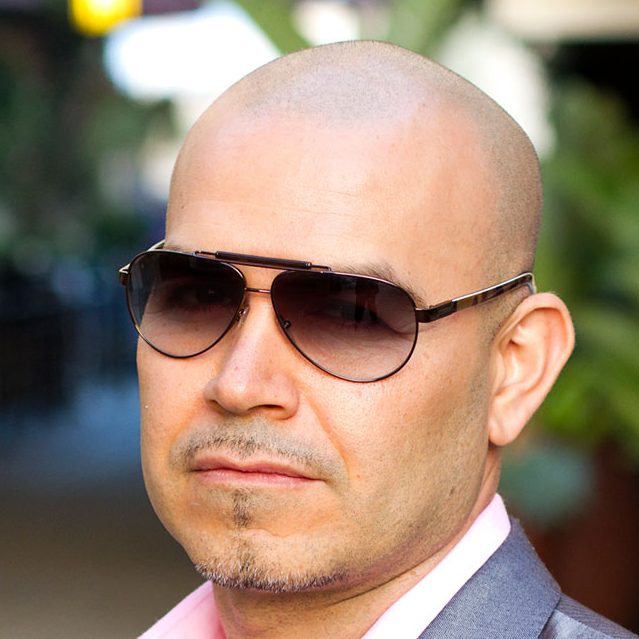
José Enrique Medina earned his BA in English from Cornell University. His first book, Haunt Me, won the 2025 Rattle Chapbook Prize. He writes poems, flash fiction, and short stories. His work has appeared in USA Today Hispanic Living, Best Microfiction 2019, The Los Angeles Review, and many other publications. He is a VONA fellow and the founder of the Chickens & Poetry Residency for Writers.
✶
Whenever possible, we link book titles to Bookshop, an independent bookselling site. As a Bookshop affiliate, Another Chicago Magazine earns a small percentage from qualifying purchases.

