
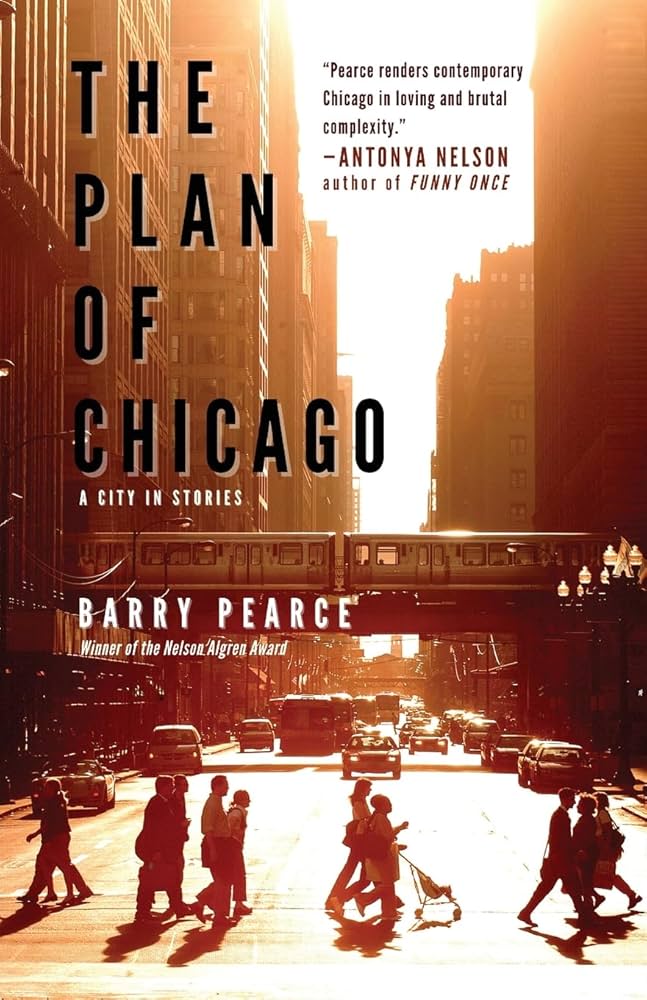
Cornerstone Press, 2025, 258 pp.
If we tell ourselves stories in order to live, the Chicagoans of Barry Pearce’s The Plan of Chicago: A City in Stories (Cornerstone Press) are telling themselves stories to keep from dying. The collection presents nine interlinked short works of fiction—each assigned to a Chicago neighborhood, with one exception—exploring how variously alienated, untethered individuals navigate an urban landscape rife with displacement, unstable identities, conditional relationships, and fabrication. Like the “City in a Garden” to which Pearce alludes in his epigraph, the book plants deep roots and unfurls tendrils across disparate patches of grass as it blossoms into a truly pleasurable read.
Just announced as a finalist for the Forward INDIES Book of the Year 2025, The Plan of Chicago marks Pearce’s foray into publishing a full collection of fiction under his own name—though he’s a ghostwriter by trade and has penned over twenty nonfiction books. He’s at his fullest prowess and most assured as a writer when writing about those whom he knows intimately: the South Side Irish. Pearce is a first-generation American who grew up in the shadow of Midway Airport as one of seven children.
These details are critical for one of the collection’s most vividly real stories, “Chief O’Neills,” where the titular Irish pub—fictional, not to be confused with the real-life one in Avondale—has more than literal cracks in its foundation. Characters grapple with the price of loyalty to their people and their community, even if it’s “too high a price to pay, too big a trade.” In other words, Pearce doesn’t shy away from ugly realities, like casual racism, endemic alcoholism, white flight, and unchecked tribalism.
In Pearce’s Chicago, disloyalty is punished, and loyalty also always comes with a price. He shapes characters’ relationships that are highly transactional. One feels real heartbreak when reading “Out of Egypt,” in which an adolescent Romani boy, Izzy—bedbound in a hospital after a staged car accident for insurance fraud goes awry—daydreams of a life after discharge where he’ll no longer be expected to prove his worth based on what he can contribute to the family coffers. Pearce brilliantly leaves us in suspended animation, keeping us largely in Izzy’s point of view and halfway between consciousness and sleep, relying on all senses but sight to convey the boy’s immediate, tragic reality. Though at times it can feel as if he relies on telling rather than showing, when deployed strategically, his more declarative sections serve to underline his characters’ compulsion to self-mythologize.
Pearce deftly structures the collection so that characters haunt the narrative. In “Clearing,” the protagonist of “Chief O’Neill’s,” Sully, returns to the narrative fourteen years older but no wiser as a struggling, nearly homeless alcoholic reliant upon the kindness of others. His impromptu benefactor, who abandoned the old neighborhood years earlier to avoid “the same narrow people with the same narrow views,” doesn’t extend a hand out of pure altruism so much as because he knows it’ll give the folks back home “one more reason he thought he was too good for them.” When Sully leaves the page for the last time, the reader is left without real closure, though Pearce has drawn him convincingly enough that one expects he’ll continue to lurk within the margins of both the story and society.
Pearce’s objective eye for detail is a clear asset as the narratives crisscross from North to South to West Side and back again, examining characters and pinpointing locations as if wielding a magnifying glass over a map. He thrives in a liminal space, though the same can’t be said for the inhabitants of the non-places he explores. The protagonist of our opening story, “Enumerator,” works as a census taker—a profession Pearce knows firsthand—counting and chronicling the lives of the hidden, the undocumented, the housebound, and “the uncountable.” Everyone we meet in The Plan of Chicago is a “displaced person,” sometimes with the official title handed down by a government or a non-governmental organization. They’re unmoored by poverty, war, migration, gentrification, addiction, divorce, or self-imposed exile. A Polish immigrant lives between neighborhood boundaries, and therefore in no neighborhood at all. A young, Black lesbian from South Shore finds herself stuck in Lincoln Park in a snowstorm. An Uptown resident insists he lives in East Ravenswood—a place that, if you ask me, doesn’t exist. In a city so segregated and distinct in its sometimes-atomized neighborhood makeup, geographic location begets destiny. Transcending the assigned location requires a privation of identity in return.
“Creatures of a Day” is one of the collection’s standout stories; a Rogers Park–set vignette that lulls the reader into a false sense of security before abruptly unsettling it. It also contains his best summary of the inherently solitary, deceitful nature of creative fiction: “Alone in the dark confines of the car, he once again finds himself the reluctant author of a story of his own, coloring the facts he knows, creating others to fill the gaps.” This is what Pearce has done with The Plan of Chicago—written what’s familiar and fabricated new accounts. Yet, mirroring Chicago’s own patchwork existence as a city of distinct neighborhoods, the lives of his imagined, interlinked denizens reveal their shared conditions. As it turns out, no one is truly alone in the City of the Big Shoulders.
Pearce knows that like cities, stories require a plan. Whether reality adheres to that plan is another story.
✶✶✶✶

Marnie Monogue is a Chicago writer and visual artist originally from rural Wisconsin. Her work has appeared in Beaver Magazine, Hidden Peak Review, and Unwoven; and her plays have been developed and performed by Make/Shift Theatre, PlayGround-Chicago and West Texas A&M University. She loves peanut butter M&Ms.
✶
Whenever possible, we link book titles to Bookshop, an independent bookselling site. As a Bookshop affiliate, Another Chicago Magazine earns a small percentage from qualifying purchases.

