
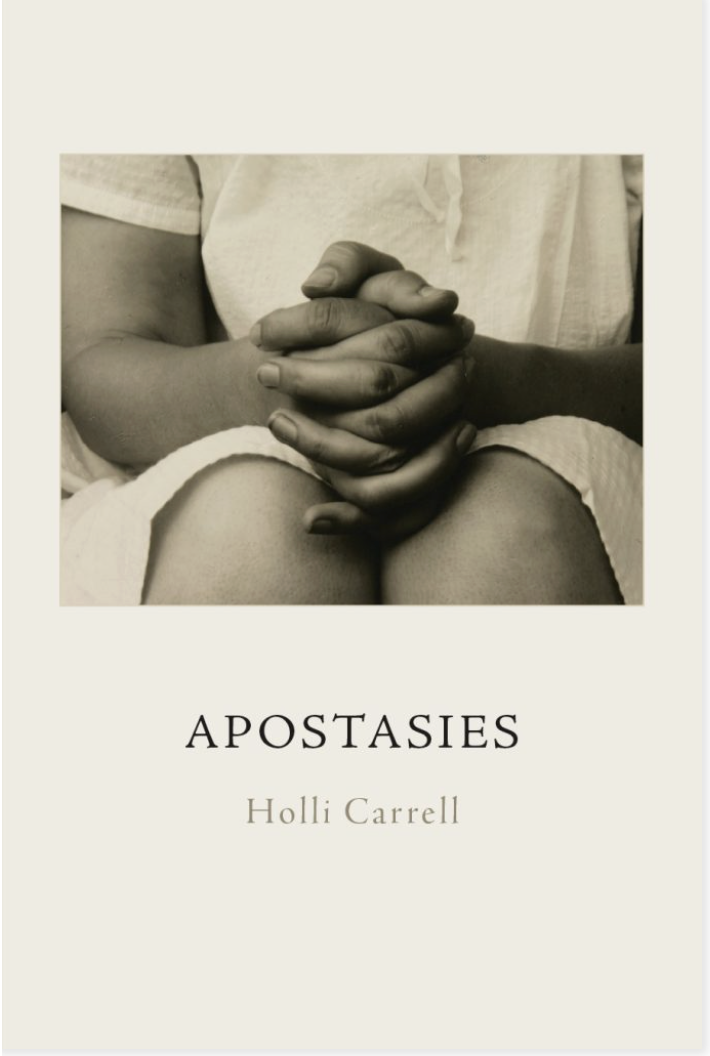
Apostasies, Holli Carrell’s first full-length collection and the winner of the 2025 Perugia Press Prize in Poetry, hinges on the difficult, often disorienting process of one woman reclaiming herself from the Mormon religion. Through a meticulously structured series of poems, Carrell shows us how religious indoctrination affects the human psyche. As she explores the awakening that leads to her eventual renunciation, Carrell never shies away from painful realities, including the circumstances that keep Mormon women trapped in abusive situations.
Much more than a litany of tribulations, this book deconstructs the persona that Carrell and women going back to the beginning of Mormonism have been forced to create to endure its grinding mortifications. Unlike most of these women, Carrell extricates herself, but not without a lasting emotional trauma. Poem by poem, Carrell reclaims the person her religion taught her to suppress.
Reminders of the sacrifice expected of women abound, including a tragic example in “The Woman Next Door.” If an advertisement for leaving the religion existed, this sad mother of seventeen children, “wild as crows,” embodies it:
massive and flowered, pale
as yeasted dough, before the beam
of the television, floundering
on her patched-up waterbed.
The speaker, a child observing this mother of “boys who tortured kittens,” cannot help but make the inevitable connection: “I saw / myself, too, like a pressed dead flower // inside the pages of a bed.”
The long poem “Womanhede” details the training of girls for the patriarchy. Carrell weaves direct quotes from Latter-day Saints (LDS) publications into the poem—quotes whose intent lurks beneath benign-sounding phrases:
The basic element
which should never change
in the lives of righteous
young women
is giving
service to others.
Here is a world where “[t]he flock watches and monitors,” ever alert to the development and behavior of its girls and women. The quote ending the poem, “Each of you bow / your head and say ‘Yes,’” leaves no uncertainty as to the flock’s expectations.
“Patterns,” a hybrid piece comprised of prose, poetry, photographs, and blackouts of letters and notebook pages, begins: “As a girl, I am taught to view facts with suspicion. A fact is always suspect, secondary to faith, negligible.” Notwithstanding, “Patterns” uncovers disturbing facts about the Mormon church, and especially its founder, Joseph Smith, who married between thirty and forty women and girls ranging in age from fourteen to fifty-eight. How was this allowed to happen? The answer comes in “the power imbalance between leader and follower,” which “enables the leader’s authority and control.” Carrell writes: “I erase the word ‘bride’ in my notebook, write ‘victim.’”
She goes on to explore Smith’s tactics as seen through the Sexual Grooming Model, “a deceptive process in which a perpetrator seeks to facilitate sexual contact with a minor while simultaneously avoiding detection and disclosure.” Smith met several of his future wives “before they turned twelve,” and promised their families “rewards, riches, and eternal salvation.” He also used “older wives to recruit younger women into polygamous marriages.” Carrell makes the inevitable comparison between these women and Ghislaine Maxwell, Jeffrey Epstein’s notorious co-conspirator: “they targeted, trafficked and groomed … shielding [Smith] from exposure and public backlash.”
The intellectual and emotional costs of such grooming reverberate throughout generations, setting expectations for behavior. In “Exhibit,” the speaker is the victim of an attack, yet her response is blunted:
Waking to a hand around my neck,
I wasn’t surprised. Violence seemed
a certain inevitability.
A lifetime of deliberate cognitive dissonance has distanced the speaker from her true feelings. As Carrell writes, “I try to examine that moment // from here, like a picture in a museum: // myself, barely past girl, so estranged / from my body.” Unable to mount even the smallest defense, she waits, “and was lucky / as his hand released, slipped off, nothing / worse.” This lack of reaction does not indicate a lack of will—it’s simply the best, the only, way a girl in her position could hope to survive.
Methodical, repetitive, and extremely effective, the system that places girls and women into such dangerous situations is the result of a process launched in childhood. In the notes for “Worthiness Interview,” Carrell informs us: “LDS youth are routinely interviewed by middle-aged male priesthood holders to determine their ‘worthiness.’” The poem describes these “interviews” in chilling detail:
I remember interviews in chapel basements
when men old enough to be my father
but not my father
took me from Sunday school
walked me down the hall
With doors closed and no one else present, these men question children about “sexual purity,” “pleasure,” sin, and obscenity. The message is clear: We expect you to behave, we are watching, and there is no escape, although the speaker imagines that she “might leap / through panes / if given opportunity.” The poem ends:
for years I held
the busted glass to my throat.
“I don’t want god, and I don’t want a child. A child is a minor god”; “I was told my womb was my reason for being, breathing.” These lines from “Matrix” cement the speaker’s renunciation. Her lack of desire for a child marks her as more than odd, almost heretic, in the eyes of her church: “Often, I see myself mutating monstrous in other women’s eyes. I learn not to discuss my unwanting.” She labels her reproductive organ as a dangerous entity: “My womb: landmine. My womb: doom.”
This book is a shining example of poetry’s ability to affect change in the reader. Through historical and personal perspectives, these poems provide a much-needed alternative to the standard faith narrative; in Apostasies, Carrell makes her case for renunciation.
✶✶✶✶
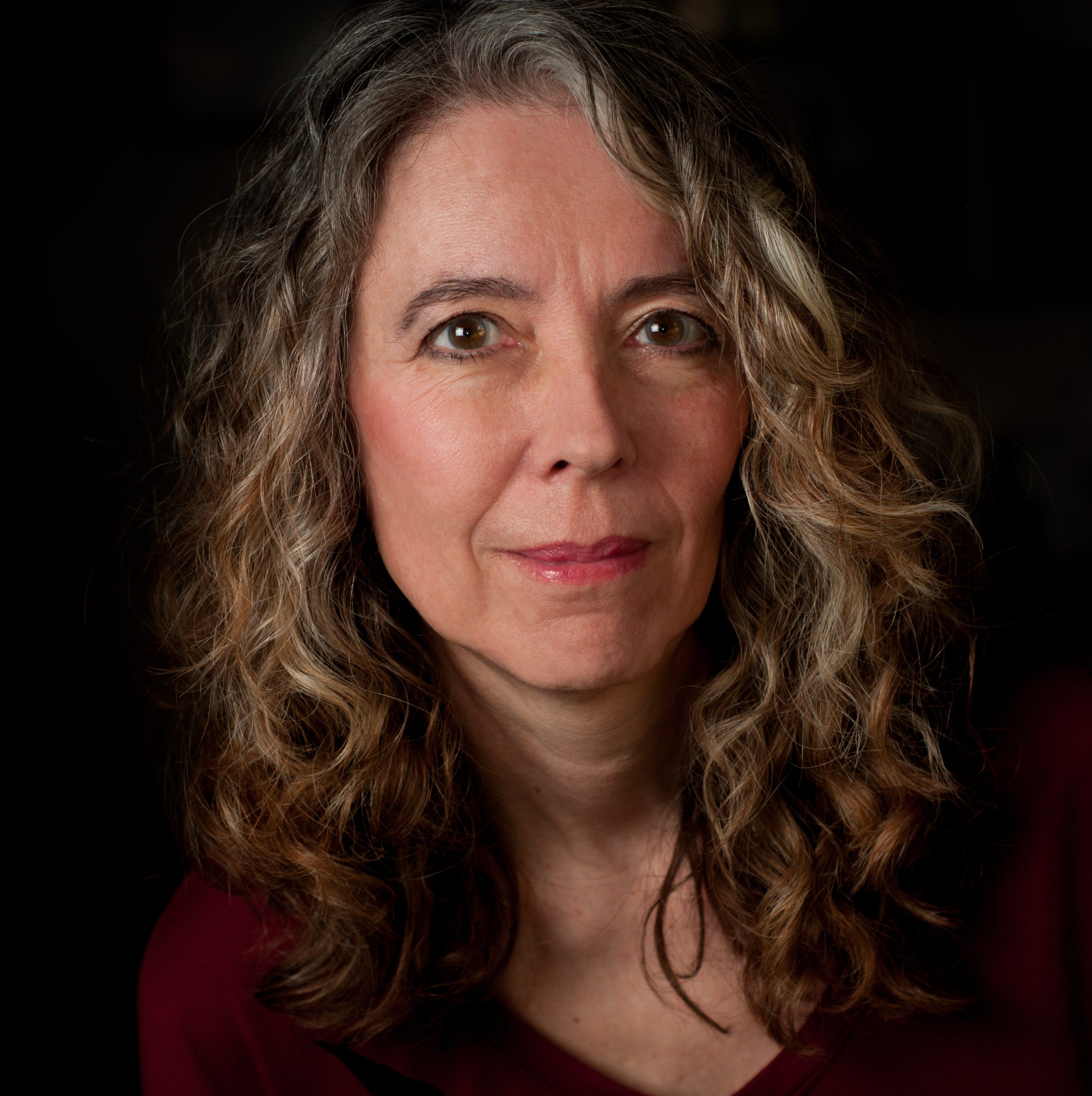
Erica Goss is the author of Landscape with Womb and Paradox (Broadstone Books, 2026) and Night Court, winner of the 2017 Lyrebird Award from Glass Lyre Press. She has received numerous Pushcart Prize and Best of the Net nominations, as well as a 2023 Best American Essay Notable. Recent and upcoming publications include Colorado Review, The Georgia Review, The Indianapolis Review, Oregon Humanities, Creative Nonfiction, North Dakota Quarterly, Gargoyle, Spillway, West Trestle Review, A-Minor, Redactions, Consequence, The Sunlight Press, The Pedestal Magazine, San Pedro River Review, and South Florida Poetry Journal. Erica served as Poet Laureate of Los Gatos, California, from 2013–2016. She lives in Eugene, Oregon, where she teaches, writes, and edits the newsletter A Writer’s Homestead.
✶
Whenever possible, we link book titles to Bookshop, an independent bookselling site. As a Bookshop affiliate, Another Chicago Magazine earns a small percentage from qualifying purchases.

