
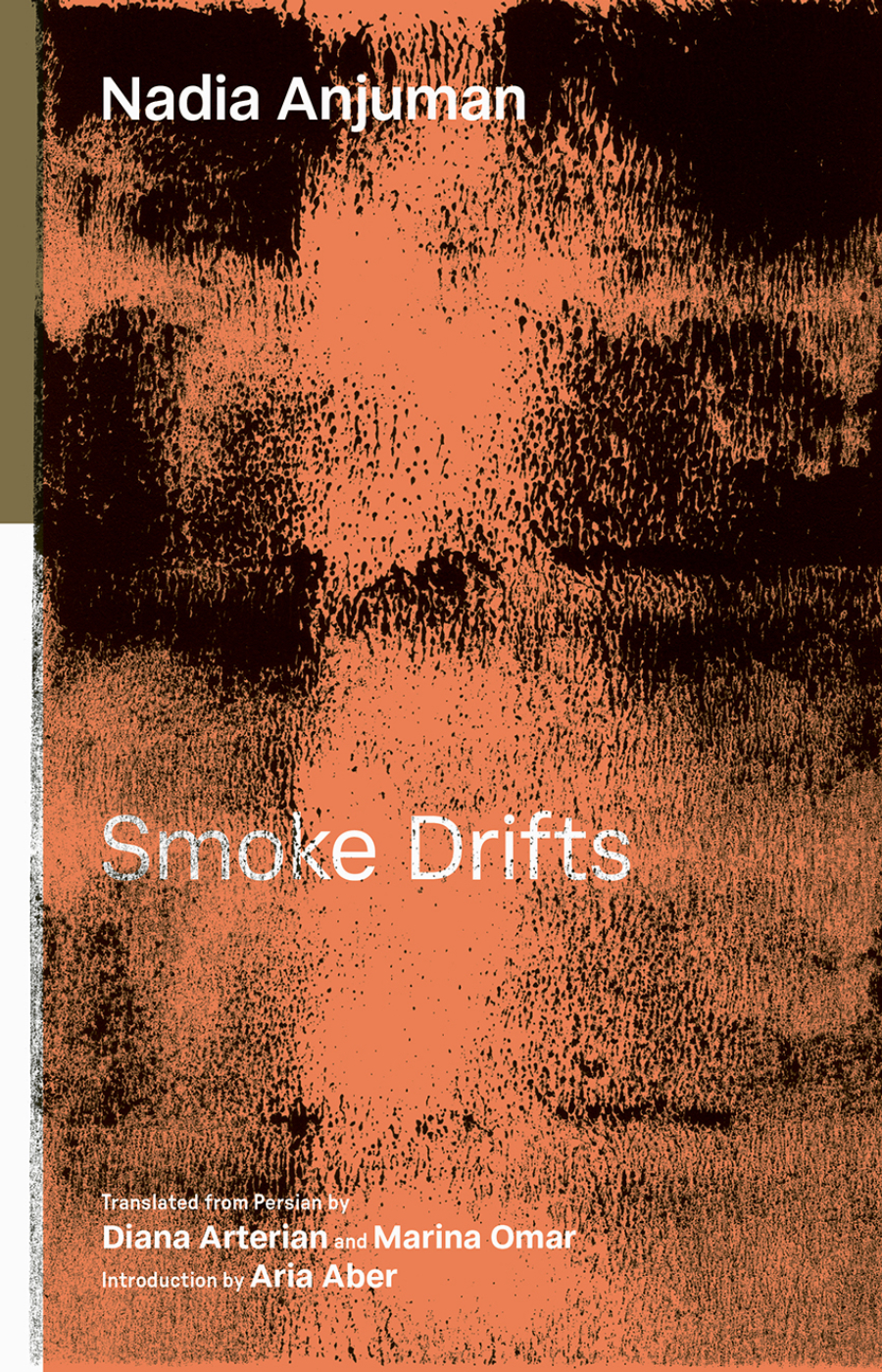
Smoke Drifts, a bilingual edition of selected poems by Afghan poet Nadia Anjuman, arrives to English-speaking audiences two decades after Anjuman’s death from domestic violence in 2005 at the age of twenty-four, just months after publishing her first volume of poetry, Gul-e-Dodi, in Afghanistan. Smoke Drifts contains selections from both Gul-e-Dodi—whose title is alternately translated as Flower of Smoke, Dark Flower, or Dark Red Flower—and Yek Sàbad Délhoreh—A Basket of Doubt, An Abundance of Worry, or A Wealth of Worry—which was published posthumously in 2006.
During her life, Anjuman was praised for her mastery of traditional Persian poetry and her prowess as a writer in Dari, the Afghan dialect of Farsi. Since her death, Anjuman’s legacy has grown more expansive, and her poems have become rallying cries, drawing attention to the struggles and aspirations of women and girls in Afghanistan and around the world. In an essay that accompanies an excerpt from the book, one of the translators, Diana Arterian, declares, “What makes Anjuman remarkable is her poetry—her ferocity and unfailing desire to continue to participate in this ancient art.”
Born in 1980, in the likewise ancient city of Herat in western Afghanistan, known for its robust literary culture and history of women in the arts, the poet adopted “Anjuman” as a pen name in honor of the local literary society Anjuman-e Adabīy-e Herat, according to another translator of Anjuman’s work, Felisa Hervey, whose own pen name is Farzana Marie. (Adopting a nom de plume, or takhallus, is a traditional practice in Persian poetry.) From the Taliban’s rise to power in 1995 to the US occupation of Afghanistan in 2001, Anjuman’s adolescence was marked by the regime’s repression of the rights of women and girls. Education was prohibited for them, but she continued hers by attending an underground school organized by women writers in Herat, disguised as a “sewing circle.” There, Herat University professors taught the women Eastern and Western literature, and the women shared their own writing, in secret and at great risk to their own safety. After the fall of the Taliban, Anjuman was finally able to enroll as a student at the university, where she continued her study of literature and her writing.
Smoke Drifts contains both free verse and poems that follow a formal architecture, including several of Anjuman’s ghazals, a centuries-old tradition that Uzbek writer Hamid Ismailov describes as “a universal poetic form,” like the European sonnet, found in literary cultures from Turkey to India. The reader need not be a scholar of these cultures to appreciate Arterian’s and Marina Omar’s English translations of Anjuman’s poetry, but the translators do offer extensive notes at the end of the book to guide the reader into a deeper appreciation and understanding of the characteristic structure, ambiguity, motifs, and symbolic vocabulary of the ghazal and Persian poetry in general. These notes are worth reading to grasp the full picture of the rich literary tradition that Anjuman studied, mastered, and practiced.
Anjuman took these raw materials and fashioned fervent poems that explore themes of grief, love, beauty, hope, and hopelessness. She sought poetry as a balm during the dark night of the soul that she, her community, and her country often traversed: “Charming poem—help me / Without you, my heart is in turmoil / You lured me in, now save me,” she writes in “Turmoil.”
Scattered English translations of Anjuman’s poems can be found on blogs, in online journals, and in print anthologies collecting the work of Afghan women writers. When comparing different translations of poems—such as “In Vain,” “Steel Strings,” and “Flower of Smoke,” as their titles appear in Smoke Drifts—one perceives how a given translator may lean toward certain dimensions of meaning or emphasize particular formal elements in a poem, such as the rhyme scheme or the refrain. While these formal elements are often more muted in Smoke Drifts, Arterian and Omar have created ornate, lyrical translations that feel concentrated and precise, never overwrought.
The collaboration between Arterian and Omar is described in the notes penned by each translator. Arterian is a poet from the United States who does not speak Persian but endeavored to translate Anjuman’s work. Omar was born in Afghanistan but lives in the United States, where she at one time worked as an interpreter for refugee families. The pairing of a writer with a native speaker, upon whom the former is dependent for their intimate knowledge of the source language and culture, is not uncommon in the field of literary translation; it can, however, lead to an imbalance in the attribution of and compensation for the creative labor of translation. The role of the native speaker, who provides what is referred to as a “literal” translation, may be diminished in comparison to the role of the writer, often credited with the artistic feat of molding the literal translation into literature.
In this case, the choice to credit Arterian and Omar as co-translators demonstrates a refusal to minimize the importance of Omar’s role. In her translator’s note, Arterian thoughtfully articulates how she sought to avoid these pitfalls and deepen her collaboration with Omar. In turn, Omar shares that “Anjuman’s poems expressed a pain that [she] too had experienced,” as she lived in Kabul when the Taliban took over and women were forbidden to work or go to school. The task of translating her poetry with Arterian was daunting, but Omar was determined “to make Anjuman’s voice heard beyond the boundaries of the Farsi-speaking world.”
That voice swells with bravado when Anjuman refers to herself in the third person in “My Garden.” In their notes on the poem, the translators observe that boasting about one’s artistry like this is a “common gesture in Persian poetry.” Weaving the poet’s pen name into the final couplet is also a traditional component of the ghazal:
I will believe in the meaning of hope
I will shut the door on grief and find another way
The roots of life need sustenance
So I will raise my glass to the future
I will let moonlight’s spring flow through shadows
I will grow cypress trees even in the stars
If I invite orange lilies to this affair
I will make gems envy my radiant garden
In time my work will be legendary
I will fill the chest of history with gold
If Anjuman helps me write these verses
I will gild every book with pure poetry
Anjuman promising to gild every book with pure poetry is not unlike a rapper swaggering about their ability to spit rhymes. In Dari, the word anjuman means a gathering, a collective, or a community, so when Anjuman refers to herself in her poems, in a way, she is also swaggering about the intellect and eloquence of her crew—perhaps the women with whom she wrote poetry in secret while pretending to sew. Or the thousands of people who showed up to her funeral in Herat. Or, since the Taliban returned to power in Afghanistan in 2021 and banned women not only from working or going to school but also from speaking, singing, or reading in public, the women who sing her poems on social media in defiance of this gender apartheid. Coincidentally, the literal meaning of the Persian term for pen name, takhallus, is to be liberated, to free oneself.
Despite the circumstances of her untimely and unjust death, Anjuman the poet will not be silenced; likewise, despite the efforts of the Taliban to erase them from public life, the anjuman of Afghan women will not be silenced.
May they fill the chest of history with gold.
✶
Note: For readers interested in the work of other Afghan women writers, please see Untold Narratives’ Paranda project.
✶✶✶✶

Emily Hunsberger is a bilingual writer and translator from Spanish. Her translation of Wonderland: Crónicas of Belonging in América, a collection of essays by Melanie Márquez Adams, was published by Mouthfeel Press in 2025. Her translations of shorter works of fiction, nonfiction, and poetry have appeared in Latin American Literature Today, The Southern Review, PRISM international, The Common, Southwest Review, and Grist. In addition to publishing original reporting, research, and criticism in English and Spanish, her poetry has appeared in Anfibias Literarias, Spanglish Voces, and forthcoming in Literary Mama. She lives with her family in Philadelphia.
✶
Whenever possible, we link book titles to Bookshop, an independent bookselling site. As a Bookshop affiliate, Another Chicago Magazine earns a small percentage from qualifying purchases.

