Review by Liz Rios Hall
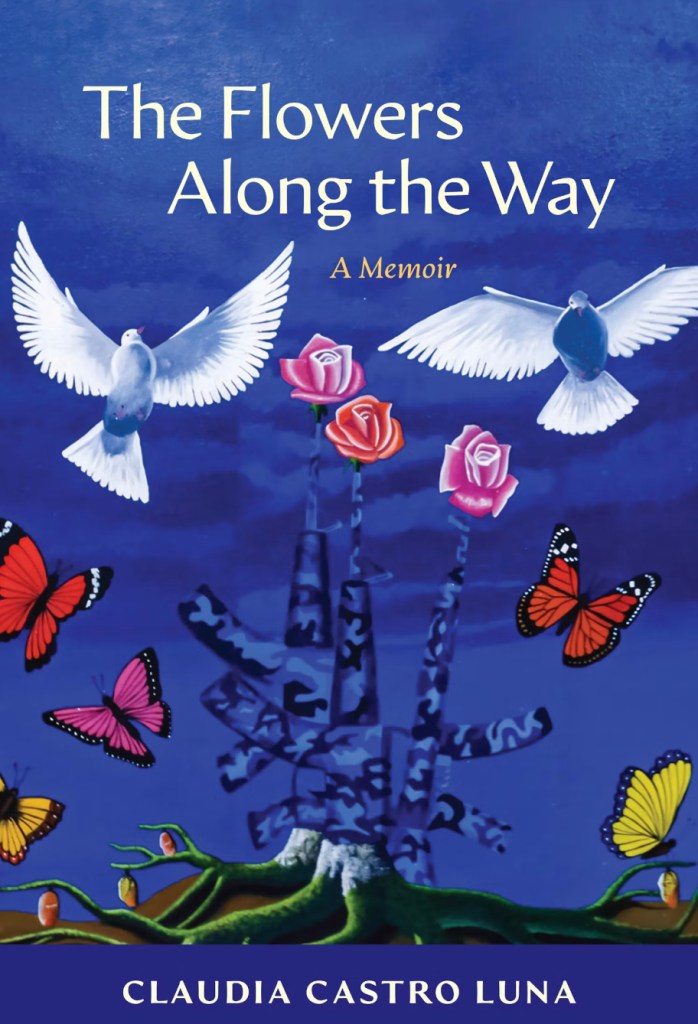
“Once there was a girl who lived in a country called Fear / There her fingers cracked and split into sharp mouths that screamed what she could not scream,” writes Claudia Castro Luna in “Agua de Beber,” a poem about growing up during the Salvadoran Civil War from her 2022 collection Cipota Under the Moon (Tia Chuca Press). The former Washington State Poet Laureate’s new memoir, The Flowers Along the Way (Curbstone Press), expands on her earlier work, weaving the story of her war-ravaged childhood in El Salvador with a traumatic event decades later that becomes the catalyst to revisit it.
In 2003, while pregnant, Castro Luna and her toddler barely survived a public shooting outside their house in Oakland, California. The experience of shielding her daughter from bullets transports her back to El Salvador and the civil war that killed more than 70,000 civilians. Castro Luna realizes the past she thought she left behind when her family sought refuge in America is still painfully present: “Gun violence could have killed me in El Salvador during the civil war my family had managed to escape, and gun violence could have killed me, my toddler, and my unborn baby in front of my house in the United States.”
The Flowers Along the Way alternates between the aftermath of the Oakland shooting and El Salvador in the 1970s and 80s. As the narrator confronts her fear of returning home to the scene of the shooting, she revisits memories of her youth when violence continually threatened daily life. With the help of a therapist, Castro Luna realizes that the girl whose dance class was ambushed by machine-gun fire has become the woman whose heart races each time she hears a strange noise.
The concept of “trauma” is familiar today, but when Castro Luna was diagnosed with PTSD after the shooting in 2003, she struggled to accept it. “In my mind, the word ‘trauma’ belonged to military personnel, not to private citizens. I had never imagined that it could apply to my family,” she writes. Eventually, she realizes her health problems aren’t coincidental. “Guerra doesn’t go away when the bullets stop or when helicopter blades no longer spin. Guerra stays inside of you like a dormant illness. Guerra comes and assaults you over and over, again and again, and your body erupts each time, inflaming your insides, sometimes cutting up your hands.”
Castro Luna’s diagnosis gives her a new perspective on her family’s past. She recalls her father’s recurrent nightmares after the family immigrated to the US and her mother’s instructions to “‘Borrón y cuenta nueva.’ Scratch out and start again.” Silence and repression are the family’s survival tactics as they move across the country looking for stable work and community. Eventually, Castro Luna lands in California, where she goes to college and graduate school, meets her husband, and starts a new family in Oakland. Then the shooting shatters her sense of safety and, along with it, her perception of the American Dream. “We worked hard, for decades, to suppress the terror of the war we survived,” she writes. “But the terror never left. It only simmered under the new lives we built.”
When Castro Luna enrolls in a writing class at a nearby community college, she finds a new way to process her fractured history. Writing becomes an antidote to silence and a path to healing. It also allows her to document the experience of war from an embodied, firsthand perspective. “For too long Salvadorans appeared as faceless people in news stories, stories written by some who did not carry the heat and sultriness of volcanic ash coursing through their veins,” she writes. In response, Castro Luna has crafted an intimate “poetry of witness,” as Carolyn Forché called it in What You Have Heard is True (Penguin), detailing the history of a conflict as it ravages outside and, as her memoir attests, inside somebody.
Though The Flowers Along the Way is memoir, the book occasionally borrows poetic techniques, like juxtaposition and white space, to reveal the connection between the personal and political. Castro Luna punctuates domestic scenes from her adolescence with war reports that could have been pulled from news headlines. On February 4, 1980, for example, as guerillas were breaking into her school to show the students how to make Molotov cocktails, “the church El Rosario in San Salvador was sprayed with gunfire from a moving vehicle, killing three and injuring many of the people who were taking refuge there.” Stories like these are not separate from daily life, she suggests—they’re the landscape she and her generation grew up in.
The civil war officially ended in 1992, but its aftershocks continue to reverberate, impacting people in El Salvador and the diaspora today. In The Flowers Along the Way, Castro Luna criticizes US support for the authoritarian government that killed tens of thousands of Salvadorans. As she observes in “Caravans,” a poem from Cipota Under the Moon, the flow of military equipment, including 32,000 assault rifles the US delivered to El Salvador, has been replaced by “a new caravan, not of weapons but of war survivors” heading “north to the place where the rifles came from.”
While The Flowers Along the Way doesn’t focus on contemporary immigration policies, as I read the book, I found it hard not to think about how the Trump administration has targeted Spanish-speaking immigrants like Castro Luna. According to Human Rights Watch, more than 9,000 Salvadorans were deported during the first year after Trump took office in 2025. The Trump-friendly Salvadoran government has incarcerated some of them, along with deportees from Venezuela, in its infamous CECOT mega-prison, while others have been forcibly disappeared. Fear of ICE raids and erratic immigration laws now haunt many Salvadoran immigrants in the US, making Castro Luna’s story even more timely as a new generation of children faces the kind of displacement and enforced silence she chronicles in her memoir. How many more Salvadorans will be traumatized by the actions of the US government? How many more children will be coerced into secrecy and hiding?
The Flowers Along the Way offers an intimate portrait of war and its invisible legacy, but the book doesn’t ignore the light as it plumbs the darkness. Castro Luna celebrates joy, faith, and hope as she confronts trauma and pain. Happy memories of her “dynamic, tempestuous” abuela and Atiquizaya, the Edenic rural village where she lived among extended family as a small child, are saturated with color and life. Castro Luna’s lush descriptions of the natural world are especially glorious. El Salvador is “a ball of tangled greens: parrot greens curl around emerald greens and flowers, like precious gems, sparkle and emanate hues charged with sunlight.” In Atiquizaya, her father tends a garden “paradise” bursting with flowers and fruits, including a queenly mango tree that shelters Castro Luna and her sister as they feast on its abundant harvest. After they move to the US, her father, a teacher in El Salvador, works as a gardener in Los Angeles. He sows a mano de león shrub in the small strip of soil outside their condo. “These plants operated as memory placeholders, reminders of elsewhere and of the way we were,” she writes.
The story reminded me of my grandmother, whose childhood was marred by the Spanish Civil War, and my grandfather, whose rural Puerto Rican village was nearly destroyed during a nationalist uprising against US rule. I imagine them outside their house in Tampa, Florida, where they eventually put down new roots. My grandmother waters scarlet hibiscus in brightly painted macetas as if it were a balcón in Sevilla. My grandfather slices an orange from a tree in the garden with his rusty machete just like he did back home on the finca. The fruit’s golden skin radiates in the sun.
“Often, we [immigrants] first broadcast our arrival, and resilience, through celluloid codes,” observes Castro Luna. “We hope for a new harvest from our in-between place, one that contains the ‘there’ and the ‘here.’” The Flowers Along the Way testifies to the healing power of that hope, showing how nurturing a garden, or a story, can generate something fresh and green out of loss.
✶✶✶✶

Liz Rios Hall is a writer from Orlando, Florida. Her work has appeared in Saw Palm, Aquifer: The Florida Review Online, and Literary Mama, where she was a book review editor. She writes about books on her Substack, The Uncommon Reader.
✶
Whenever possible, we link book titles to Bookshop.org, an independent bookselling site. As a Bookshop affiliate, Another Chicago Magazine earns a small percentage from qualifying purchases.

