
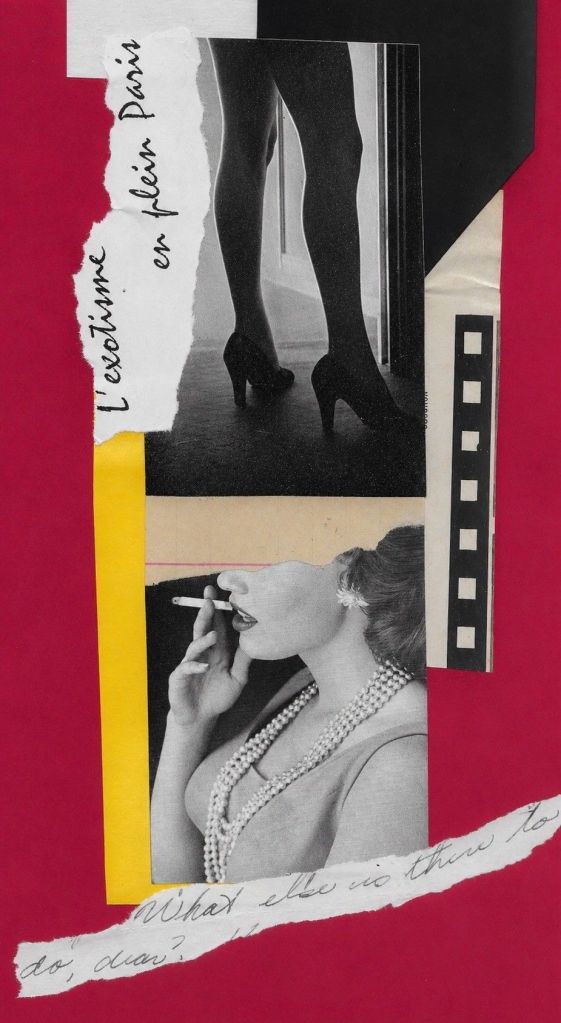
Lucy staggered out of her office, sunglasses on, cap pulled low, trying to keep the glare from searing her brain. Friday evenings were hell. She knew the headaches were psychosomatic (God, how she dreaded going home to an empty apartment), but her body was a drama queen, ready to relinquish its peripheral vision or vomit on cue. Why she thought she could feel her way home was something she’d let her therapist parse. But she knew the routine: left out of the elevator and south on Michigan. Right to Adams. Cross the river and keep going west. Twenty blocks in thirty minutes on a good day.
Today was not a good day. Every step jarred the base of her skull against her spine. She could feel her central nervous system unraveling, the friction lighting each filament on fire.
It took her forty-five minutes to reach the familiar door handle. She pushed her way in, leaning back against the glass until she was steady enough to speak to her doorman. Sam would lead her into the elevator and open her apartment with his key. He’d linger in the doorway until he saw her flip the bedroom light switch twice, on and then off again. She’d drop her bag on Jonathan’s side of the bed, then kick off her shoes, open a packet of Goody’s, and pour it on her tongue. Then she’d drink a bottle of water and pray she didn’t wake up until Saturday.
But something was off this evening. Migraines heightened her sense of smell—her lobby was brass polish and Dawn dishwashing soap. But this one? She drew the scent in cautiously. Paperboard covered with dust. Acrid, inky illustrations.
“May I help you?”
She slid off her sunglasses half a centimeter at a time. The nameplate on the desk read “J. Ranson, HB.” He was sixty-ish, tall, sturdily built, his gray hair falling over his deeply set eyes. “Can you tell me where I am?”
He leaned forward on his elbows. “Metaphorically or literally?”
Her cheeks burned. “The address.”
He leaned back, as if he’d lost interest in the question. “Ranson’s Puzzles. Latitude 41.878911. Longitude about twice that, negative, of course, since we do reside in the Western Hemisphere.”
The heat on her cheeks felt good, so she massaged it toward her aching temples. The puzzle store. She knew it existed, but she’d never been inside. Jonathan had, of course, to buy a birthday gift for someone. He’d mentioned that the proprietor was—
“Are you here to shop or to get directions to the nearest mental health center?”
Lucy hesitated, wondering whether it would take less energy to tell the old man to mind his own business or to do as he asked. She was in no state to work a puzzle. Tomorrow, though, or the days after that?
He slipped on a pair of half-frame glasses to make it more obvious that he was looking down his nose. “Busy weekend planned?”
“Toss-up between watching The Golden Girls while chewing the lead-based paint off my fingernails or eating popcorn laced with Sel de Drano,” she snapped.
And immediately felt better.
“Aisle 7,” Mr. Ranson said, pointing a thumb over his left shoulder. “Romance and Ruins.”
Lucy grabbed the first puzzle she came to and darted back into line. While she waited to check out, she looked the box over. Romances in ruins was more like it. The artwork, designed to look like panels in a comic book, included a crashing airplane towing a banner that read “Marry me, Lois!” Another showed a semi-truck jack-knifing on the highway, spilling heart-shaped boxes of oozing chocolates. There was a little pink house, bleeding where it had been chainsawed in half. Jagged stumps of wine bottles and glasses lined up on the counter of a melee weapons store. There was even a pop art panel reminiscent of the old optical illusion—was it a young woman or an old hag?—except that it depicted a droopy bosom and a flaccid penis, entwined so that you could only see one or the other at a time.
“That will be fifty-four dollars.” When Ranson saw her jaw drop, he raised his thick, white eyebrows and explained: “Taxes. Neighborhood, city, state, federal…” He trailed off with a shrug, as if he couldn’t remember them all.
“And this last one?” Lucy pointed to a cryptic notation on the credit card receipt.
“Oh, I wouldn’t worry about it. We only add that fee if you solve the puzzle.”
✶
She backtracked three blocks and crossed the street. Her doorman looked surprised—perhaps he didn’t recognize her without the hat and sunglasses—but he said nothing, only pointed to the bag. “Don’t you love that place? Jonathan bought my daughter a puzzle for her birthday last month. That’s where she spends all her allowance now.” He abruptly turned away and pretended to cough into his elbow, as if realizing he’d uttered a forbidden name.
There wasn’t enough light in the apartment to do the thousand-piece puzzle. She went from room to room, twisting the wooden blinds open, flipping on lamps and ceiling lights. On the advice of the realtor Jonathan had hired to show the apartment, she’d bought new living room furniture. All the soft furnishings—mattress, drapes, rugs, even the bathroom towels—were new, too. She’d had the plaster walls sanded and repainted and had hung nothing on them but an antique mirror. She’d even emptied the shelves and drawers, boxed up the contents, and taken them to the climate-controlled storage unit they’d rented in preparation for the big move west. When she needed something—a roll of tape, a hardback book, a bottle of acetaminophen, a pretty piece of glass—she bought it. Right now, there was no clutter in her life, nothing to overstimulate or aggravate.
Jonathan liked to accumulate. Guitars, abstract art, people he met in the ER where he’d just completed his residency. If he were home tonight, he’d be making his house specialty (cucina di fiasco, three different recipes started and discarded as something new struck his fancy), and someone she’d never met before would be unpacking a bag in the spare bedroom. There would have been no place for her to work a—she checked the dimensions on the box—twenty-four-by-thirty-inch puzzle. But right now she had options. Coffee table, kitchen island, dining room table? She chose the latter, realizing that only the cleaning lady had been in the room for weeks.
She recollected their system. Separate the pieces by color—in this case, black, white, red, blue, yellow, green, both solid-colored and hatched. Place each pile on a flat surface (the white cafeteria trays her husband had “borrowed” from the hospital were long gone, so she spread out six new dishtowels). Sort out the edge pieces, also by color. Begin. They could work a thousand-piece puzzle like this one—i.e., straight-edged with discrete panels and more or less realistic artwork—in four hours. Unless they were drinking, which tended to distract them. She managed to push that memory out of her head but not this one: Jonathan could work a puzzle upside down. He’d sit on the floor across from her at the old makeshift coffee table—a wooden ironing board laid across two plastic crates—with one foot resting between her thighs.
The puzzle was edged with a thick black line, making the frame pieces almost too easy to identify. She was almost halfway finished when she got up to get a glass of water, but when she realized she’d left her headache as well as her money with Mr. Ranson, she poured a half glass of wine instead. When she walked back into the dining room, her mind did a time shuffle, and for a second, she expected the mantel to be crowded with paintings, some hanging, some standing on edge, no two frames alike, each work overlapping the one before it like the scales of a big, kitschy dragon. That was Jonathan. She tapped the birdseye maple mirror as she passed. Was that Lucy? She still couldn’t decide.
A few sips in, she acknowledged she was stumped: An edge piece from her brand-new puzzle was missing. She smoothed her hands over each dishtowel, augmenting her sight with touch. She lifted each corner to peer under it. Nothing. Nothing trapped in the box. Nothing dropped to the thick rug under the table. Nothing wedged in her lap, fallen into a pocket, or tracked into the kitchen.
The shop was open for another hour. Anticipating that she’d have to provide evidence, she took a photo showing the gap in the frame and hurried out the door.
Ranson was explaining his filing system to an assistant, a wisp of a girl with soft pink hair. “Those shelves represent the puzzles we’ve sold this month.” He was pointing to an empty bookcase behind him. “They walked, as grown children and good scotches are known to do.” He pointed to the bookcase at his right, which was stacked high with used puzzles, their lids askew, their corners pinched and split. “These are the ones who’ve come back to us, unwanted and unsolved.” He pinched a fake tear from his eye. “And these”—he gestured to his left, at an empty bookcase exactly like the first one—“are our happy endings. The kids are okay. They check in on Instagram from time to time, but we never see them again.”
The pink-haired woman sucked on her upper lip. “Ever consider using a spreadsheet?”
He swiveled his laptop toward her. “Access. I’m certified. But I like having a more tactile representation of what we’re dealing with these days.” He gestured from bookcase to bookcase, framing the words with his hands as he summarized. “Missing in Action. Walking Wounded. Mission Accomplished. Got it?”
The girl saluted.
Lucy tapped on the desk to get Ranson’s attention.
“Oh, it’s you,” he said. “Finished already?”
“Your puzzle’s defective.”
She expected him to raise his eyebrows, in keeping with the persona of “eccentric old coot.” But only the assistant responded, her soft “he he he” audible over her coffee cup. So Lucy showed them the photo.
“Quarter to,” they said simultaneously, which Lucy knew was shorthand for a piece whose arm jutted out to the left. The old man reached up until he connected with the young woman’s high five, and then he pushed his glasses down. “How long has it been since you worked a puzzle?”
Maybe her nostrils flared a little. But then her spine softened. Before the Residency. That’s what she and Jonathan called it. The BR for short, as if it were an era, one that coincidentally rhymed with “ER.” How long has it been since we spent your night off alone together? Before the Residency. When was the last time you stayed awake long enough to finish anything? Before the Residency.
She straightened her shoulders. “A while. Why?”
“I’m wondering if you’re out of practice.”
“This is a very simple edge.”
“Perhaps. But you’ll never know for certain until you finish the interior, will you?” He pointed his thumb toward the exit.
In her mind, Lucy bared her incisors and growled. But she would sort the puzzle again, piece by piece. She remembered that sometimes one piece really was two pieces, the edge nonexistent until its partner filled the empty space. She was opening her cell phone to type a note for her next therapy session when she realized she was home, and Sam was clearing his throat to get her attention.
She stopped.
It was a beautiful evening, short-sleeve weather in March. Even the damp that lingered at the feet of the taller buildings was gone. Sam should have been home by now, in time to light the grill, check on his children’s plans for the weekend, say something to make his wife glad he was home. But there he stood, one hand twisting his shirt collar.
“I was supposed to tell you something earlier today,” he was saying. “And then I thought, surely she knows. Surely he texted or phoned.”
She touched his elbow, noticing that the skin was dry or scabbed, she couldn’t be sure which. “Tell me what, Sam?”
“Jonathan came by over lunch. He was in such a hurry that he didn’t leave you a note. He asked me to tell you—” He cleared his throat and looked her in the eye. “He asked me to tell you he borrowed the keys to the storage unit.”
She tried to shape the word “Oh” so that it sounded ambiguous. Oh, that’s nothing. Oh, no problem. Oh, he probably realized he’d boxed up something he needed sooner than he expected. But all that came out was a whoosh of air.
✶
Back in the BR, Lucy had learned that if you double the number of pieces in a puzzle, you quadruple the difficulty of assembling them: The more pieces there are, the more opportunity there is for error. Yes, she and Jonathan had struggled during his residency. But they struggled even more afterwards, when he was working full-time and prepping for his medical boards. When he was too busy to come home, they video chatted at the end of each shift until Jonathan fell asleep, his chin sunk to his clavicle, his fingers still curved over the keyboard. Over time, the video chats became phone calls. The phone calls became texts. He had too many cases, he insisted, and too little time.
Except that after he’d accepted the job in California, there had been a photo of him on Instagram, hadn’t there, one of a pretty intern hooking him up to a drip bag supposedly full of vodka, the caption joking that this was how a doctor drank when he had to wear a mask.
She checked her cell phone, even though she knew Jonathan wouldn’t interrupt evening rounds to make or take a call. She found the number of the company that was storing everything they’d decided they could live without for now, most of it Jonathan’s. But her wedding dress was there, too, and the furniture they bought second-hand for their first apartment in Irving Park, and all those CDs and DVDs that had kept them entertained when they were holed up together, oblivious to the world beyond their bolted door. . .
Lucy would make the call—she really would. Just not yet.
She worked the puzzle panel by panel, starting in the upper left with the crashing plane and moving clockwise. Each panel told part of the story: The wedding was a mistake, the romance died, the possessions were divided. But what explained the old couple, aged beyond reckoning but still interlocked? Maybe they’d been chased over a cliff into a peat bog or smothered in volcanic ash. Maybe they’d died while protecting one another. Or maybe they’d died while trying to break free.
“It’s a puzzle, dummy,” she said out loud, and she worked late into the night to solve it.
✶
She was back at Ranson’s by 10 a.m. with proof. “It’s all there,” she said, showing him the photo. “Except for the one piece.”
He stirred his tea, wrapping the bag around the bowl of a spoon as if he were tying a prisoner to a chair. “So I see. Any small children or pets in the home? Sometimes you must wait several days for a piece to reappear. Be sure to wear gloves when you search for it.”
“I don’t have children. Or any other animals,” she said.
“Of course,” he said, stretching the word with a laugh. Course-huh. “And you’ve looked everywhere?”
“Everywhere.”
“Garbage disposal? Bandage tin? I once had a customer who found her missing piece in an oil drip pan in her father’s garage.”
“Why would it be in the—” She gave up. “Okay, not everywhere.”
He held her gaze without comment this time, and she noticed the thick cataracts on his eyes. “Come back and see me when you’ve looked everywhere.”
✶
She needed coffee. Sal, the caffeine drug lord—she hated being called a barista—pulled a tall coffee with almond milk and started to pack up the cinnamon scone Jonathan had always ordered for her.
“I think I’ll try something different today.”
Sal held the tongs in the air. She wanted to say something, Lucy could tell, but she settled for a neutral smile. “What’ll it be? Cayenne and gouda? Fennel and provolone?”
“Surprise me.”
Maybe Sal misunderstood. “I always knew he was a dick,” she said.
Lucy wondered if Sal had seen Jonathan since she had, too.
She ate at the dining room table, pushing the crumbs into the space created by the missing edge piece to close the frame. Before he’d left for work yesterday morning, Jonathan had asked her to meet him at the park near her office so they could eat lunch together and finalize the details of the move. She wanted to believe he picked the spot because he was trying to be thoughtful. But Lucy had planned to work from home that day, tidying up client records in preparation for the transfer, so the park was out of her way. No matter. When she got there, she saw three young women tending children whose unzipped winter coats kept sliding off their arms, but no Jonathan. She waited until all five kids had been warned twice not to climb on the fiberglass cow, and then she went to the office, figuring she might as well finish her work there.
She called her therapist to tell her this story.
“Lucy,” she said. “Lucy, Lucy, Lucy.”
“What?”
“You know he ghosted you, right? Twenty-four hours have passed, and he hasn’t checked in at all. That’s unusual even for Jonathan. Call the storage company, Lucy. It’s better to know the truth than to wallow in uncertainty.”
Better? How could it be better to know for certain that while she was out of the apartment, her husband had grabbed the keys to their storage unit, taken his belongings, and left for California without her?
The possibility made her stomach churn. Or was that the gouda?
She heaved the first wave all over the unsigned apartment purchase agreement. In the bathroom, she stayed on her knees longer than she needed to, one hand wrapped around her hair to keep it out of the toilet, her cheek resting on the heated seat. When her eyes adjusted, she noticed she’d upchucked a chunk of something dark. A blood clot?
She looked closer.
It was a piece of paperboard.
✶
She didn’t bother to take a picture of the puzzle, figuring Ranson would already know it was complete. He gestured toward the empty bookcase at his left without even looking up.
“What?”
“Put it away,” he said, as if reshelving an imaginary box was the obvious thing to do.
She went along with the charade, cocking her thumbs inward as if she were holding the box by the front corners, while she considered where to place it. The shelves were alphabetically coded. She looked for the letter R, checked herself, and set it down under the letter L.
The pink-haired assistant was confused. “What do I enter in the spreadsheet?”
“Lived and Learned,” she said, half a beat before Ranson. He blinked at her, widening his gaze as if to gather up all the available light.
✶✶✶✶

M. H. Perry’s work has appeared in The Sewanee Review, Boulevard, and The Penn Review. She is the author of the chapbook The Country We Live In (Heartland Review Press), and her poem “Fragile Animals” was nominated for a Pushcart Prize. She is Master Naturalist in Residence at the Perry Farm, where she grows-to-share organic fruits and vegetables and tends a hundred acres of native plants.
JC Alfier’s (they/them) poetic sensibilities run astride backroads and marginal regions, toward the déclassé—those haggards of rural and urban loneliness. They are the author of The Shadow Field (Louisiana Literature Press), and their work has appeared in Faultline, Fugue, New Delta Review, New York Quarterly, Notre Dame Review, Penn Review, River Styx, and Vassar Review. Their collage art is influenced by photo-artists Toshiko Okanoue, Francesca Woodman, Deborah Turbeville, and Katrien De Blauwer. Like Saul Leiter, they love imperfections, unguarded moments, and the belief that the real world has more to do with what is hidden than what is open.
✶
Whenever possible, we link book titles to Bookshop.org, an independent bookselling site. As a Bookshop affiliate, Another Chicago Magazine earns a small percentage from qualifying purchases.

