A New Vision for Another Chicago Magazine
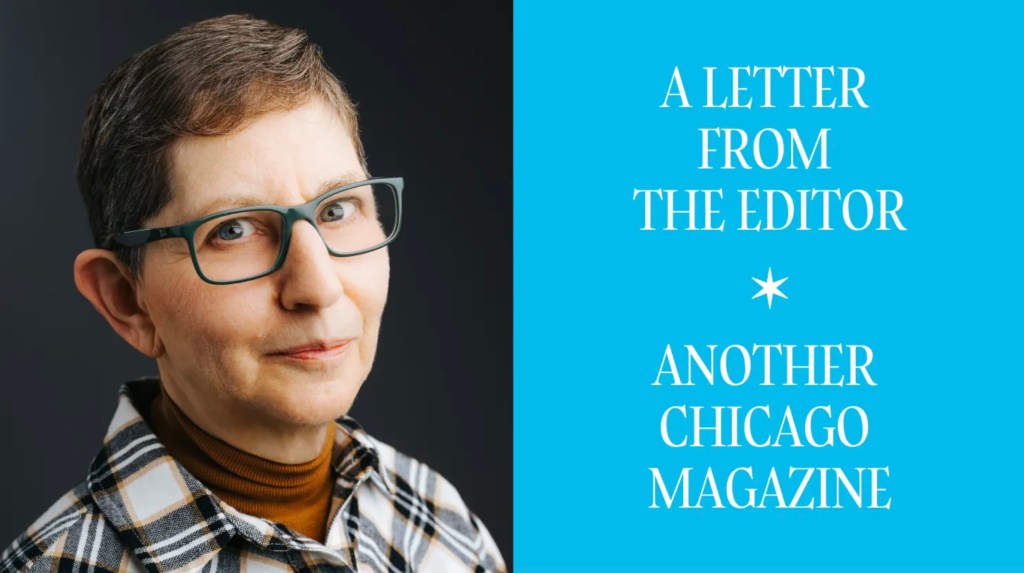
A letter from Executive Editor, Karen Paley
My name is Karen Paley, and I became Executive Editor of Another Chicago Magazine in January 2026. I thought you might want to know what I had been doing before and also my vision for the magazine. At the risk of losing readership, I think it best to be open about the beginning of my career as a writer. After over 100 submissions, I published my first essay, “How to Live After Death,” in the Nov./Dec. 1988 issue of the Journal of Irreproducible Results. The journal’s mission is to satirize bad science. Here’s how my essay begins:
“I am a licensed independent certified eternity counselor (L.I.C.E.C.) … There are very few of us here and that’s because you practically have to kill yourself to meet the requirements…”
Nobody in academia held this tomfoolery against me, so I went on to get a doctorate and teach literature and writing for twenty years, subsequently retraining as a successful financial advisor. Once the call to write again grew too loud to ignore, I landed in the MFA program at Goucher College, specializing in nonfiction. As I sought to place my work, I found Another Chicago Magazine on a list of publications whose entries garnered Pushcart Prize nominations.[1] A rejection from ACM encouraged me to submit more, and when I returned to the website, I found the opening for Executive Editor, applied, and now I am here.
My attraction to the magazine is that it is political in the way I am. The atrocities being dealt to Palestinians, Ukrainians, and immigrants are on my mind, and I want to hear their voices. I hope to publish reviews or interviews with authors of related books like Sarah Aziza’s The Hollow Half: A Memoir of Bodies and Borders. I just got my hands on what was called “the most anticipated book of the year”: The Future Is Peace: A Shared Journey Across the Holy Land, cowritten by Aziz Abu Sarah and Maoz Inon, a Palestinian and an Israeli who each lost a family member in the conflict.
I would like to see ACM publish more literature in every genre describing peacebuilding and nonviolent resistance to international authoritarianism, whether these efforts are individual acts such as refusing to accept an award financed by a company behind attacks on civilians or group protests such as dock workers refusing to load missiles. As Omar El Akkad writes,
“[E]very small act of resistance trains the muscle used to do it…That having called for justice in one instance, one might do it again and again, might call for a just world.”
ACM publishes twice a week online, and our subscribers receive these issues free of charge. We are all volunteers. We have been able to do this work for free because of the generosity of a former editor who has left the magazine. We need to increase the number of paid subscribers as well as outright donors in order to continue paying the fees for Submittable and WordPress, platforms that allow us to publish high-quality writing twice a week. Tables at the annual Printers Row and Association of Writers & Writing Programs conference (in Chicago in 2027!) also require fees. We need to increase our income even to be eligible to apply for some grants.
Once our income increases, it is my hope that writers will receive some compensation. Help us keep ACM’s mission alive—publishing writing that engages with the world without being polemical or didactic and that represents writers of all walks of life, not just those from Chicago. If you would like to help, please click one of the links below.
Thank you,
Karen Paley
Executive Editor
Another Chicago Magazine
Donate to Another Chicago Magazine
Subscribe to Another Chicago Magazine
✶
[1] In the last ten years, writing in all ACM genres has been recognized by Pushcart: a poem received a Pushcart Prize in 2026, three fiction and three nonfiction pieces received special mentions. Two of our published translations appeared in the anthology The Best Literary Translations.


