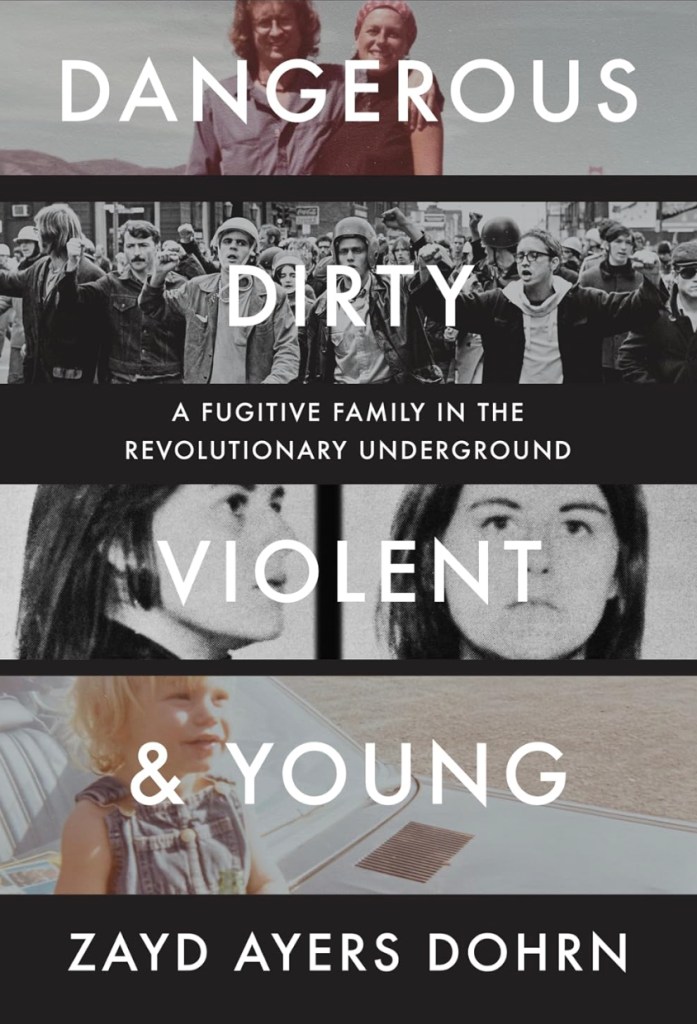
W. W. Norton & Company, 2026, 448 pgs.
Review by Karen Paley
How do you write a memoir about celebrity parents you are proud of, wounded by, and still deeply entangled with? Zayd Ayers Dohrn’s parents, Bernardine Dohrn and Bill Ayers, were leaders of the Weather Underground, a group responsible for blowing up buildings in protest over racism and the war in Vietnam. It was not easy for him. “Maybe,” he writes in his memoir, Dangerous, Dirty, Violent, & Young: A Fugitive Family in the Revolutionary Underground (W. W. Norton), “I didn’t want the responsibility of explaining or justifying my parents’ actions.” Instead, Zayd frames the story of their activism from his own perspective, the child of revolutionaries who, while claiming to have put their high-risk behaviors behind them when he was born, subsequently helped facilitate bank robberies and organized a family “camping” trip, a reconnaissance mission for a jailbreak. He also refers to them by their given names instead of familial ones.
Zayd has no interest in inheriting revolution, “the family business.” He prefers teaching, writing plays, and hosting podcasts over marching in the streets or being featured on the FBI’s Most Wanted list. He is the Director of the MFA in Writing for Screen and Stage at Northwestern University. That said, his upbringing—“We went to protests and demonstrations the way some families went tailgating”—nourished the creative work. Zayd’s podcast series Mother Country Radicals, the precursor to his memoir, won the 2024 duPont-Columbia Award and the award for Best Audio Storytelling in Nonfiction at the 2022 Tribeca Festival. The production of his punk/hip-hop musical Revolution(s), with lyrics written by Rage Against the Machine’s Tom Morello, performed to sold-out audiences.
Much of Zayd’s memoir is a chronological narrative of the escalation of his parents’ radicalization when the enormity of the Vietnam War and racism in the United States intensified. His representation of a dramatic moment in that story, the split in Students for a Democratic Society (SDS) at its 1968 Chicago convention between the Progressive Labor Party (PL) and the Revolutionary Youth Movement (RYM), leans toward the way Bernardine Dohrn, his mother, would tell it. She led the RYM, many of whose members followed her into the Weather Underground.
From 1968–1976, I was a member of PL, a group Bernardine referred to as “cultural aliens” due to its aversion to dressing or behaving in any way that might offend the Party’s idealized vision of blue-collar workers. (Her representation of PL was accurate, but I benefitted from its mandate to get off marijuana and LSD.) The central question of Zayd’s memoir is mine as well: How do you balance self-care and care for your family with the persistent interior call to “do something” about the dark side of the world we live in?
The memoir feels like a sequel to his father Bill Ayers’ books, Fugitive Days and Public Enemy, themselves connected to the reflections of two other former members of the Weather Underground, Cathy Wilkerson’s Flying Close to the Sun and Mark Rudd’s Underground. Zayd recaptures some of the same highlights as his father, such as the protest and repercussions at the 1968 Democratic Party convention in Chicago, resulting in what came to be called a “police riot,” as well as the accidental detonation of explosives in Wilkerson’s father’s New York City townhouse.
However, there is a large difference between Bill’s books and his son’s memoir. Where Zayd maintains tension throughout his narrative by examining the pain he felt as a child, Bill gives no indication of how his involvement in the Weather Underground’s violent activities impacted his three children: Zayd, Malik, and Chesa. In fact, Zayd’s father minimizes it. “To call [our family] dysfunctional would be both unnecessarily cruel and redundant—aren’t they all?”
One way Zayd explores the effect of revolutionary activism on children is by describing Chesa, who served as an example to Zayd of what could easily happen to him and Malik. When Chesa was a breastfeeding 14-month-old, his parents, Kathy Boudin and David Gilbert, left him with a babysitter while they helped rob a Brink’s truck to get money to support the Black Liberation Army (BLA). Instead of coming home to her toddler, Kathy went to a maximum-security prison for twenty-four years. When Chesa’s grandparents brought their infant grandson to visit his mother, the guards told her if she touched him even once, they would terminate the visit. Every time Chesa reached for his mother, she had to pull away. Now a young adult, Chesa struggles to describe his feelings at the time to his stepbrother Zayd. “[A]bandonment and shame and being unlovable and blaming myself—I couldn’t understand. … Was it something I had done wrong?” The young Chesa had fits of rage and seizures.
Many times, Zayd asks his father if he gave any thought to the impact on his family of their high-risk political acts. At the age of five, he asked if he’d still be loved if he were a racist. It is a sad indication that a child that young could understand that his father’s political convictions might outweigh his love for his son. On another occasion, Zayd asked Bill “whether they ever thought about the dangers of bringing a toddler along on a trip to scout a jailbreak.” His father responded that what they did was not illegal and furthermore, they “felt not only would it be of assistance to the BLA but the world would be better if Assata weren’t in prison. So, we did it for them. And we did it for ourselves.” Bill’s defensive responses punctuate the narrative; he comes across as oblivious of Zayd’s past emotional life. “Whenever my parents left me in the car to run errands … I’d hold my breath … that this time my mom might not come back to get me at all.”
This insensitivity may seem incomprehensible to anyone who has not been involved in a political movement at a time when people are dying at the hands of the military arm of an aggressor nation. I have been there, and I do understand. Once, while a fanatical student member of the Progressive Labor Party at the University of Rochester, I received a call from my mother asking me to come home because my grandmother was about to have open heart surgery. What she was asking of me was unthinkable. A year or so later, when seven months pregnant with my first child, I was arrested in a hotel en route to a massive demonstration in Washington, D.C. I never gave a second thought to dismissing the grandmother who had been a rare source of love for me growing up or to the child in utero. My indifference may have looked like pure selfishness when it was about the magnetic pull of the cause, as strong as any substance addiction.
Zayd looks for answers to his questions outside the family. After Bernardine refused to provide information about members of the BLA in a grand jury indictment, the boys were separated from her while she served nine months in jail, leaving Bill with a full-time job and responsibility for three children five and younger. He hired a man named Peter as their nanny. Speaking of Kathy and David’s abandonment of Chesa, Peter said, “I would never, ever have sacrificed this child. I would never have had that deep of conviction of anything.” His perspective helped Zayd realize that “not everyone had to commit their lives to making revolution, that there were, actually, other ways to live.”
Unlike the previous Weather Underground-related memoirs, the climax of Zayd’s book is not a confrontation with the police in an attempt to prevent the killing of more Vietnamese or a townhouse explosion, but in the turnaround of Chesa’s mother, Kathy Boudin. Before the attempted robbery, she “was determined to not have being a mother stop [her] from also being a revolutionary.” When released after twenty-four years, the reader may find that what transpired looks like a story designed by a fiction writer at the peak of their craft, a story I will not spoil by telling.
Dangerous, Dirty, Violent, & Young is a fast-paced account of an underreported story of the lived experience of children of political activists who embrace violence as a tool of resistance. Zayd and the Black “Panther cubs” were not alone. Xochitl Gonzalez, the daughter of a member of the Socialist Workers Party, saw her mother only once a year even though she carried out her political work close by. She tells her own story where we learn that it was only after reading her daughter’s novel that the mother realized how her absence impacted her daughter. I imagine Zayd’s book having a similar effect on his parents.
The final chapter of Zayd’s memoir is a nonfiction denouement. His own children, Dalin and Light, emerge to extend their father’s exploration of nonviolent methods of speaking out against injustice without endangering self and family. Dalin is an artist who created a virtual memorial about the victims of the Weatherman townhouse explosion sixty-three years before, “the site just two blocks away from her college classroom.” Light published an opinion piece on “the moral repercussions of political violence” and, in turn, received hate mail “and even calls for her expulsion.” Zayd closes the memoir with a speculation about the many ways young people like his own children will rise to the significant moments of their time. “They may … aspire to be artists and journalists, or musicians and poets, or social workers and teachers, and find their own ways to change the world.”
✶✶✶✶
Karen Paley is the Executive Editor of Another Chicago Magazine. She received an MFA in nonfiction from Goucher College and is working on a memoir, Life on the Left: From Revolutionary to Peace-Builder. Southern Illinois University Press published her book I-Writing: The Politics and Practice of Teaching First-Person Writing. Forthcoming or recent work appears in Allium and The RavensPerch.
✶
Whenever possible, we link book titles to Bookshop.org, an independent bookselling site. As a Bookshop affiliate, Another Chicago Magazine earns a small percentage from qualifying purchases.

