
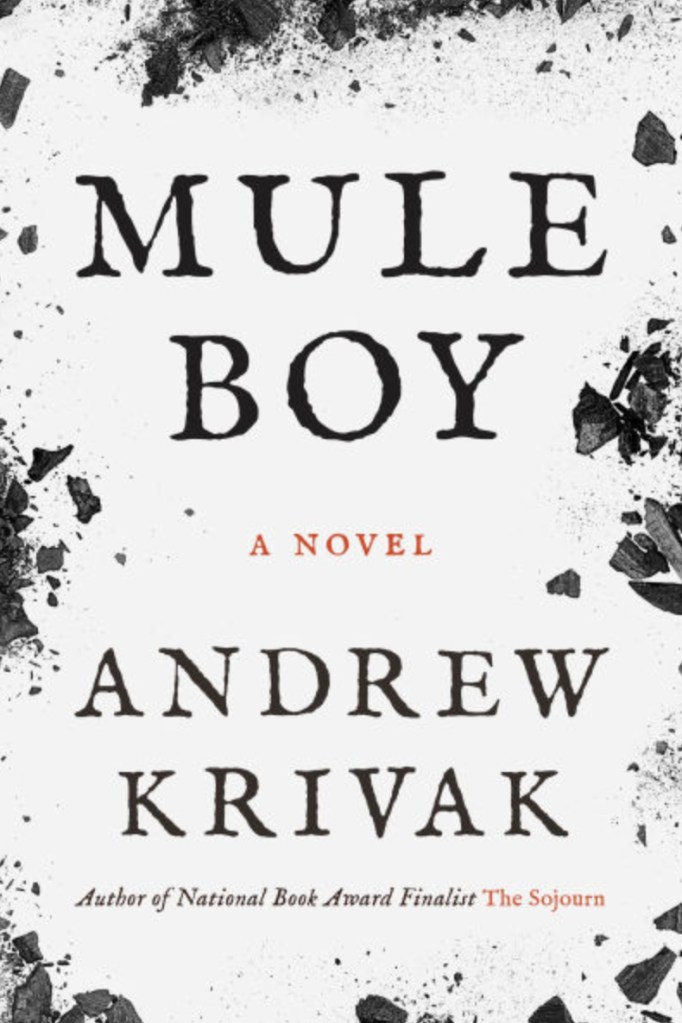
Bellevue Literary Press, 2026, 192 pp.
Andrew Krivak’s Mule Boy is a novel that seems spoken into existence. It unfolds as a single, sustained utterance—a life in one long sentence—and in doing so invites the reader into an intimacy that feels both confessional and liturgical. Krivak’s book is deeply concerned with what it means to survive and remember catastrophe, to carry the dead as voices, gestures, and final words that shape the living.
Set in the coal-mining region of Pennsylvania in 1929, Mule Boy stars Ondro Prach, a thirteen-year-old Slovak immigrant who works in the mines as a mule boy, guiding coal carts through the darkness. The labor is dangerous, the environment unforgiving, yet the novel emphasizes character over spectacle or incident. Krivak portrays the mine as a place where men descend into tight, airless tunnels, ration their breath, and depend on one another’s signals and voices to move safely through the dark, so that ordinary measures of time and self-preservation give way to immediate bodily need and mutual reliance. When a cave collapse traps several miners underground, killing them slowly while Ondro survives, the novel’s central tension is established: survival as a burden rather than a triumph.
Mule Boy becomes an excavation of memory. Ondro’s life proceeds through adulthood, marriage, addiction, war, imprisonment, and old age, but it is continually pulled back toward that day in the mine. Krivak treats memory as something felt in the body, a pressure that resurfaces in moments of stillness. “… I couldn’t bear to close my eyes because I would see their faces and smell their smells and hear the water dripping onto the floor of the mine.” Ondro remembers the presence of the men who died—their voices, prayers, fears, and tenderness—and it is this presence that defines him.
One of the novel’s achievements is its nuanced portrayal of labor and suffering. Krivak’s miners are not heroic archetypes, nor are they reduced to pitiable symbols of exploitation. They are men who speak of food and family, who pray and joke, who fear dying but also fear being forgotten. Ondro survives the mine collapse by becoming the custodian of the miners’ memories, preserving what they said and prayed for in the darkness, and passing those stories on to their children and grandchildren. Krivak’s prose is inseparable from these concerns.
The novel’s stream-of-consciousness structure mirrors the way a life—especially one shaped by trauma—resists neat segmentation. Krivak largely avoids full stops, and although the book is divided into chapters, they flow into one another, leaving no clear point at which one can pause and declare an ending. The book is organized like a series of memories, and the narration is reminiscent of one’s internal monologue: the prose moves forward the way thought does, sometimes deliberate, sometimes scattered, always expanding on what came before. Reading Mule Boy requires surrender to this rhythm, and in return it offers an immersion that is rare in contemporary fiction. Like Karl Ove Knausgård, Krivak composes extended paragraphs with long sentences that track thought in real time, merging past with present.
The language itself is spare and evocative. Krivak’s descriptions of physical environments—the mine, the forests of New England later in Ondro’s life—are tactile and grounded in elemental imagery: stone, wood, darkness, light. These landscapes are extensions and sometimes distortions of Ondro’s interior self, places difficult to distinguish from his psyche: “And I row back to shore in the afternoon, a storm threatening in the west and the air becoming pungent with the smell of ozone and it is this air and this light that remind me of coming home from work one day … and Magda was gone with all her things … the whole place quiet and thick and lonely-feeling …”
Ondro Prach is a remarkable character precisely because he resists easy categorization. His later struggles with alcoholism, his failed marriage, and his imprisonment as a conscientious objector during World War II complicate any notion of moral clarity. His life unfolds as a series of attempts—sometimes faltering, sometimes generous—to live with his traumatic memories. His faith, rooted in Catholic ritual and immigrant tradition, becomes a linguistic system in which his grief can be expressed, but not necessarily resolved: “… he fingers the old wooden rosary in his pocket, the one that hasn’t left him … and he thinks he should try to say an Ave Maria … then thinks it’s not the prayer or the sound of the prayer, but the feel of the wood that changes him …”
In the novel’s later passages, Ondro encounters the descendants of the men who died in the mine, and these moments quietly reframe the book’s central concern: to remember, Krivak suggests through Ondro and his actions, is to testify. Ondro’s role becomes that of a witness, someone who can speak what others cannot and to honor the words spoken in darkness. These scenes are among the novel’s most affecting, not because they resolve the past, but because they acknowledge its persistence: “He asked me which of the miners died with the most dignity, had the happiest death and I wasn’t ready for the question … to think about what it meant to find in those mines a happy death.”
Mule Boy is a novel steeped in mortality, and deeply attentive to life’s fragility and the grace that emerges within it. Krivak does not offer redemption as release; there is no moment when the burden of memory is lifted and rewarded. What he offers instead is the idea that meaning is made by bearing suffering thoughtfully and with grace. The novel’s final movements create an attitude of acceptance—acceptance of traumatic memories as both a burden and a gift.
Released amidst a cultural zeitgeist oriented around immediacy and early payoffs, Mule Boy distinguishes itself instead by delaying gratification. It is a book that asks the reader to slow down, and to listen closely: Krivak has written a novel that feels contemplative and trusts the reader to parse what’s left unsaid. Long after finishing it, one is left with the sense of having been entrusted with something real—Ondro’s life, memories, and legacy—and with the responsibility to remember and preserve it.
✶✶✶✶

Winston Carruthers IV is the pseudonym of a Chicago-based writer and editor.
✶
Whenever possible, we link book titles to Bookshop, an independent bookselling site. As a Bookshop affiliate, Another Chicago Magazine earns a small percentage from qualifying purchases.

