
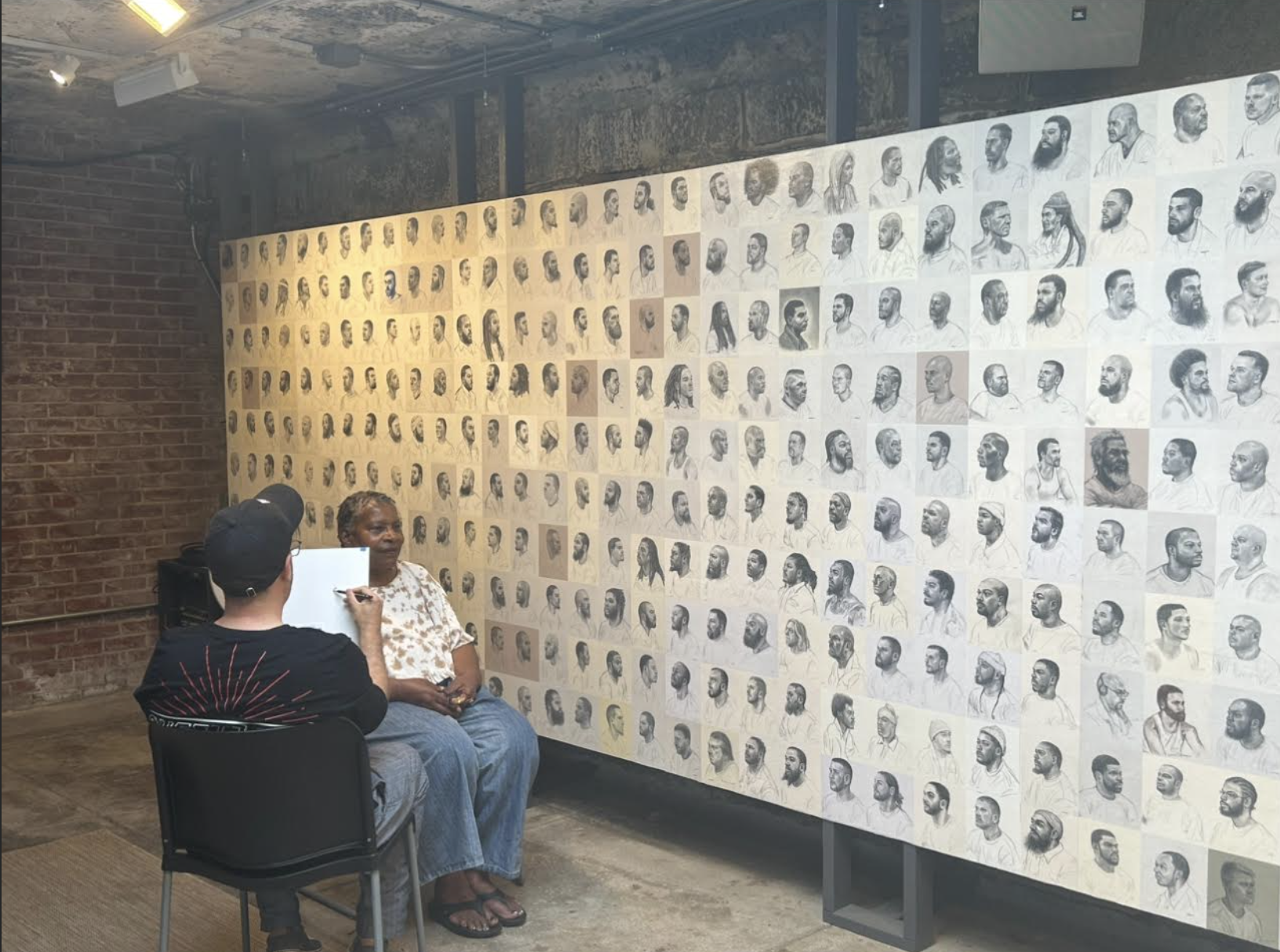
Inside the former Eastern State Penitentiary, in Philadelphia, a seventy-seven-year-old Black woman, Phyllis Jones-Carter, sits quietly on a folding chair as artist Mark Loughney studies her face. She has a carefully composed persona: gray-and-brown twists neatly styled, ears adorned with artisan-crafted mixed-metal earrings, an airy silk white-and-brown tie-dye top, and well-cut jeans, all purposefully sourced from independent designers. She meets the world with soulful elegance.
Behind her, hundreds of graphite portraits line the walls, including faces of men she knows, once knew, and others whose lives unfolded within institutions much like this one. Rendered with quiet tenderness, the portraits of incarcerated individuals lining the walls of a curated exhibition space inside this former prison, now preserved as a National Historic Landmark, are deeply arresting. Some of the subjects of Loughney’s artwork are bearded, others wear kufis, eye patches, glasses, or COVID masks. Faces are full, gaunt, youthful, weathered. Hair is worn in mini twists, long locs, sculpted afros, or close-cropped cuts. Though rendered in similar media, the portraits pulse with individuality with each person marked by choices of adornment, faith, style, and bearing, resisting the flattening anonymity so often imposed upon the incarcerated. And though the subjects rarely look directly at the viewer, their averted gazes somehow pull one closer, facilitating a quiet intimacy.
Before sitting down to be sketched, Jones-Carter moved through the exhibition. She did not avert her gaze. For her, the experience felt at once historical and deeply personal; among the faces she recognized were several people connected to the Philadelphia MOVE tragedy. MOVE was a Philadelphia-based Black liberation and back-to-nature organization whose long and contentious relationship with city officials culminated in the 1985 police bombing of its West Philadelphia home, killing eleven people, including five children, and destroying more than sixty neighboring houses.
Over the years, she has learned how to look carefully, steadily, at people the world too often prefers not to see.
The portraits surrounding her are part of the exhibition Pyrrhic Defeat: A Visual Study of Mass Incarceration, a monumental project by contemporary artist Mark Loughney, himself incarcerated for ten years in the Pennsylvania State Correctional Institution – Dallas, where most of these drawings were created. More than 800 meticulously rendered graphite drawings confront viewers with the human scale of incarceration. Though created from lives shaped within a single Pennsylvania correctional facility, the portraits gesture toward the broader reality of mass incarceration in the United States. Individually, each portrait invites attention. Together, they overwhelm.
Jones-Carter is posing for the second phase of the exhibition: portraits of people actively working against mass incarceration. Advocates, organizers, family members, and professionals whose lives have been shaped by proximity to the system rather than confinement within it are drawn with the same care as those who were incarcerated. Loughney has already completed over 400 portraits in the second phase, with the goal of completing 800.
A retired employee of the Pennsylvania State Correctional Institution – Chester, Jones-Carter managed life-skills programming for incarcerated men and women. Her work included GED preparation, arts initiatives, and reentry support, but she speaks less about programs than about people. During her fifteen years in the system, Jones-Carter cultivated relationships which she says were grounded in consistency and respect.
“If someone’s parent passed away and they couldn’t attend the funeral, they’d ask, ‘Miss Carter, would you go for me?’” she says. “I’d go, bring back the obituary, tell them about the service. And when their children graduated, sometimes they’d ask me to attend, to bring a gift. My guys were trying to hold on to their lives outside.” Loughney notes the kindness of such gestures. Jones-Carter responds simply: “I didn’t mind. If I could show up for somebody, I did.”
Jones-Carter’s advocacy did not end with retirement; informally, she continues helping formerly incarcerated people secure odd jobs in the community. Such small acts of support can ease reentry.
“A lot of times, just showing up, listening, and treating people like human beings made all the difference,” she says. “That wasn’t always how the system operated, but that was important to me.”
As Jones-Carter sits for the piece, visitors move past her, many stopping short when they enter the exhibition space. The density of faces is startling. Some visitors fall quiet. Others whisper. “I’ve seen reactions like this before,” Jones-Carter says, in a kind of reflective undertone. “You see moms, wives, children, older parents coming in to visit, especially those first visits, with their snacks and stuff, paperwork, bringing their hope and then they’re confronted with the sheer scale of it all. It changes people when they see it for themselves.”
Loughney’s work operates as a form of social justice by restoring visibility to people rendered invisible by mass incarceration. Through portraiture, he confronts a system that relies on distance and dehumanization, insisting instead on proximity, specificity, and presence. Each drawing challenges viewers to reckon with who is confined, who is seen, and whose lives are deemed worthy of attention. His portraits are not sketches. They are finished graphite drawings, each completed in approximately twenty to thirty minutes, yet marked by remarkable sensitivity and precision. All are rendered in three-quarter profile. This compositional choice is deliberate. Sustained direct eye contact can feel intrusive, even threatening, particularly within a prison environment. The angled view allows space. It suggests presence without domination.
“Trust is central to the process,” Loughney shared. Many of his sitters were men he knew during his incarceration, not strangers, but people whose lives intersected with his through shared routines, constraints, and institutional rhythms. Even so, sitting for a portrait requires vulnerability. To allow one’s image to be captured inside a prison and released into the world is no small act. Loughney describes the process as an intuitive exchange, built on quiet attentiveness rather than control.
From this exchange emerges what is given back to us: our sons cocooned in headphones, our lovers graying, our neighbors shielding tired souls behind sunglasses, our uncles with beautifully braided hair, our fathers carrying heavy locs like halos. Even in their three-quarter profiles, we somehow glimpse the whole of them, their humanity refusing to be obscured.
Installed within one of the nation’s most historically significant prisons, in the city where the Declaration of Independence was signed, the exhibition collapses time, linking early American philosophies of punishment and reform to the realities of the modern carceral state. As the United States approaches its 250th anniversary, Pyrrhic Defeat asks viewers to consider how liberty has been defined, distributed, and denied.
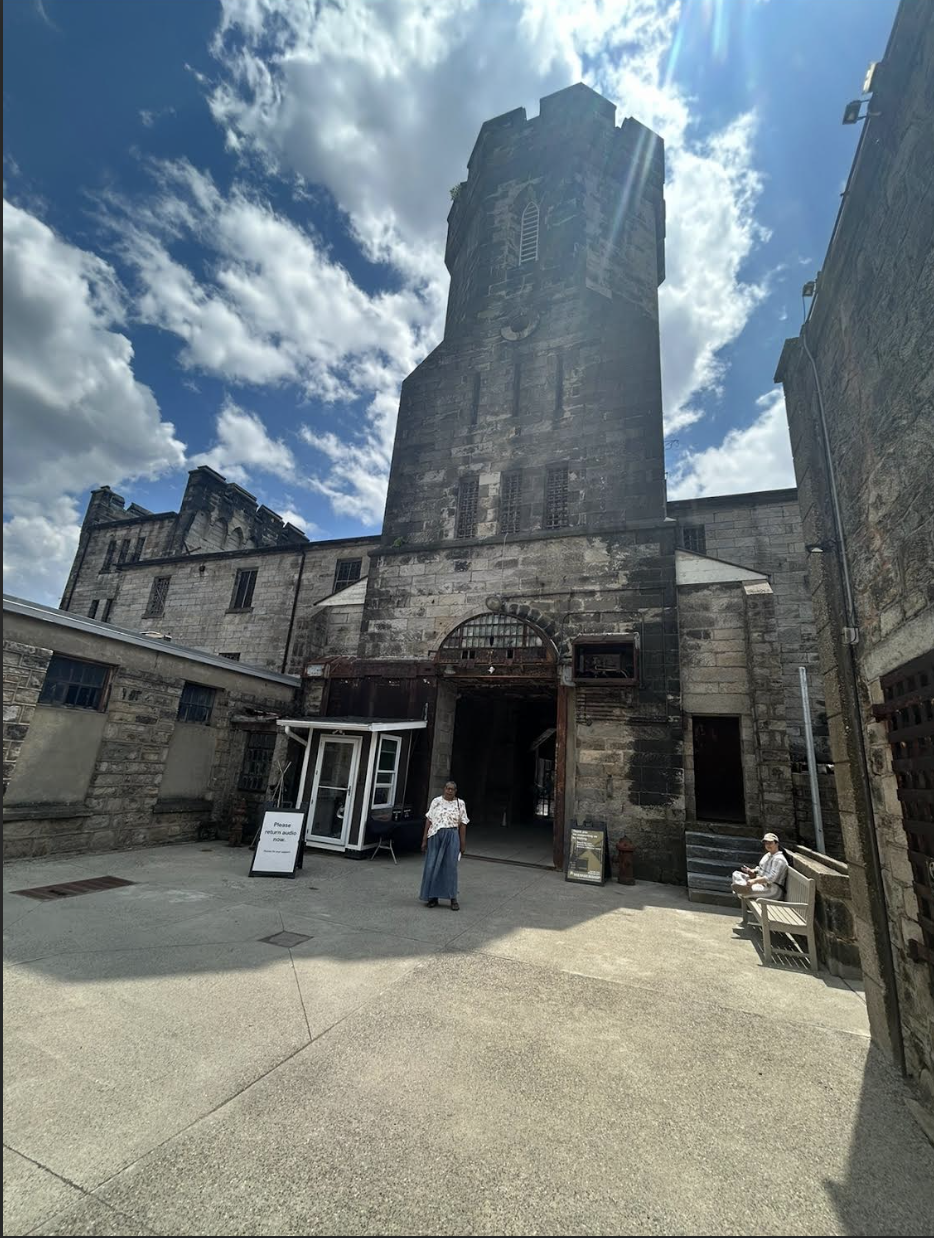
Eastern State Penitentiary operated from 1829 to 1971 and was once the most expensive building in the United States, costing about $780,000. Its design reflected a then-radical reform ideology: prisoners would be isolated in individual cells, denied contact, stripped even of their names, and left alone with their thoughts in the belief that solitude would inspire penitence. Light entered cells only through a narrow skylight, intended to symbolize divine observation. The building’s architecture, massive, Gothic, fortress-like, resembles a medieval castle. Today, it sits in the heart of Fairmount, a gentrified Philadelphia neighborhood, its looming walls in stark contrast to sidewalk cafes, Victorian and Queen Anne–style row homes and close proximity to some of the most renowned art museums in the world such as the Barnes Foundation, the Rodin Museum and the Philadelphia Museum of Art.
Eastern State Penitentiary unfolds in a radial design with corridors of cells extending outward from a central point like spokes on a wheel. Across eleven acres, 450 cells sit behind towering thirty-foot walls that stretch nearly a mile, underscoring the vast scale of confinement. This kind of structure is intended to facilitate optimal monitoring and control. To reach Loughney’s particular exhibition space, visitors pass row after row of former solitary confinement cells where, nearly two centuries ago, men and later women, were held in enforced silence. The setting is not incidental.
Inside a prison system designed to watch and discipline, Loughney’s portraits do something unexpected: they return individuality to people too often seen only through the eyes of institutions. Loughney asks questions as he draws; questions that are not scripted, not interrogative, but curious. He listens as much as he looks. “Tell me about your earrings. They’re so interesting,” he asked. “Well,” Jones-Carter says, touching one of her earrings, “when I left the prison system, I opened a clothing boutique—it’s been fifteen years now—where I sell interesting clothing pieces, jewelry, art, furniture, all kinds of unique items. They’re from my place. Curating the things in my boutique makes me feel like an artist.”
“I get that,” Loughney says. “Curating is its own kind of art. You have to see what belongs together, what tells a story. That’s not far from portraiture.”
During his own incarceration from 2012–2022, Loughney created more than 3,000 works comprising drawings, paintings, and conceptual art. Portraits were sometimes exchanged for commissary items, but the practice was never merely transactional. Prison, he observes, is often framed as a place of shame, its inhabitants reduced to their most destructive acts. Pyrrhic Defeat rejects that framing. The portraits elevate their subjects, restoring individuality to people too often rendered anonymous.
“People are more than the worst thing they’ve done,” Loughney says. “I wanted the portraits to slow people down long enough to really see someone, to see a person, not a label.”
“A lot of the portraits came out of conversation,” he says. “Sometimes people talked about their kids, what they hoped for when they got home. Other times, it was about sentences, mistakes, things that happened to them that still didn’t sit right. You hear a lot when somebody trusts you enough to sit still.” The drawings absorbed these conversations quietly, without annotation or spectacle.
In 2017, while still incarcerated, Loughney drew on his clear sense of artistic purpose to reach out to Eastern State Penitentiary, which is now a multipurpose site for exhibitions and public programming, to propose mounting his work in this historic space. “I wanted the work to exist in conversation with the history of incarceration,” he says. “Eastern State wasn’t just a gallery space to me—it carried the weight of the system itself.”
Nine years later, that vision has been realized.
As the portrait takes shape, Jones-Carter speaks about the humanity she encountered daily inside the prison where she worked. “Prison is complicated,” she says. “There were people who made serious mistakes, yes. But there were also people who had been unsupported in so many ways long before incarceration. You can hold both truths at once.”
Loughney lingers over the delicate architecture of her locs, the swing of her earrings, the strong character of her nose, the generous fullness of her cheeks. Slowly, the portrait accrues something deeper than likeness and truly expresses a life attentively seen.
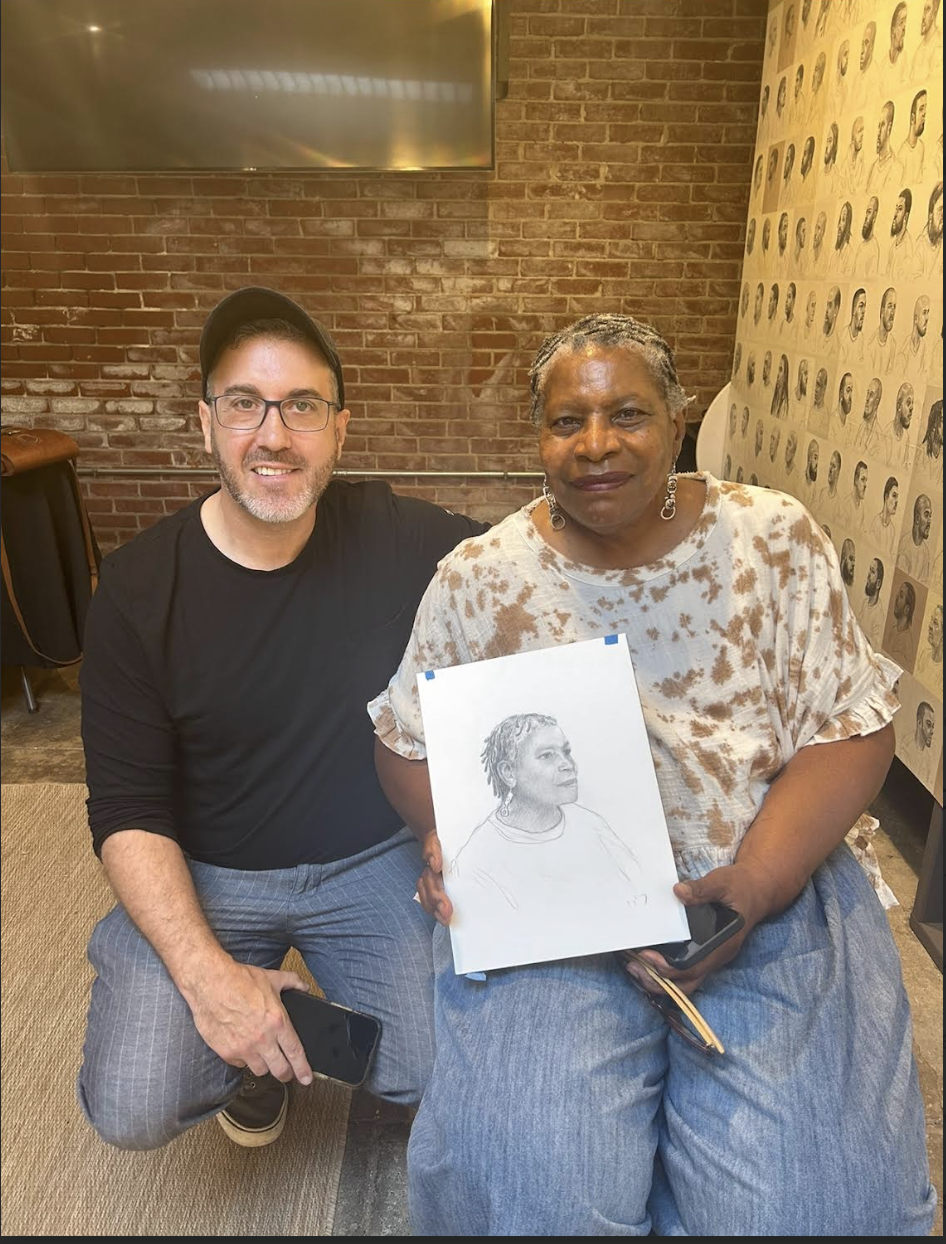
The portraits in Pyrrhic Defeat share a visual consistency, yet none are interchangeable. Each face asserts presence. Displayed within a structure originally designed to erase individuality, the drawings function as both counter-archive and indictment, rendering visible the cumulative and deeply personal toll of mass incarceration not as abstraction, but as lived reality.
Loughney deliberately turns away from philosopher Jeffrey Reiman’s phrase “Pyrrhic victory,” drawn from Reiman’s book The Rich Get Richer and the Poor Get Prison, which describes, Loughney says, a system that appears to fail while quietly serving entrenched power. In Reiman’s framing, the prison system “wins” by incarcerating millions of poor and disproportionately marginalized people, creating the appearance that crime is being punished and social order maintained, while broader harms, including corporate wrongdoing and structural inequality receive far less scrutiny.
For Loughney, however, the human cost of mass incarceration, carried by individuals, families, and entire communities, leaves little room for the language of victory. He calls it what he believes it is: a Pyrrhic Defeat.
“I didn’t want to call it a victory,” Loughney says. “Whatever the system gains, the human cost is too high. You see too much loss for that word [victory] to feel honest.”
While Loughney shares Reiman’s critique of the system, he remains troubled by the word victory itself, questioning whether any system built on such profound human suffering should be understood in any triumphant terms.
As the United States prepares to mark 250 years since its founding, Loughney’s exhibition unsettles easy patriotic narratives, asking how a republic built on ideals of freedom also came to sustain one of the world’s largest systems of incarceration.
Loughney holds up the completed portrait. Jones-Carter laughs softly, tilting her head. “Okay now,” she says, smiling. “You did alright.” Then, after another look: “No…you really got me.”
“You really care about people,” he says in his measured, quiet tone. “You can hear it in how you talk about them.”
✶✶✶✶
Octavia McBride-Ahebee’s literary work is influenced by the convergence of cultures and the many ways in which people move throughout the world. Her work explores relationships within the broader framework of global inequality. Her work has appeared in many journals and anthologies and her three poetry collections include Assuming Voices, Where My Birthmark Dances, and Praise Song for the Gravediggers. She also contributes to The Africa Migration Report Poetry Anthology Series, a multi-year initiative exploring African and diasporic migration through poetry. Additionally, she is involved with Forced Migration and The Arts, an international network connecting artists, scholars, and those with lived experience to examine the intersection of forced migration and creative expression.
✶
Whenever possible, we link book titles to Bookshop, an independent bookselling site. As a Bookshop affiliate, Another Chicago Magazine earns a small percentage from qualifying purchases.

