
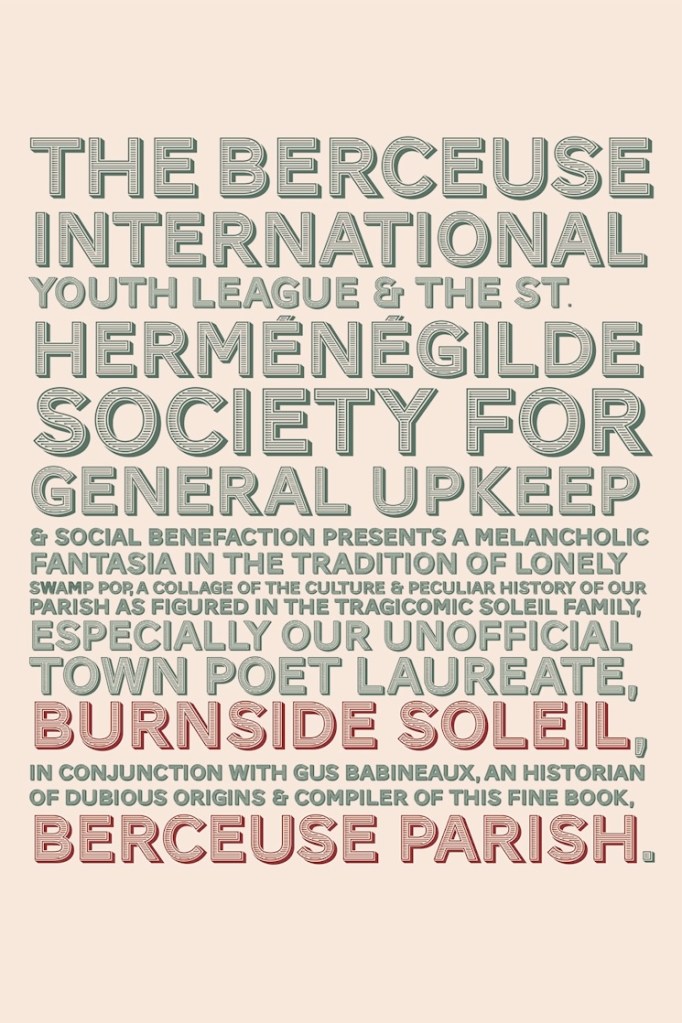
Texas Review Press, 2026, 74 pp.
If you’re old enough to have succumbed to the virality of the podcast Serial, an investigative whodunnit about the disappearance of a high schooler, you’re old enough to know that memory is faulty at best. Most days we can hardly remember what we ate for lunch the day before, let alone who we were with and where on this day ten years ago, with much accuracy. Memory exists as a sort of liminal space, where fiction often overtakes the facts. Burnside Soleil makes the same space of his debut collection, Berceuse Parish, and he makes absolutely no apologies for it. Instead, he almost reveres the fallacy that memory and history must align.
Off the bat, the feature-length title announces the work as a “A Melancholic Fantasia”—a fantasia being defined as a work in which the author’s fancy roves unrestricted. And rove it does—all over the Acadian parish of Berceuse, a place we can be sure is fictional and, somehow, a place we can be sure exists. It must exist because we know one just like it, and we’ve heard all kinds of tales about it. Much like the tales we hear intermittently from the book’s narrator, Gus Babineaux, who is also entirely made up and wholly authentic. He, too, admits his potentially misinformed perspective from the beginning; he introduces Berceuse as “vexed by a history that has little to salvage.”
It’s from this shaky framework that the (re)collection unfolds. Between the centering, if unsteady, scene-setting that Gus interjects, we find ourselves in a sort of time capsule—a hatbox holding a pile of letters that has been collecting dust in a closet for decades. Every poem is dedicated to a character named in the cast—real, imagined, or a bit of both—and each reads like an epistolary, an elegy, or an ode. There is something inherently intimate about the direct address of these forms that give the work an almost arresting sense of intrusion. It’s as though we as readers are eavesdropping, and we should probably stop—but damn, is it hard to look away.
The relationship dynamics are so vivid that our witnessing them begins to feel like gossip, and our participation, our pleasure, becomes tinged with a hint of guilt; that we’re invited here at all feels gluttonous, indulgent, and somewhat devious. We watch as the speaker swears, “Nothing has ever happened,” yet details every seemingly insignificant experience. In “Jeremy,” Soleil writes:
In the gutter, we found a bird’s nest
pine needles thatched with jute.
The eggs black speckled, mint.
We spared them. It’s not the same,
but the next morning, we cracked farm eggs
to fry, yolks colored almost like clementines.
These earnest admissions, at once abrupt, dramatic and convincing, punctuate the poems. They telescope us between what this speaker observed and the leap they take toward a universal truth or conclusion, urging us to wonder how it is we arrived here. It reinforces the tension between lived and imagined experience, which Soleil also alludes to in making comparisons between childhood and adulthood, as he swears a sort of allegiance to both, writing, “Summer is really only summer in childhood,” and, “Adulthood is the last magical word.”
Hovering between it all, though, is the persistence of love in all its forms: romantic, familial, platonic. Gus points to the liminality, too, of devotion in one of his last monologues, wherein he describes the speaker spending time with his otherwise absent father: “There would be a story, usually, something preposterous, and our poet would listen, and there was warmth, and there was drink, and there may have been forgiveness. It wasn’t love, but like love, and enough.”
Ultimately, he suggests that all remembering, whether accurate or not, is an act of love—and all love is an act of remembering. Every life is a good story we keep telling.
✶✶✶✶

Annelise Schoups is a Chicana Belgian-American poet, essayist, and wannabe critic who laughs at her own jokes and writes about things that are mostly not funny. Her poetry appears in HAD, december, Silly Goose Press, collaborature, and the San Diego Poetry Annual; her prose in Hunger Mountain and Tupelo Quarterly. You can find her in San Diego, where she plans thru-hikes with her partner, or on Instagram, where it’s less weird to follow her: @anneliseschoups.
✶
Whenever possible, we link book titles to Bookshop, an independent bookselling site. As a Bookshop affiliate, Another Chicago Magazine earns a small percentage from qualifying purchases.

