
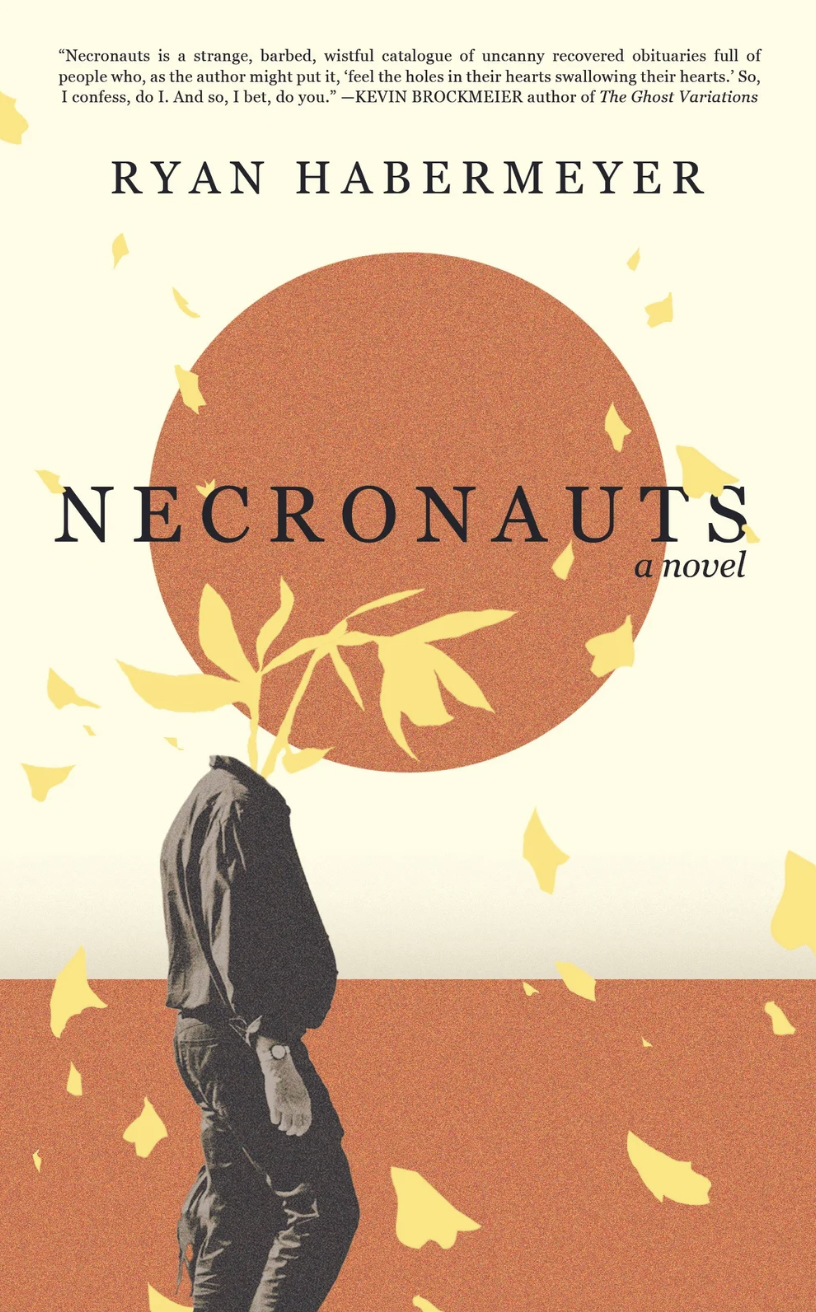
Stillhouse Press, 2025, 322 pp.
The deaths that occur in Calypsee, Utah—a “small fundamentalist town at the edge of nowhere” that’s kept alive by misfits and prophets—are the most interesting thing about it. Except one thing: Calypsee doesn’t exist. But its devout Mormonism and religious moral center is more relevant than ever.
Calypsee is the fictional setting of Ryan Habermeyer’s novel, Necronauts. Told through a series of ninety-five obituaries, Necronauts explores what it means to live in a religious community that seems to quell hope and how those outside that faith can still find something to sustain them. It is a novel of dark humor and uncanny magic realism, illuminated by eerie black-and-white photos. The tone of the novel rests somewhere between hilarious and psychoanalytic.
Habermeyer is a Los Angeles–born writer and professor of Creative Writing at Salisbury University. This is not the first time he has written about Utah. It is his first full-length novel, and he has two short story collections published—Salt Folk (Cornerstone Press) and The Science of Lost Futures (BOA Editions)—the latter taking place in Utah as well.
Habermeyer writes in a blog post on Dawning of a Brighter Day about how his Mormon roots show themselves inevitably in most pieces that he writes. He explains, “I never really did leave Mormonism … We’ll always be relapsing Mormons because it’s a religion that sinks its teeth into you and never lets you go, so like it or not you’ll always feel the ghost of this faith gnawing you down to atoms.”
Necronauts primarily centers on a dentist with addiction issues and a cosmonaut boy who talks with his hands and yearns for his home on Planet X. This unlikely pairing appears in most vignettes and is surrounded by the town’s suffocating Mormonisms and peculiarities. The dentist and the cosmonaut boy’s dynamic oscillates between Calvin and Hobbes, and abuser and the abused. They get high on ketamine, whippits, and other injectable substances, adding to the prose’s hazy, liminal narration. Though the novel touches on pertinent topics such as drug abuse in rural areas, homelessness, and religious psychosis, Habermeyer’s humor is cutting and mostly focuses on exposing the hypocrisies of Mormonism and organized religion.
Habermeyer uses the isolating form of obituaries to highlight the absurdities of Calypsee’s religious zealots and expose a kind of truth about organized religion: that there is both beauty and horror in it. “Believe in something even if it’s wrong,” says the cosmonaut boy as he and the dentist work together to rebuild a trebuchet that will launch the boy into space. It is a situation that feels impossible, in which hope is a prayer.
Hope, in Calypsee, can add light to a dark situation, or it can enable hateful rhetoric. Because the boy and dentist are not Mormons, most of the townsfolk dislike them; they are Calypsee’s sore thumb. They are also two of the few survivors of Calypsee’s smothering nature. Religious doctrine might claim people are judged in the afterlife, but each townsperson of Calypsee is also undoubtedly judging their neighbors in life too.
For example, the reckless teens who relentlessly bully the cosmonaut boy destroy his trebuchet time and time again—despite, as the town believes, God’s written pleas for loving thy neighbor. Nevertheless, the boy and dentist persevere and believe in a seemingly impossible future. Perhaps their efforts are just as outrageous as it is to believe in any kind of god.
The dentist and the boy are “Wiedergängers,” a term highlighted halfway through the novel. Not easily translated, the German word means “the pioneer thing that walks and walks and refuses to die.” Coming from Mormonism himself, Habermeyer is the best person to highlight the hypocrisies and hilarities that come with organized religion—he is a Wiedergänger. According to him, in the eyes of Mormon text, the soul does not wander the earth as a purposeless ghost. Rather, it roams in the direction of an awakening, something to fill the soul with reason and understanding of existence. Habermeyer aptly portrays Calypsee’s citizens in an obituary frame, ultimately encapsulating their soul, their purpose: what they were living for, regardless of if it included Mormonism or not.
And while some of Calypsee’s Mormons may be wandering souls searching for enlightenment, the agnostic characters yearn for death. The dentist’s drug addiction can only lead to an eventual overdose. The cosmonaut’s return to Planet X could be a death sentence, if his low-tech rocket and trebuchet are unable to deliver him into orbit. Maybe home is a form of death, a final resting place—be that kicking one’s feet up to relax or being buried six feet underground.
Habermeyer frames life and enlightenment as an ongoing search for meaning. Removed from religious context, this is existentialism in its purest form; people can choose what to believe in, what to live for, and what gives them purpose. Each of Necronauts’ obituaries highlight what a specific Calypsee citizen was living for, many of which may seem incredulous and silly: finding a life’s purpose in licking stamps, watching sci-fi pulp movies, etc. But in Habermeyer’s work, even the seemingly silly is valid.
Uncanny, hilarious, and unforgettable, Necronauts is a testimonial for the faith-sick and those sick of faith. Habermeyer challenges the truth of Mormonism by challenging what it means to be normal and what it means to be alive.
✶✶✶✶

Erin Norton is New York City–based writer, creator, and loud lesbian. With a BFA in Creative Writing from Emerson College under their belt, they are a blog writer for Dreamworldgirl Zine and a bookseller. Her poetry has appeared in Ghost City Review and Version(9)Magazine. Semi-regularly, she posts on her Substack, erin’s diary.
✶
Whenever possible, we link book titles to Bookshop, an independent bookselling site. As a Bookshop affiliate, Another Chicago Magazine earns a small percentage from qualifying purchases.

