
On September 13th, 1935, a rally was held in Nuremberg in which the beams of 130 antiaircraft searchlights placed at forty-foot intervals made a dome over hundreds of thousands of rapt German citizens ringed by twenty-one thousand Nazi flags.
Thirty-eight years later, Lou Reed was about to go on tour behind his album Berlin when he asked Andy Warhol for advice on mounting a stage show and was told to use the same stark, raw lighting that Albert Speer designed for Hitler’s rallies: intense white spotlights against a dark background.
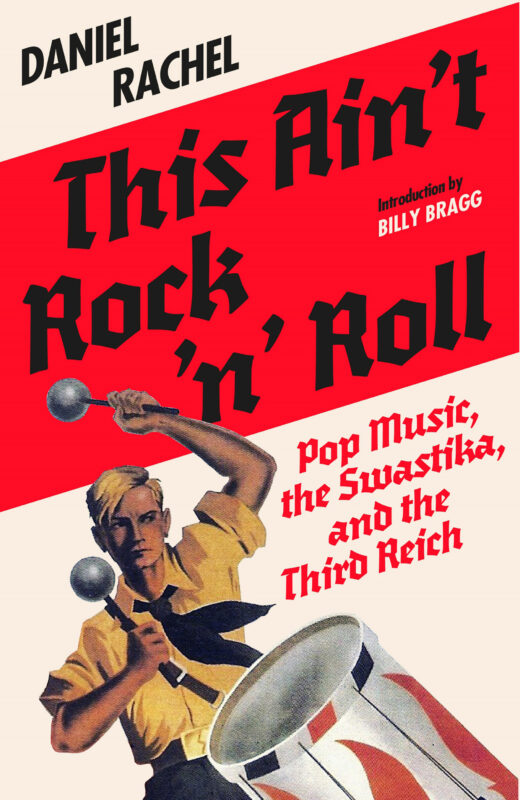
Together, these two anecdotes, the second drawn from Daniel Rachel’s This Ain’t Rock ‘n’ Roll: Pop Music, the Swastika, and the Third Reich (Akashic Books), capture the book in a nutshell. The first dramatizes the power of intoxicating stagecraft, a force so great as to unmoor an audience from any semblance of rationality. And the second makes it clear that once reason is abandoned, so is decency and restraint, not to mention a sense of history. Lou Reed and Andy Warhol weren’t embracing Nazi doctrine; they just decided to forget about it.
Daniel Rachel frames an argument about how spectacle can override ideology and historical awareness. In doing so, these examples endorsed showbiz over ideology, but what else is new? There has never been an entertainer who didn’t want to mesmerize. Ever since the first caveman stepped into a firelit circle and brought his audience to their feet, seduction has triumphed over substance.
A true music insider, Rachel is a former musician turned author whose books include the much-acclaimed Isle of Noises: Conversations with Great British Songwriters (Picador). (He’s a Londoner, which explains the numerous references here to bands less known in the States.) He has also written sleeve notes for such artists as The Kinks, Madness, Ray Davies, and Bryan Ferry.
Sometimes acts are accused of leanings that don’t seem to apply. In 1958, an Elvis concert was described by a critic as resembling “one of those screeching, uninhibited rallies the Nazis used to hold.” Five years later, as Beatlemania reached pandemic level, one observer took note of how the boys shook their hair and emitted trademark OOOHHHHs in a way that made their audiences shriek with one voice and added, “As an inducement to hysteria, it’s a wonder Hitler didn’t think of it.”
Rachel treats these examples as evidence of how exaggerated comparisons can distort the way popular music is interpreted and remembered.
But unless you’re convinced that Elvis and the Beatles were secret supporters of the Third Reich, you might guess that the willful abandonment of reason predates them. What the Nazis added was style. The uniforms of the elite SS or Schutzstaffel or “Protection Squadron” were particularly striking with their peaked caps, death’s head buttons, and black riding boots.
“The Nazis knew how to put themselves in the limelight and present themselves,” said Brian Ferry, and Lemmy Kilmister of Motörhead (note that umlaut, reader) would be the first to agree. Lemmy openly flaunted his Nazi memorabilia, which included a Gestapo uniform, saying, “I just dress how I like to dress … If the Israeli army had the best uniforms, I’d collect them.” Point taken: think how different war movies would be had all those German officers been wearing grimy camo.
In its sublimely thoughtless mix of naïveté and pigheadedness, that I-dress-the-way-I-want-to mentality accounts for the bulk of Daniel Rachel’s subjects in this illuminating and often disheartening book. Again and again, one musical genius after another comes off as about as thoughtful as a four-year-old and, like any self-respecting kindergartner, just as eager to shift the blame. David Bowie recalls:
“Everybody was convincing me that I was a messiah, especially on that first American tour. I got hopelessly lost in the fantasy. I could have been Hitler in England … Concerts alone got so enormously frightening that even the papers were saying, ‘This ain’t rock music, this is bloody Hitler!’ … And they were right. It was awesome. Actually, I wonder. I think I might have been a bloody good Hitler.”
Rachel builds his case through a series of these pointed case studies, using figures like Patti Smith, Joy Division, and Roger Waters to trace how provocation and historical amnesia intersect in popular music.
For example, Patti Smith called Hitler “a fantastic performer” and a “black magician,” adding “I learned from that. You can seduce people into mass consciousness.” She wasn’t a fascist, either, just someone who made the mistake, in Daniel Rachel’s words, of dragging “what should have been personal into the public sphere.”
Other musicians were more blatantly unrepentant. The band Joy Division not only took its name from that of the brothel system that flourished in Auschwitz, Dachau, and other death camps in which women prisoners were forced to perform as sex workers, but also featured Nazi iconography in their record covers and promotional material. When asked about this, drummer Stephen Morris replied that public outrage “encouraged us to keep doing it, [because] that’s the kind of people we are.” And Rachel describes Roger Waters of Pink Floyd as “one of the few musicians who continues to unapologetically flirt with Third Reich–related imagery.”
So how big is the problem today? In recent days Kanye West (or Ye) has tweeted “I love Hitler,” “Hitler was soooo fresh,” and “IM A NAZI” in addition to releasing a song called “Heil Hitler,” but it’d be a mistake to see him as an outlier. Groups and individual performers who at least trifled with Third Reich iconography range from The Animals, The Rolling Stones, and Led Zeppelin to Kiss, Queen, and Lady Gaga, who appeared at a 2016 Hillary Clinton rally dressed as “a futuristic Nazi.”
Unfortunately these inflammatory posturings and pronouncements are reflected in the culture at large. The New York Times observed recently that social media posters noted how Gregory Bovino, the Border Patrol official who became the face of ICE, presided over raids with a racial subtext in a Nazi-style greatcoat accented by a black scarf, brass buttons, and buzz-cut hair. And according to ABC News, late last year, Young Republican members were chastised for racist messages that praised Hitler and made joking references to gas chambers. (In response, Vice President JD Vance attempted to downplay their behavior, noting “I refuse to join the pearl clutching.”)
Responding to a question about writers with problematic views and behavior, novelist George Saunders argues convincingly that the artist is separate from the art, that a monster can produce a masterpiece. And the farther the monster recedes in time, the easier it is to respond to the art, especially among younger fans. Just the other day I ran into a student on my campus in a Joy Division tee; he was vaguely aware of what the name meant (“Something about dividing prisoners in concentration camps into groups?”), but said he and his friends still liked to dance to their music.
Artists, you live in the same world as the rest of us, but you have power we don’t. The question Rachel seems to be asking is, how are you going to use it?
✶✶✶✶

Entertainment Weekly has called David Kirby’s poems one of “5 Reasons to Live.” Kirby teaches at Florida State University; his latest books are a poetry collection, Help Me, Information, and a textbook modestly entitled The Knowledge: Where Poems Come From and How to Write Them.
✶
Whenever possible, we link book titles to Bookshop, an independent bookselling site. As a Bookshop affiliate, Another Chicago Magazine earns a small percentage from qualifying purchases.

