
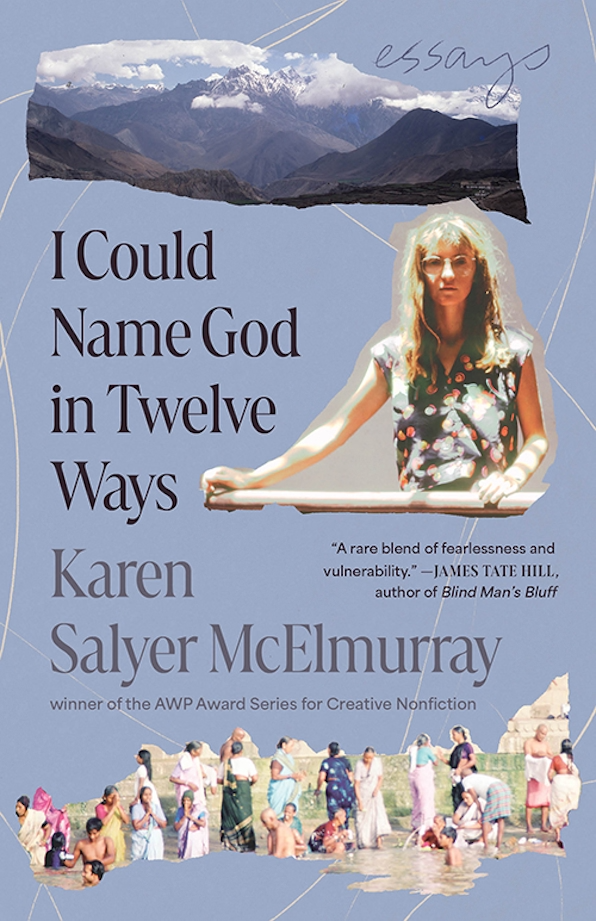
The University Press of Kentucky, 2024, 184 pp.
One: blue glass. Two: roads. Three: the Grand Canyon. Four: the Ganges. Five: a young girl cupping a bird embryo in her palms. Six: an aunt, deemed mad, living in an upstairs room. Seven: the experience of vertigo. Eight: chasing transcendence. Nine: mourning a dead father during a pandemic. Ten: yearning for a lost mother’s love. Eleven: memorializing a long-ago lover. Twelve: the restless search, across space and time, for some kind of home.
Twelve lyric essays, twelve different ways of naming God. And yet Karen Salyer McElmurray’s latest collection, I Could Name God in Twelve Ways: Essays, is actually a baker’s dozen, for we end with a thirteenth essay, a thirteenth way. “Spirit House” begins with the image of two miniature houses, inlaid with colored glass and mounted on tall pillars in a terraced garden along the Chao Phraya River in Bangkok. As the speaker and her travel companion—young twenty-somethings here—float in a boat down the river, their guide explains that the miniature spirit houses guard the wealth and bless the ancestors of those who live in the full-size, larger house behind them. As the essay proceeds, we follow the speaker on a winding path through memory and language as she names the spirit houses she’s known (“Smokehouse. Canning house. Chicken coop. Warm house. Longhouse. Hogpen. Coal shed.”), until we reach the essay’s final image, its ultimate spirit house: the speaker’s own body. Transformed by age and work, marked by familial traits, worn from its decades-long journey, her body is finally turning back, via memory, toward home. But memory is all that remains, because that home, like the speaker herself, is forever changed, its denizens diminished, many of them turned spirits themselves. “You are becoming,” writes McElmurray to her own speaker-self, “a vessel for what is missing.”
“Names,” says Dr. Janet Soskice, author of Naming God: Addressing the Divine in Philosophy, Theology, and Scripture, “are about being in relation.” Maybe, too, naming—putting words to things, attaching language to experience—is one way of invoking spirit, of holding or striving to hold some essence of what eludes us. This is what McElmurray’s essays do: name things as a way of seeking the ineffable. Ranging through six decades and across thousands of miles, they chronicle the speaker’s travels: departing from her rural Kentucky home at fifteen, pregnant, her “shadow trailing behind [her] like a tattered mourning cloth”; drifting across Europe and Asia in her twenties with Paul, her long-ago lover, carrying only “five hundred bucks hidden in [their] backpacks and no return tickets”; flying, decades later, from Baltimore to Kentucky in March 2020, as COVID was just beginning its devastating spread, to attend her own father’s funeral. These are journeys made physically, across great distances, and also journeys made spiritually, tunneling inward: the eleven days, for example, she spent on a psychiatric ward, admitted for severe General Anxiety Disorder at the age of sixty. Together, the essays—these namings—ask what the meaning of all this traveling has been. Why the movement? Why the restlessness? There are no simple answers, but one effect of all the journeying has been “the uncovering of a grief so far down inside me, thousands of miles weren’t enough to escape its hold over my life.”
It is a life ravaged by loss. The loss of a son, surrendered to adoption by the then-fifteen-year-old speaker, a son that continues to haunt her dreams. (One night, after drinking retsina on a Cretan beach, she dreams of a young man who walks “out of the waves, [touches] the top of [her] head,” and says he forgives her.) The loss of a pregnancy, terminated as an acquiescence to Paul, who didn’t want the baby. (“I hated Paul for it,” McElmurray writes, “but I loved him enough not to give him up.”) These two primary losses thread throughout the essays, but they are echoed by many others: the loss of love (Paul does not, ultimately, stick around); the loss of both parents; of a cousin to suicide, of strangers to the pandemic, of Kentucky land to catastrophic flooding, of family stories to a chilling silence. What is born from all these losses is that aforementioned grief, yes, but also a sorrow-tinged longing that bears a resemblance to faith.
Not, I hasten to add, a faith attached to any kind of orthodoxy. McElmurray, who calls her own childhood Christianity “bitter,” full of “sin and impossibility,” has nevertheless spent a lifetime chasing some kind of transcendence, some kind of divine presence amid the devastating overwhelm of the mundane. Hence the naming of God. But God, in these essays, remains mysterious, elusive, powerfully present and distant at the same time. “I am humbled,” McElmurray writes, “by the loneliness at the heart of all and grieved by a face of God I perhaps will never see.” Or, paraphrased: I want and I want and I want and I seek and I pray and I strive and I write, and always, I am disappointed. And yet I continue, because, perhaps, it is what living—and, notably, living the life of a writer—consists of.
If God appears on these pages, it is in the sacred clarity of the concrete detail. The speaker as a young girl, drawing ankhs and peace signs in the back of her bible, listening to a hymn as it slides beneath the pews. Or as a young woman, backstroking naked across a Grecian channel to reach a Marian shrine, where, blind without her glasses, she prays to that holy mother who also lost her son, another mother whose “heart” is “empty with grief.” Or, in another country, while hiking a burnt-red trail to a hilltop temple, she finds an animal’s pelvic bone discarded by a predator, and strings it with red thread to make a necklace. Or later, older, she speeds past a mining town on Highway 66, her “pockets full of pottery shards” that she will, much later, give to that relinquished son. Each of these essays glistens with crystalline imagery, polished to a luster by McElmurray’s loving attention to language. And it is in the accumulation of these images across these pages, these places, and these years, that one begins to sense the shape of McElmurray’s writerly faith. It is a faith shot through with grief—restless, questioning, pained, but persistent, a faith in words and how they matter, in the practice of gazing at a life, turning in the mind, pressing it through language until beauty and meaning shine forth and become precious offerings, become another kind of communion.
“I wanted poetry and God,” McElmurray writes of her wandering twenties, “visions and truths, in whatever order they came to me.” In I Could Name God in Twelve Ways, she’s offered those things to us. In these pages, you will find all of the above: poetry, God, visions, and truths, in an order marked not by chronology, but by the unique movement of McElmurray’s mind. Shards, pieced together here into a whole; “words, sacred words,” arranged into meaningful, pleasing, even transcendent shape. McElmurray has written a book like a spirit house—guardian of immaterial wealth, residence of ancestral ghosts, temporary dwelling for the reader’s restless spirit, a place to find respite along the road.
✶✶✶✶
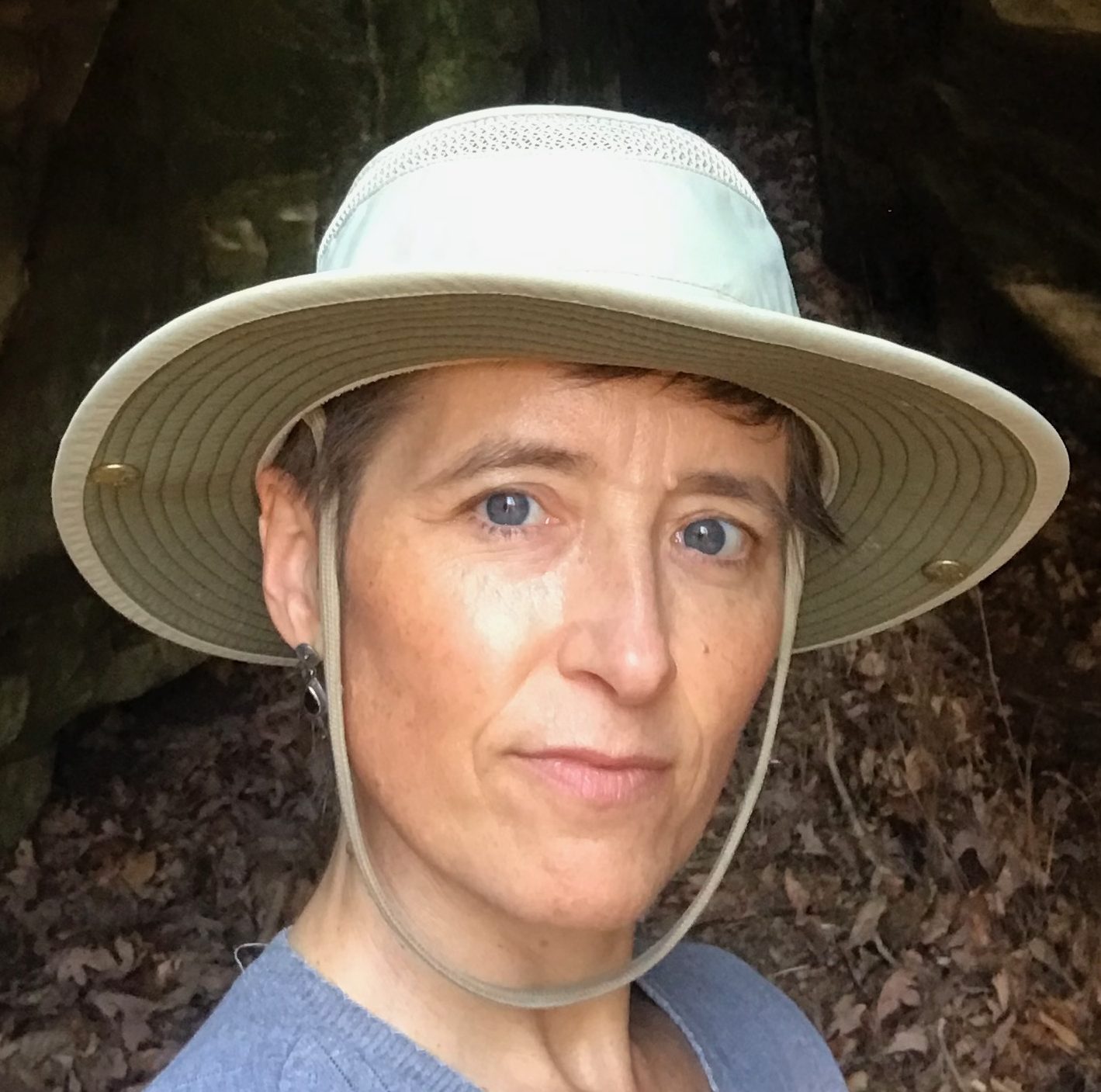
Amy Hassinger is the author of three novels: Nina: Adolescence, The Priest’s Madonna, and After The Dam. Her writing has been translated into six languages and has won recognition from Creative Nonfiction, Publisher’s Weekly, IPPY, the Illinois Arts Council, and the Ucross and Ragdale Foundations. She’s placed her work in many publications, including The New York Times, Creative Nonfiction, The Los Angeles Review Of Books, and Blackbird. A graduate of the Iowa Writers’ Workshop, she teaches creative writing at the University of Illinois.
✶
Whenever possible, we link book titles to Bookshop, an independent bookselling site. As a Bookshop affiliate, Another Chicago Magazine earns a small percentage from qualifying purchases.

