
Review by Mia O’Neill
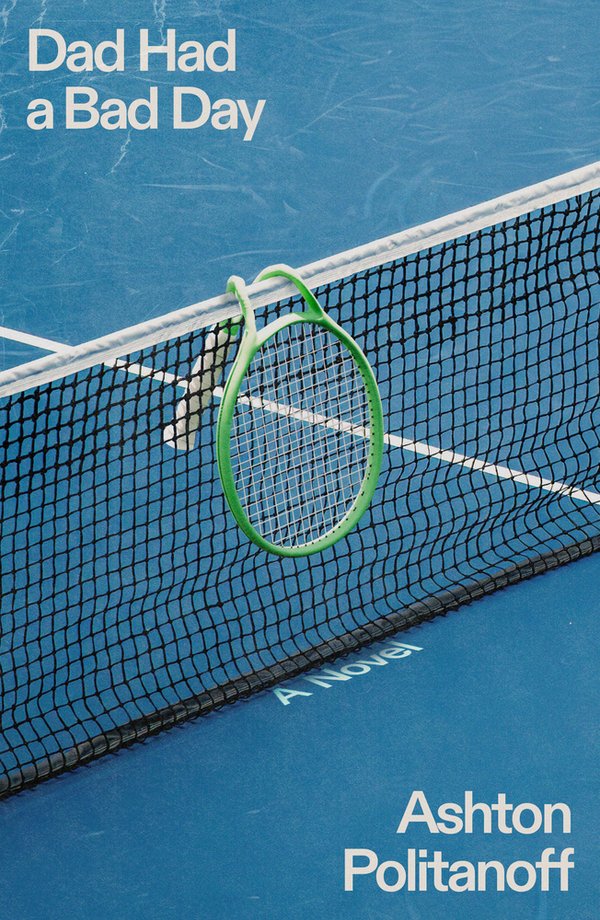
Early on in Dad Had a Bad Day (Astra House)—Ashton Politanoff’s berserk new novel about selfhood, belonging, and the perils of the unchecked male ego—Ned, a washed-up collegiate tennis player turned stay-at-home father, hears a voice. “You’re back,” the voice says. He’s sitting in the steam room of his childhood tennis club, the one he recently rejoined behind his wife’s back, using her credit card. “You probably don’t remember me,” replies the voice, seemingly from nowhere. “But I remember you.”
Whether the voice belongs to some phantom beneath the steam or whether (more likely) it’s all in Ned’s head as he attempts to relive his glory days, we’re never told for sure. Instead, Politanoff—himself a former Division I tennis player, now an English professor at Cypress College in California—seems more interested in the psychological undertones that the voice elicits, as it urges Ned to succumb again to the sport’s intoxications: the delicate tightrope of maintaining sanity after the loss of one’s identity; how fathers, frustrated with the cards life has dealt them, pass their rage and self-pity onto their sons.
A frequent contributor to Diane Williams’ annual literary journal NOON, Politanoff is a master of the spare, fragmented narrative. His previous book, You’ll Like It Here (Dalkey Archive Press), explores the history of early twentieth-century Redondo Beach through vignettes drawn from old newspaper clippings. Dad, too, is composed of many vignettes, chosen details that hold the constant power to surprise. Like a gallerist, Politanoff selects the most telling anecdotes to convey both Ned’s personal unspooling and a broader scrutiny of contemporary masculinity. (In one memorable scene, Ned and a fellow father sip beers as they idly watch their young sons wrestle at a birthday party.)
Once a star youth player, Ned is now in his thirties, married, adrift. He’s recently lost his job. His wife works long hours, is frequently out of town (and out of touch); meanwhile, Ned picks up his racket again, volunteers to captain a men’s team, and leaves his six-year-old son Freddie at the club’s daycare while they practice, bribing him with toys and sweets to keep the secret from his mother.
Back on the court, Ned grows increasingly—comically—unhinged as he vies for rec-league glory. He flirts with infidelity. He spies on opponents. He drinks too much. He recruits Freddie to sabotage his rivals’ gear. Gradually, through flashbacks, we learn of Ned’s own troubled relationships with older men: with emotionally abusive coaches and his cold-hearted stepfather, who seemingly based his entire self-worth on Ned’s athletic success. Dad is a satire, yes, but lurking just beneath the surface there is a feeling of deep sorrow: of fathers and sons, of a longing to love and be loved, a longing as potent and corrosive and tantalizing as addiction, as sport itself.
One wonders at a certain point what to make of Ned’s relationship with his wife, Loraine, who remains offstage for large sections of the novel. Throughout, the text is interrupted by (presumably) undelivered notes from Ned to Loraine, in which he confesses his secret behaviors and attempts to air his marital frustrations. That their marriage is doomed seems inevitable; nevertheless, Loraine is so frequently absent that it’s hard to read her. How much sympathy should we have for her? Is she neglectful in her affections, as Ned suggests, or is she simply overwhelmed, as the sole breadwinner and responsible parent? Perhaps this omission is purposeful; in highlighting Ned’s own ability to craft a narrative, Politanoff makes clever use of the fragmented form to highlight his protagonist’s blind spots. Still, I couldn’t help but wonder: What would her notes to him look like? (We do get one, late on, which feels both cryptic and undeniable, and does little to clarify the particularities of her character.)
Still, the emotional heart of the novel is in Ned’s relationship with his son. Despite his many flaws as a parent, Ned genuinely cares for Freddie and wishes to have a relationship with him. He respects his interests (he doesn’t push him into playing tennis); he looks for bonding opportunities (even if those opportunities include recruiting Freddie to help him cheat)—a sign that Ned (doomed or not) is at least trying, unlike the men who raised him. It’s notable that Freddie himself often emerges as the “parent figure” in his interactions with Ned, gently scolding and reassuring him that he’s doing all right.
That Ned, despite his destructive behavior, still manages to evoke some sympathy from the reader (this reader, at least), is a testament, too, to the power and variety of the book’s language. The prose moves between wry, staccato sentences laden with subtext (“sometimes people ask me if my son is my son”) and lyrical descriptive passages, particularly when Ned is describing the game of tennis: the skill and athleticism, but also the quieter moments of eccentricity. Here, Ned describes a teammate, Burris, moments before a match:
“One peculiarity was he kneeled down next to the net, face alongside it as if he was speaking into its ear … I didn’t know him well enough to ask him what he was saying.”
In describing fellow players’ routines and neuroses, Ned gives humanity to these men whose lives (like his own) may otherwise be unraveling. For them, tennis is one last opportunity for self-mythology, for escape from the disappointments of everyday adult life.
Ultimately, though, sports seasons—like benders—must end. What’s left, when the dust settles, is one’s own self, raw and weary and standing at the foot of a mountain.
✶✶✶✶

Mia O’Neill is a writer from Virginia. Her work appears or is forthcoming in Electric Literature, New Ohio Review, Narrative, The Washington Post, and elsewhere. She is the recipient of New Ohio Review’s 2026 Fiction Prize. She lives in New York City, where she is pursuing an MFA at Columbia University.
✶
Whenever possible, we link book titles to Bookshop.org, an independent bookselling site. As a Bookshop affiliate, Another Chicago Magazine earns a small percentage from qualifying purchases.

