
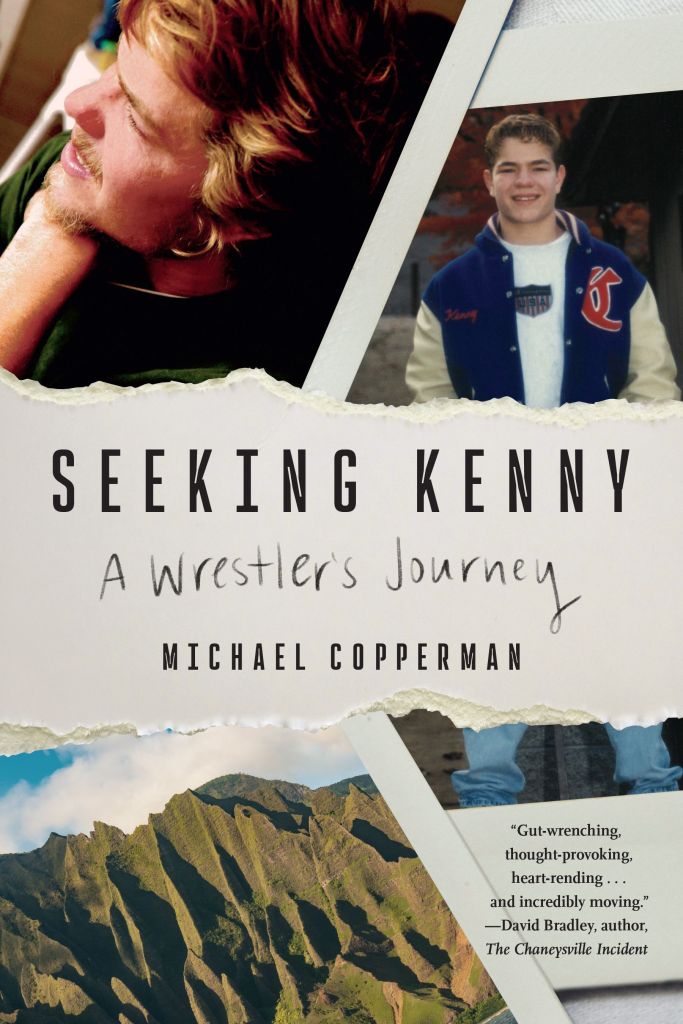
University of Iowa Press, 2026, 230 pgs.
Review by Adam Straus
Just because you haven’t heard of Kenny Cox doesn’t mean he isn’t famous. Among the greatest high school wrestlers in Oregon history, he won five junior national titles and was voted the ASICS National Wrestler of the Year in 1997. His face graced promotional posters. Within three years, though, Kenny’s athletic career at the University of Oregon would come to a disappointing end, leaving him to spend the rest of his short life trying to figure out what might fill the resulting void. But in the small world of wrestling, a star like Kenny never fades. “That’s Kenny f-ing Cox. THE Kenny Cox,” a startled Eugene cop tells his partner of the wild-looking young man they’ve accosted at three a.m. on a summer night in 2005.
Kenny died four years later, aged thirty-one, shortly after emerging from seventy days solo in the Hawaiian wilderness with limited supplies. It is this arc, from devout Christian star athlete to spiritually seeking anti-capitalist hippie, from wrestling shoes on the mats of elite invitational tournaments to barefoot beach travel, from Oregon to Baja and back again, that Michael Copperman traces in Seeking Kenny: A Wrestler’s Journey (University of Iowa Press).
Kenny’s is not the only wrestler’s journey readers follow. Copperman trained with Kenny throughout high school, medaled at several state championships, and was recruited to Stanford. Like Kenny, Copperman’s wrestling career ended in disappointment. In the aftermath, he found himself wondering, “Even if you can name and reject the harm of your former pursuit, how can it be that you still long for its simple math, missing it like a father or mother or child, like a lost limb? How can you get back what you have taken from yourself?”
To answer, Copperman crafts a narrative about Kenny’s story qua story, his mythos and ethos. From their first encounters as teenagers, Copperman thought, “There was one man I wanted to be: Kenny Cox, the boy on the poster. I made myself in his image as best as I was able.” In elucidating that image, the book functions partially as an investigation, with brief interspersed snippets chronologically recreating Kenny’s trip along the West Coast and his final journey to Hawaii. But for Copperman, “the literal question What killed Kenny Cox? does not seem as important as the ocean that question sounds, that is, the reasons Kenny chose to live his life as he did.” Most remembrances of Kenny invoke his breathtaking capacity for punishment, the sprints he would run long after his teammates had all collapsed and quit. It was never enough. Kenny, himself a sort of legend, lived and died in pursuit of myths beyond his own understanding.
I understand how seductive these hypermasculine fantasies can be. After an athletically unremarkable childhood, I walked onto my college’s varsity lightweight rowing team as a sophomore and spent the next three years systematically starving myself and erging until my lips turned purple from oxygen deprivation. While the sports differ in many ways (perhaps most notably in the socioeconomic strata from which athletes are traditionally drawn), lightweight rowing and wrestling share dramatic dehydrating weight cuts, relentless physical suffering, and spandex. For me, rowing’s simple brutality was a gift. What I lacked in traditional athletic virtues, I could compensate for with a willingness to suffer lodged close to my core.
In seeking Kenny’s core, Copperman must also confront his own. He interviews Brian Watson because Watson was Kenny’s teammate at Oregon. In high school, though, Watson beat Copperman for four state titles. The author admits that “for a long time, [Brian] was the great villain of my story.” They talk at length about Kenny, but at the end of their conversation, they turn to their shared history. When Watson reveals just how close-fought their last match really was, Copperman marvels “at all we can discover anew of the past—what was true, what it meant, what it means.” These are not Biff Loman figures, but wrestling was such a central part of their self-image that even years after last competing, they struggle to articulate themselves separate from the sport.
Perhaps that’s due to the depth of devotion they displayed, devotion verging on spirituality. “Cutting weight was religious,” Copperman recalls, “like a fast and then the feast and mass: You abstained from something essential until the experience of it became heightened and holy.” In a weight class sport like wrestling (or lightweight rowing), weight is everything. Kenny was a god at 125 pounds, but his coaches didn’t think he’d be competitive at 141, where he would have been significantly smaller than his opponents.
Similarly, I only became an athlete at five p.m. the night before a race, when I saw 159.9 on the scale after rowing and biking with layers of jackets and trash bags, after suffering in the sauna side by side with my teammates. Going back twenty-four hours, my largest meal would have been a few bites of an apple and a ProBar before bed, washed down with laxative senna leaf tea. I learned to like the feeling of hunger via Pavlovian conditioning: I associated it with the identity I wanted to wear, with belonging to a team I was eager to be defined by. Each unsatisfying bite of salad in the dining hall reminded me who I imagined myself to be.
While the men in Kenny’s life (mostly wrestlers themselves) accept his disordered eating as part of competition, the women are more clear-eyed. After overhearing Kenny forcing himself to throw up after a meal, his then-girlfriend waves away his explanation, telling him bluntly, “I’m a girl. I know what bulimia is.” Later in life, Kenny turned to dumpster diving and often went days without food while traveling. It’s likely that protein-calorie malnutrition was a contributing factor to the infection that killed Kenny: “Thought of this way, for seventy days Kenny was too successful in making a final cut.”
A different book might have focused entirely on those weeks in the Kalalau Valley. But while Kenny’s story could be told as a straightforward “man in the wilderness” undertaking, Copperman blends Jon Krakauer’s factual pursuit of Chris McCandless in Into the Wild (Vintage) with Henry David Thoreau’s soul-searching in Walden (Serius), colored by Edward Abbey’s attention to the natural landscape in Desert Solitaire (Touchstone). The settings (rural Oregon, coastal California, remote Hawaii) are beautiful, even if the action is often ugly. Readers come away with an unflinching look at Kenny’s life, including his stint in a psychiatric hospital, but there’s nothing salacious in the telling. Copperman knows Kenny and Kenny’s milieu too well to sensationalize. His ultimate goal is to “finally see us clearly. To love Kenny for Kenny, and so discover how to love myself.”
It’s a mournful mission, and the book is suffused with loss. That reflects Kenny’s tragic death, of course, but it also stems from the reality that “if sport is the defining field of play, then on any given day half of us cannot triumph.” I certainly didn’t. At the end of a bitterly disappointing senior racing season, I spent my last weeks as a rower watching from the dock. Miserable as I was, the night before graduation I wept myself senseless over what we’d lost. My teammates and I stood draped on one another, faces wet with tears and button-downs soaked with beer. What options are offered in adulthood that approximate those hardest-fought and best-lived experiences of adolescence? Will anything ever matter this much again? I hoped I had obviated these questions by joining the Marine Corps. That turned out not to be a long-term solution.
I’m gesturing towards the Marine Corps because Kenny’s story nests in a larger understanding of “American manhood, winner takes all, success at all costs, live large or not at all.” While eremitism is neither uniquely male nor uniquely American, there does seem to be something in our society that worships solitary men, on or beyond the frontier. What makes Seeking Kenny so successful is its ability to locate Kenny within larger aspects of the world he fled, without losing sight of his specific subjectivity. It’s a microcosm, illuminating the life of one American man while shining a light on the rest of us. Follow Copperman’s search for Kenny, then, and you might find fragments of yourself along the way.
✶✶✶✶

Adam Straus is a Marine veteran. The author of Remedial Action (University of Nevada Press, 2027), his writing has appeared in The Iowa Review, The Missouri Review, The Los Angeles Review of Books, and elsewhere. Adam lives in Philadelphia with his wife.
✶
Whenever possible, we link book titles to Bookshop.org, an independent bookselling site. As a Bookshop affiliate, Another Chicago Magazine earns a small percentage from qualifying purchases.

