
The month that my mother returns to her home, my heartbroken daughter is three. Too young for my mother and I to have told her of her grandmother’s plans, not so young that she couldn’t double over the marble floor wailing the moment she realized that there was an autorickshaw outside and a packed suitcase at the threshold. My daughter is intelligent. She knows instantly that half her world is moving away. And her loss splurges out of her with an ache so strong that I have to trudge through its waves with shaky knees to hush her. We tell her: you’ll visit every summer.
All summer, she corrects with a cry through clogged nostrils, grabbing the free end of her grandma’s sari and wiping the tears off her face. She wraps her arms around her Ma’s legs, snot dribbling out her nose. She is being abandoned. But for once her Ma cannot do much; she’s looking at me. Arms draped over her granddaughter’s shoulders; my mother’s lip quivers. I know she has to go. She has to leave. Now, my daughter can become my world and I can become hers.
Maybe because she was always going to leave, my mother managed to never look at her with the slightest hint of scorn or irritation. She has nothing but love and care for my child. But now her imminent absence weighs heavy on the marble floor right outside the bedroom where she sat leaning against the wall, crushing almonds with sugar and ghee for us. I cannot help but take a couple steps back to lean against that wall once my mother steps out the house. By my feet, the marble warps and creates a hollow crater that twists and turns. If I dip my toe into it, my foot will be caught. And all I will be able to hear are the echoes of the doors that have shut behind her.
So, I sit down on the floor to scoop my baby up into my lap and rock her till she stops crying. She wraps her little arms around my neck and does not swat at the air to be picked up by her grandmother. Instead, she settles in and stares at the floor. Once she’s done sobbing, she waddles out my lap and traces the smooth marble floor to feel the dip in the ground, right where her grandmother had sat earlier today to fold laundry. Her finger twitches and she pulls it away. She has found her own hollow crater. With swollen eyes, she looks up and asks me to make her something sweet. My mother has taught her body too that love is excess. I mix sugar into some rice for her, and I tell her joyfully about the time she was born; how in an anesthetic haze, I asked my mother why my baby wouldn’t speak to me; there was so much I wanted to tell her.
✶
The year that my mother leaves, my daughter learns bigger words and has a thousand questions for me. She buzzes around me now, just me. When I tell her why there’s no sun in the sky at nighttime even though it’s a Sunday, she looks at me with wide eyes and parted lips, as if her mind has been blown. When I ask her if she wants water, she says Yes, I want paani, and then starts pulling the word apart—pa ni, ni pa, pa pa—she halts, she turns to me and she asks, why don’t I have a papa? And I tell her it’s because I wanted a child, so God put a baby in my belly. She believes me.
Armed by the knowledge that I know things, she scuttles off to the yard and brings back insects cupped in her palms and frees them in our living room. Then, she asks me what they’re called. She runs across the house, tumbling over herself, bumping into furniture, and stumbling over the craters in the floor. She jumps over them. Runs circles around them. Her heart doesn’t weigh so heavy that she’s tempted to hover over one and let it suck her into its warped space. She simply walks away, unsettled, and asks for something sweet, something hearty. When I say no, an irritability fumes out of her. It is then that she looks most like her father.
✶
The summer after my mother leaves, my nephew comes to take my daughter to her Ma’s house, and she’s gone for a month. When he arrives, she keeps searching my face. Her beady bright eyes blink when she learns one dimension or another of my heartbreak, of what it will mean to be separated, and she echoes it on her face. She holds my hand, plants a kiss, and I tickle her to make her laugh. She tells me she’ll be back in no time, and then asks how long a month actually is. When she leaves, she doesn’t cry.
I try not to step into the hollows around me that keep turning into sinkholes.
When I accidentally hover over the one by the bedroom door and feel its pull, I head to the yard out front. I gather small twigs, fallen leaves, and marigolds to toss in. I gather emptied-out envelopes of child support checks, electricity bills, phone bills, old letters and feed them to the bigger sinkhole underneath our bed. The sinkholes around me slow down their churning, but I still don’t know how to stifle the one in my chest.
When my baby sleeps, she sprawls out with a meaty arm over my torso and a stout leg over my hip. Her heavy limbs hold me tight in place. I scoop my arm underneath her, so she can pin it down and snuggle closer. I find a new dip in the bed while she’s gone.
I cannot help but speak to it. I whisper her name and it responds with the sound of her laughter, coarse and sweet like honey. God knows what she’s doing. The earth of my village is made of sand that will get in her eyes and rocks that’ll scrape her knees. There are spiders, and then there’s the men—dauntless men. My chest feels hollow. I get up, walk away from the warped mattress and I take the summer quilt with me. I sleep, and I will always sleep on the sofa with the TV on when she’s not here, when no one is here. The dip in the bed feeds into the sinkhole underneath it.
✶
When I go to my mother’s house to bring her back, I stay for two days, and my three nieces, three nephews, two brothers, and their two wives tell me all about my child:
just a baby, but still so kind just a baby, but still so perceptive look at her belly
she’s mischievous and so loud sometimes she gives us kisses when we ask
when I was withering in bed, cramping, she snuggled next to me stayed by me while I slept
you should look out for her weight she doesn’t let us brush her hair she takes after you
I echo what they say because they are right. Even if they’re not, people will agree with them, and that makes them right. I ask her, isn’t it easier to breathe when your stomach is half full? I coo the words out, so she looks at me. But she turns away, and I don’t know if she understands.
She takes after me.
✶
When we return, I chase after her with a bottle of oil. Her hair is about to matt. She runs up the stairs onto the landing and realizes that she can’t open the door to the roof. She tries to hide under the dining table, somewhere in the maze of chair legs like she always has. But she’s bigger now, she doesn’t fit. She was born too thin, too skinny, and my mother fed her bananas and milk and ghee until she ballooned up. And when she discovers that she cannot fit into a crevice she could before, I catch her. I hold the chunk of hair I am wrestling with by the roots and she still wails with her whole chest. The muscles in her face strain, the vein on her forehead pops. I know it hurts a little when I tug at the knots, but really, she cries because she does not want to be held in place. Not by me. I ask, tell, demand her to not cry. She’ll get a headache, she always does. I apologize.
I give her kisses, I wrap her up in my arms, and she relaxes a bit. I tell her how her hair falls just like mine. I know what it needs, I have spent years learning what it needs. I have spent each waking moment learning how to nourish her. Must I spend a lifetime proving that I can?
✶
My daughter is bright, brilliant, and five, two years after her grandmother leaves. We sit down and plan out all that she has to learn to pass the primary entrance exams for the best schools in the city. She does great. Because she’s meant to achieve grand, wonderful things, and because I wake her up an hour early each morning to revise what she learned the day before. Come evenings, we sit outside in the grass and I ask her questions in silly, scary voices and make funny faces, so she pays attention. She sings her answers instead of reciting them and throws her hands up and her hip out to the beat of the syllables. The day that I ask her to stay up till midnight to study, she asks me for the very first time if she can sleep by herself in her bedroom. She cannot.
✶
The year that my mother has her first stroke, my daughter learns that I can lie to her. In the hospital, my mother’s doctor tells us of bodies that were starved fifty times in two hundred years, and the bodies of their children and how they’ve learned to keep reserves in their flesh, not understanding that some of us are no longer that hungry. It is then that my daughter realizes that genetics also apply to us. And I tell her of her father: his infrequent use of needles, his affinity for booze, his anger, his violence, my desire to raise her safe. I warn her of wants so strong that they become uncontrollable needs. And I tell her we’ll be cutting down on weekly ice cream. When we step back into our house, I know that she sees the sinkhole underneath our bed. She can feel its pull for the very first time. I know because then I find a sinkhole in her room.
It’s at the foot of the almirah. It twists relentlessly, steadily, and I can touch it because it is not mine. In it I find: a tiny Hannah Montana box holding a faux purple diamond that my mother gave her; toffee wrappers; her diary in which she scribbles about her crush. Abhay, that’s his name and I don’t know him. She’s still a child. Her body is that of a child. Her flesh was made within me and from me. It will not be touched, and it will not be traced, not now, not soon. I tell her. She understands it through the pulsating sting in her cheekbone. And when the moment passes, I know that we can both hear our sinkholes expand, cracking the floor. She tells me she will be sleeping in her room tonight.
Just eight years old, in a room with heaps of toys, stationary, and stuffed animals that will create shadows on her ceiling. She doesn’t get it. She doesn’t understand that an empty bed is vast, and our bodies are intertwined, and that there are sinkholes in the house. That she’s made of me. Her being is tethered to mine, and that is all she has ever known. To fall asleep without that warmth—she’ll dream her first nightmare sleeping on unsteady ground. Even when she jolts awake, terror will coarse through her limbs and keep her frozen. Splatter pieces of her nightmares across the ceiling. Her reality will bend, and she’ll call for me. And I will soak up the terror out of her body. I have to.
I let her sleep alone in her room. But I climb into her bed at three in the morning when I jolt awake in a panic. She does not get angry at me. And I never tell her that boys don’t like bodies that are as plush as hers.
✶
My mother has another stroke, a month after my daughter turns eleven. My brothers convince my mother to move to the city we live in. She cannot keep our names straight, and it is easy to fool her into believing that her unmarried grandchildren are married to rich businessmen and doctors, and the smarter ones have become businessmen and doctors. But she knows who we are. We go visit her at my brother’s house every two weeks or so. She sleeps a lot. I sit by her bedside and think of clogged arteries. When a deep frown settles on her face as she sleeps, I feel the sinkhole in my chest warping my being.
I cut out ghee from our rotis, oil from our vegetables, sugar from our sweets. When my daughter is hungry for a snack, I pull out trayfuls of fruits, so she’ll be full during dinner. She does not like the food I cook; she does not enjoy eating anything that’s healthy. Instead, she fills up on chips and candy that she hoards in her room. She does not show much concern for the sinkhole in my chest that I can only quieten by feeding her right. I squeeze juice out of oranges, berries, pomegranates. I buy coconuts and bring her liquids all day long. I find expensive wheat and organic vegetables and I give her a snack every two hours whether or not she wants it, so I can fill her stomach up with safe and good things, before she gets a chance to try to quell the churning within her belly.
I wake her up early to do yoga with me. I make her sit still so we can meditate though she itches to leave. Retreat to her room full of toys, away from her mother. She asks, more frequently, if we can go visit my sister and her kids. We can, only if she lets me rub turmeric and red clay on her patchily tanned skin. She does not care for her body; she does not heed the care I have for her, or how we will be perceived. Sometimes, when I see her sitting in her aunt’s house, I cannot look at the way her stomach folds. I cannot look at the heaviness of her cheeks and how they overpower the femininity of her face; enhancing the wideness of her jaw and pooling flesh around her eyes so they look unnaturally small. She does not eat from my plate at their house; she does not sleep in the same bed as I do. We see them three times a week.
She prefers to be at her aunt’s house. Even though when she eats there, her aunt tells her that she should exercise more. Her uncle suggests she shouldn’t eat more than one roti, and her cousins tell her that it will be hard for her to find a boyfriend. When she cannot find it within her to gulp her food down, she asks her aunt to make porridge like her Ma used to. And her aunt cannot refuse. I wonder sometimes if she understands the gravity of my family’s words to her, and how much they hurt me. That when we marvel at how unexpectedly different her body is, we are telling her that she does not look like me; she looks like her father.
When she asks if her Ma is going to die soon, my knees buckle. I slide my arms around her waist, and I lean. The softness of her plump skin, for once, feels only warm and inviting. I sob into her shirt. After a second, she pulls away. She takes a step back. She tells me it will all be okay. She tells me to stop crying. I cannot. But I can speak as I sob, and I can tell her once again that my mother sent me to live with my aunt halfway across the country when I was just seven, and I will never make that mistake. I will always hold her close. That she is my world and I am hers. She squeezes my hand.
✶
The year that my mother dies, my daughter is thirteen, and we play a game of stealing glances. When we look at each other, I can only look at her face and not her body; she can look at me, but she does not meet my gaze. I jolt my voice with more emotion, so she looks at me. Even if it is for a couple seconds. But she traces my wrinkles. Not meeting my eyes, she lingers on old creases infamous for holding emotion I do not have words for. This is the summer she shrinks.
The first month, she goes to the gym for three hours a day, every week, and then she never returns to it. She stays up till five in the morning, doing god knows what, just so she can wake up at one in the afternoon and miss breakfast. Now, none of her mealtimes align with mine. She remains in bed all day, caged in by her laptop, her phone, her novels. If she leaves her bedroom, she leaves the house. She doesn’t eat at the dining table anymore, and she takes an hour to finish one meal. If I find food I never threw away in the trash, I don’t think much of it.
She steers clear of the sinkholes that belong to me.
But my family tells me:
she’s grown to be beautiful, look at her she has your eyes but her grandma’s jaw
she should eat more so she doesn’t become too skinny she smiles like you
that old shopkeeper by the tower asked us if she was your daughter she’s so quiet now
I show her pictures to my coworkers and they ask me what her secret is. They ask me what she cut out from her diet, how many times she goes to the gym in a week, and they fawn over the before-and-after photo I created, which she only glanced at.
Her older cousins ask me why she doesn’t visit them anymore, why her voice isn’t as loud and her laugh as bodied as it used to be. We chalk it up to her being a teenager, but they ask their mothers to crush almonds with sugar and ghee for her anyways. Even on a diet, she cannot refuse an ode to her grandmother’s love. She only eats a bite.
She shrinks away each time I try to touch her but relents a moment after. She does alright in school, and I don’t yell at her when I see her report card. She becomes homebound. When her friends ask her to join them wherever they are, she stays on the phone and asks me if she can go while gesturing furiously—say no. I do. Loud enough, into the speaker, so they can hear it clearly. We bring out our blankets and settle on the sofa to watch tv all evening. I can look at her now. Her eyes are larger, her cheekbones high, and her jaw sharp. She’s light enough for me to lift her off the ground.
When her hair falls out in chunks and halves in its size, I realize she hasn’t had her period in months. I take her to the gynecologist, and she asks her: have there been sudden shifts in your weight? And I answer, tentatively, by giving her the statistics. She tells us that there are cysts on my daughter’s ovaries. She tells us that our bodies are rigged to hold onto fat because our ancestors were forced into manufactured famines. That they’re silly, our bodies. They don’t understand beauty or health, only drought. She tells my daughter she should lose just a couple more kgs.
I take her to a hair specialist, and he sends us home with four bottles of capsules. I learn how to make oils out of flowers I’d never heard of before. I sit her down and my panic oozes out of me with every breath. She looks at me, stares at me, wide-eyed, mirroring the terror in my eyes, shrinking from the force of my urgency. I cake her head with eggs, with onions, with gooseberry oil, almond oil, henna. She lets me. If it hurts, she cries silently, furiously. But she sits still. She eats the fifteen capsules I feed her daily. And pretends to agree with me that the gyno was wrong.
✶
Two years after my mother dies, my daughter is fifteen. She has lost control; she has lost restraint. She still does not eat with me, but she feasts at night behind closed doors, and then repents behind closed bathroom doors. She blares music, she brushes her teeth afterwards, she wipes her face dry—she hides from me. But still, she’s stronger now. There’s only so much she can repent for. Color somewhat returns to her face. Her voice is louder now. She does not stay cooped up at home.
But I am her mother. I know how her face swells and what her eyes can carry. I can hear it all in how hoarse her voice is. I ask her, I beg her, wait to eat until dinnertime; pleading with her to engage in some ounce of normalcy, but she doesn’t listen to me. Her body does not believe that she will feed it, and she keeps giving into its fear, she keeps feeding the sinkholes that surround her, thinking it will make them shrink. But they only become bigger. I have nightmares about them.
✶
Three years after my mother dies, I know why she keeps my sinkholes at an arm’s length. There is one in her chest. It warps her heart. I never saw it until the moment I saw her in the balcony of her room, smoke cascading from the lit end of her cigarette and then billowing from her mouth. She looks like her father. Destructive, dangerous, uncaring for anyone but herself. Oblivious to the smoke spiraling into the cracks in the floor.
In a moment, I will storm upstairs. She has not spotted me yet. She’s staring at her phone. Right now, I cannot move. I’ve noticed another sinkhole under her feet. It churns and warps the floor of the balcony. I cannot move, because if I look down, I will see a sinkhole too, churning concrete, drudging against the bottoms of my feet. One careless step, and she’ll fall through. The house will fall through.
In a moment, I will storm upstairs and throw open the balcony door with gritted teeth and my eyes won’t blink for minutes afterwards. There’s a storm brewing in her chest and it will destroy everything. Her lungs will shrivel, her heart will char. Then her liver. I can feel the back of my throat itch with the stench of the smoke. I can see her so clearly—I can see the day she will come home drunk and shatter my world. I cannot see her at all; every inch of her skin is churning.
In a moment, I will tell her all this. I will pull her up by her sleeve, drag her inside, and I will tell her that she is turning into her father. A drunk, dirty liar, soon to be found passed out with a bottle in a ditch. She will scream at me, waving her phone in my face. Her grief will burst out of her in waves and crash against mine. She’ll flash pictures of women with protruding collarbones, cinched waists, exposed ribs. Insist and demand—isn’t this what you wanted—and my stomach will drop with shock. I’ll ask God, out loud, what sins I committed in my past life to deserve a fate like this. I will raise my hand and aim straight for the cheek but not the bone. It will sting but only for a second. It needs to. It will teach her to not hurt herself, not hurt me. Then I will sleep in her bed, and hold her close, however much she tries to squirm away seething, so I can give her a head massage when the migraine comes. But for now, I cannot move. If I do, I will slip into my sinkhole and find that all it is made of is her.
✶✶✶✶
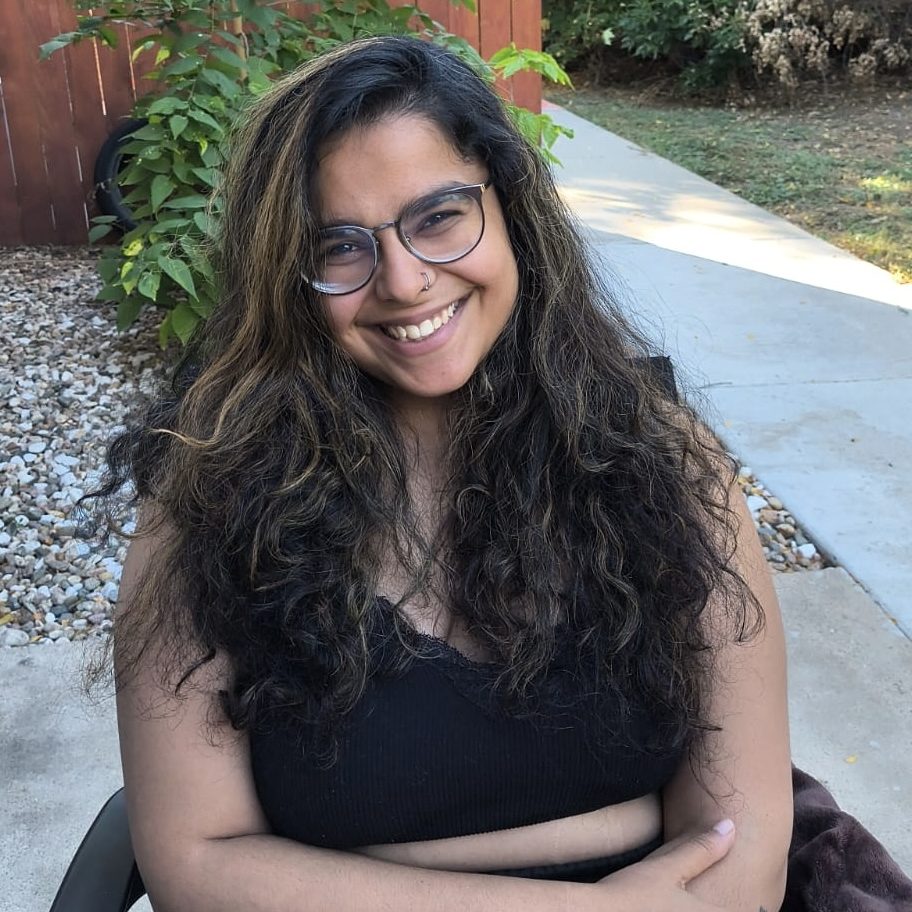
Navya Sharma is an MFA candidate in Fiction at Colorado State University, where she is working on a novel. Her work blends the everyday with the mystical. She lives in Fort Collins with her partner, her friends, and a cat. Her work has been previously published in Short Vine Literary Journal.
✶
Bastienne Schmidt is a multi disciplinary artist working with photography, painting and large-scale drawings. She was born in Germany and has lived in New York for the past 30 years. Her art work is included in the collection of the Museum of Modern Art in New York, the International Center of Photography, the Brooklyn Museum, the Victoria and Albert Museum in London and the Bibliothèque Nationale in Paris among many others. She has published seven monographs, and was the Artist in Residence at the Parrish Art Museum in 2017 and in 2018 was awarded a residency at the Watermill Center. In 2019 she was chosen to be part of the Parrish Art Museum exhibition ‘Artists Choose Artists’. She is the recipient of the Kodak Book Award, the Best German Poto Book Award and the German Photo Prize. She is also a winner of the World Press Photo Award and she received a grant from the Soros Foundation for her documentary work..
✶

