
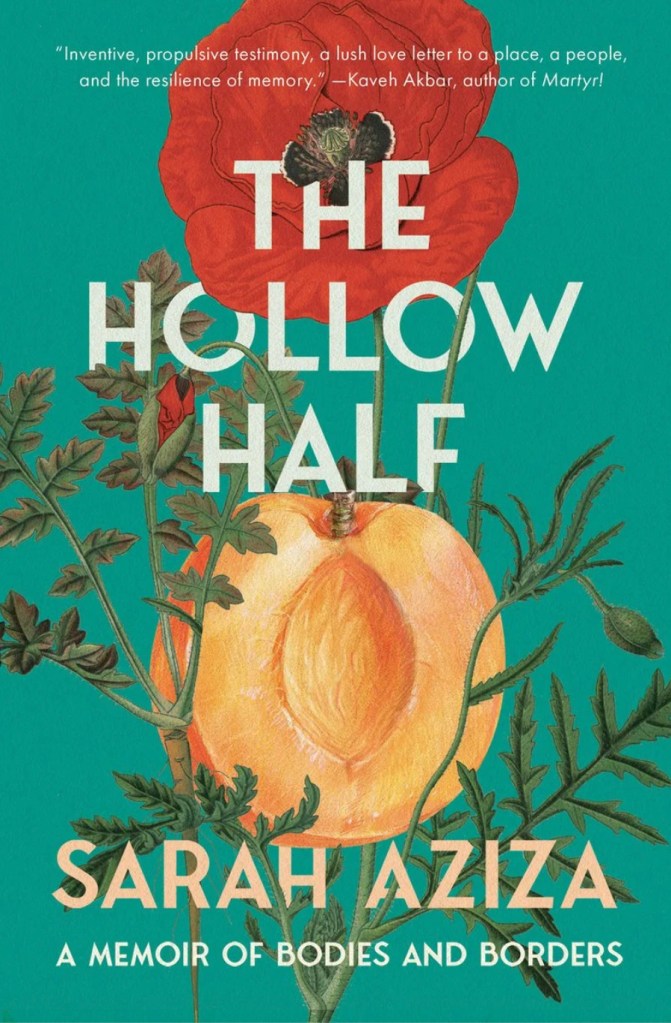
Sarah Aziza, author of the memoir The Hollow Half: A Memoir of Bodies and Borders (Catapult), presented on a featured panel at AWP in Baltimore in March of 2026 with the soft-spoken strength of a tall, thin female writing activist. The book, written in what has been called “experimental nonfiction,” starts off as a lyrical narrative about a young woman, 5′10″ and 82 pounds, on the edge of death from starvation. The reader who had not seen Aziza in person and who learned of the slow death from anorexia of Geraldine Brooks’ childhood pen pal in Foreign Correspondence, might fear for the narrator’s life. It was not until page fifty-eight of the memoir that the promise of a bigger story emerged: “‘Daddy is from a place called Palestine,’ he said in a lesson captured by my mother on the family’s camcorder.”
Aziza’s humble public presentation and the first fifth of her debut memoir belie the accomplishments of her career as a Palestinian-American journalist who reported from Saudi Arabia, Jordan, South Africa, the occupied West Bank, and the United States. Her publishing credits include The New Yorker, Harpers Magazine, NPR, and The Nation. The mild-mannered reporter who spoke at the writers’ conference has been in proximity to a great deal of violence and some of it perpetrated on her person.
The Hollow Half is A Memoir of Bodies and Borders and it does explore both. On the one hand, it recounts the author’s descent, recovery, and intermittent relapse from an eating disorder. Her personal experiences, often depicted in brief snippets, are braided into the border stories of her grandmother, Horea—both her time living with Aziza’s nuclear family in Chicago and in 1948 when the Israel Defense Forces (IDF) captured her land and destroyed Ibdis, a Palestinian village about thirty miles from Gaza City—and the impact of the displacements on Aziza’s father, Ziyad.
The description of the author’s personal trauma is so effective that, even after finishing the book, readers might experience flashbacks as if they had been eyewitnesses. There are scenes of Americans scorning her grandmother such as when a friend sees the woman preparing food on the kitchen floor and says, “Dude, I can’t believe that is your grandmother. What is she?” Aziza internalizes their revulsion and rejects her grandmother for a period of time. We learn of Aziza being stalked and raped in Jordan by two men “fixated on her mixed race,” answering her in English even as she pleaded with them in Arabic. Once Israeli soldiers blocked her from passing through a checkpoint and “forced [her] out in the dark;” she would have spent the night alone in the desert if Jordanian soldiers had not found her.
As a student anti-Vietnam protester and a participant in recent campus actions against the war in Gaza, I am taken by her activism while a student at the University of Pennsylvania from 2010–2014. Once “a set of steel fingers” grabbed her arm, and with a “beer-blowing mouth,” the attacker called out to his buddies, “This girl—she believes that Palestinians should have equal rights,” prompting their boisterous ridicule. During this assault, “the crunch of his grip throttled [her] back to the night a West Point student forced himself on [her]” when she was a college freshman. The hostility toward pro-Palestinian students was so threatening that they hired private security for their events.
It is as if the violence in the Israeli occupation of Palestine makes a somatic imprint on the narrator. Throughout the book both her body and her thoughts serve as a contemporary shield of Achilles, and her descent into anorexia seems inseparable from the story of the Palestinian extrication from the land.
The link between the personal and the material worlds, the “bodies and borders,” is accomplished through the careful use of diction, with words like “disappearance” and “erasure,” that simultaneously describe her anorexic thinking and apply to the colonization of Palestine. While a patient in the eating disorder program, the narrator “feels[s] herself disappear behind a grid” when put on a meal plan. She experienced the “first grooves of self-rejection,” becoming “eager, edging on disappearance” when she learned how Palestinians are viewed in America. The “edging” morphs into her “lust for disappearance.” In a period of relapse into compulsive running, her exercise bulimia, she is “racing once more to disappear.” While an activist at the University of Pennsylvania in the 2010s, a fellow student yelled at her, “Palestinians aren’t real,” but at that time she was “unprepared to be erased.” [Emphasis added in quotations.]
What is true of the narrator’s experience is also true of the land from which her paternal family comes. The link is foreshadowed before we know of her Palestinian heritage, just as we read about the progression of her anorexia: “A sandwich is halved, then becomes a crust. One mile becomes four, then eight. And so, the disease sprawls, colonizing time and energy.” Her disease is taking away her body and her energy just as the Israeli government and its military continue to take lives and land from the Palestinians. One of the descriptive words resurfaces during her first trip to Jerusalem in reference to the separation wall built by Israelis to contain Palestinians. It is “sprawled” and “gnaw[s] the green breasts of the land.” Occupation eats away at the body of the land just as anorexia does to the body of the narrator. [Emphasis added cont.]
The most graphic effect of anorexia comes as the book concludes. The narrator learns that her chronic physical pain is the result of “serous fat atrophy,” a condition caused by “extreme starvation … your bones eaten from the inside out.” The Israeli government’s blockade of food trucks into Gaza is a weapon of war with the intent of starving Palestinians from the inside out.
Despite what is written here, this memoir is not a political diatribe and it is not depressing. By relegating most of the political analysis and history, frequently derived from surprising direct quotes from people like Barack Obama, to footnotes and endnotes, Aziza skillfully preempts her well-crafted creative nonfiction from turning into political manifesto.
Second, the reader is saved from despair by little shoots of hope that peak out of the text as it progresses. There may be multiple causes of these signs of healing such as: a reasonable amount of compliance with the treatment for anorexia, the process of researching her family history including more than one return to the land, recapturing the love for her now deceased grandmother, and the process of writing the book.
The narrator stops wearing “monochrome men’s clothing” and puts on a red silk dress. Suddenly writing in the third person, Aziza describes coming to the table to eat and, instead of clandestinely throwing away food as she did when in the hospital, she advises “letting life slide into you, make hollow into a place.” The “Hollow Half” is filling and the narrator is becoming whole. She returns to Jordan and the person she was before much of the trauma, rescuing a blind kitten and, after preparing her grandmother’s recipes, eating with greasy fingers while sitting on the floor, a reclamation of the scene that triggered the Americans’ scorn for her grandmother, Horea. The occupiers take land from Palestinians, but they cannot take their culture.
✶✶✶✶
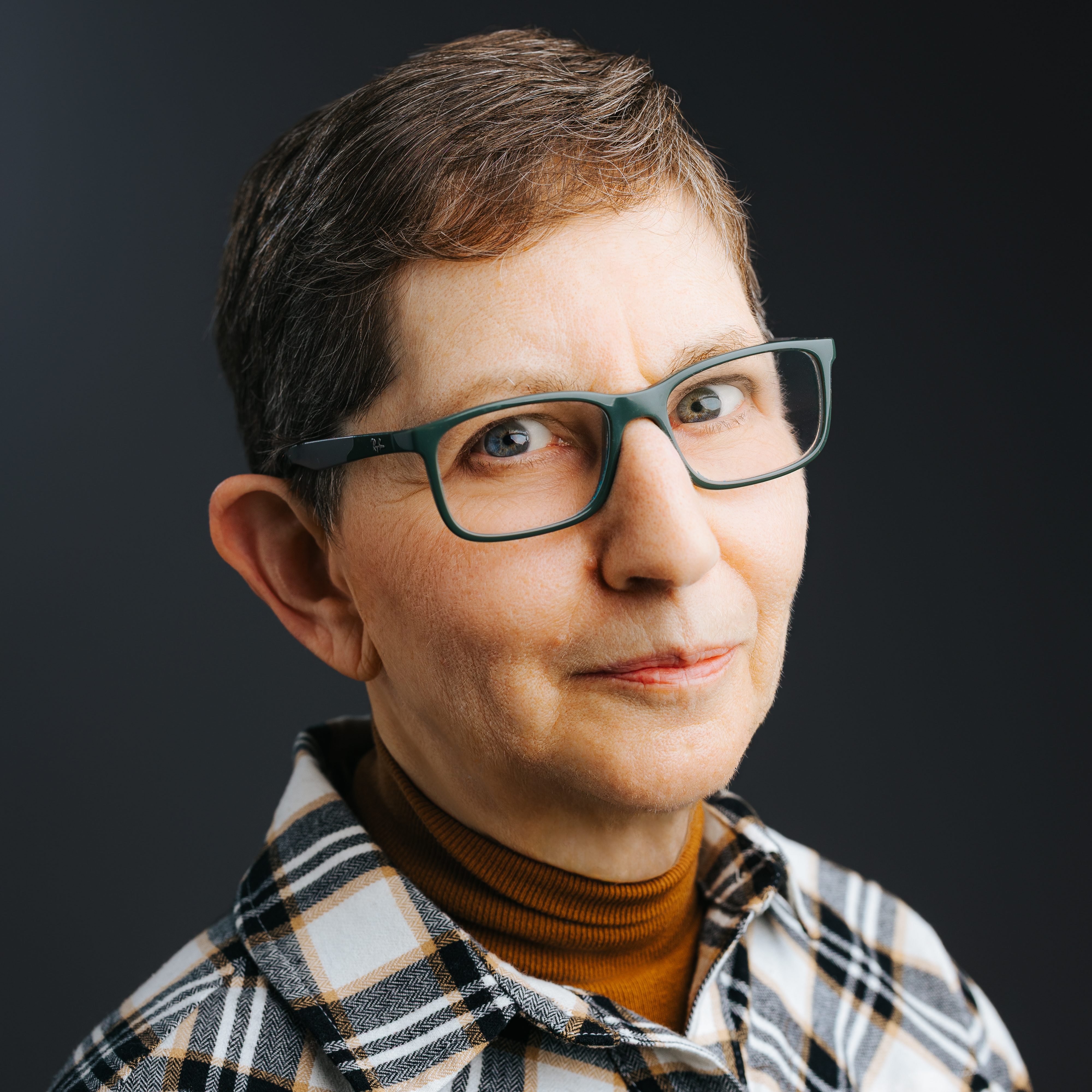
Karen Paley is Executive Editor of Another Chicago Magazine. She received an MFA in nonfiction from Goucher College and is working on a memoir, Life on the Left: From Revolutionary to Peace-Builder. Southern Illinois University Press published her book I-Writing: The Politics and Practice of Teaching First-Person Writing. Forthcoming or recent work appears in Allium and The RavensPerch.
✶
Whenever possible, we link book titles to Bookshop, an independent bookselling site. As a Bookshop affiliate, Another Chicago Magazine earns a small percentage from qualifying purchases.

