
My path to Ukraine led through a series of shady social media networks and clandestine phone calls to an alleyway in Krakow, Poland, in March of 2022. There, I met a man and spoke to him for the length of time it took to smoke half a Marlboro. Two hours later I loaded my bags into the back of his Subaru and five of us in that little hatchback drove several hours south through the night and crossed the border into Ukraine near the Carpathian mountain town of Staryava. We slept in a military compound near Yavoriv, where three weeks before over 200 international volunteers had been killed by a single Russian airstrike. In the morning I was driven to a cluster of buildings in Ternopil Oblast, in the far west of Ukraine, where I and a couple of other international volunteers were dropped off and left largely to our own devices. At that time we were three of 30,000 or so military volunteers in the country.
In the early spring of that year we lived in a sanatorium in the countryside of Ternopil that looked across the many lakes and the plain to the mountains. The sanatorium functioned as a center for internally displaced persons. The refugees had come from Kharkiv and Kyiv and Kherson and many other places, and they shuffled weakly across the grounds of the sanatorium in their dozens, thirty or forty tired and saddened people stopping to absently push their children on rusted swing sets. They checked their phones for calls from loved ones and walked among the pine forests and along the edges of fallow wheatfields. They fished at the edges of the lakes. In the evenings we would take our meals with the refugees. After small suppers we would smoke with them beneath the awning of a tall Soviet-era building within the sanatorium that had once been used to house the insane and the invalid. We were seeking shelter from the spitting snow and spring rain and unfriendly aircraft in the skies above. As we smoked we would exchange stories over the wail of an air-raid siren—stories of our homes, of Texas and Manchester, of Zaporizhzhia and Mariupol. The Ukrainians would express their worries for their loved ones. They would thank us for coming to help the country. And they would say to us:
“We are slowly starving.”
We were starving with them.
At breakfast we would eat a serving of boiled buckwheat, and on mornings when the helpings were especially plentiful, a thin slice of Spam. For lunch there would typically be a small helping of rice and a watery soup of cabbage, tomatoes, potatoes, and onions. For dinner we would eat either rice or potatoes with a small slice of pan-fried meat. In all, on a typical day, we were consuming between 700 and 1,000 calories. Food levels in the pantry of the sanatorium were ever dwindling. Russian airstrikes had brought Ukrainian food production and imports to all but a standstill.
People lost weight. Ribs began to show.
Others slowly joined us at the sanitorium—mainly other former YPG fighters, who had also fought in Syria, where we joined the international wing of the Kurdish militia that defeated ISIS. Some were veterans of the other Middle Eastern conflicts of the early twenty-first century. Eventually, there were seven of us, almost all of whom had fought in the militaries of our home nations or as international volunteers in the militaries of the local people. We aimed to do the same thing in Ukraine, beginning in the west, distributing humanitarian aid to refugees and training Ukrainian military units until we could find the best avenue to the fighting at the frontline in the east. We each came to Ukraine for many reasons: chasing the dragon of combat, for a sense of adventure, out of boredom, but we all believed that we could do some good and offer some sense of hope in a time where the fate of this corner of the world seemed overwhelmingly bleak.
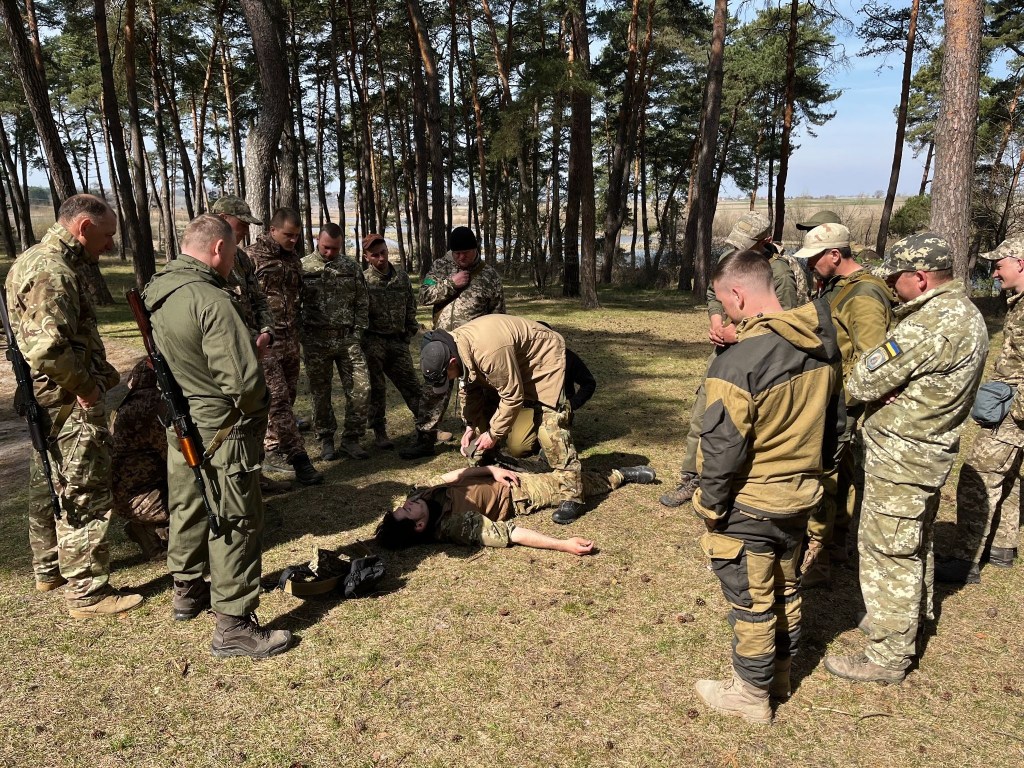
We seven spent most of our days preparing ourselves for the war that we were sure we would soon see. Broomsticks became rifles and stones became grenades and we practiced clearing rooms of imagined enemies in the sanatorium. We rose early in the morning before the sun to run three miles through a nearby and perpetually misty forest of ash and beech trees. Occasionally we would meet up with local Territorial Defense Forces units and show them how to dress wounds and how to fortify defenses. The TDF was a loosely formed militia of armed Ukrainian civilians. They existed in pockets throughout Ukraine, usually receiving only cursory training before being shipped to the front line. They rarely asked for our help, so we trained on our own.
Dizzy from running and too many cigarettes, we would stumble in from the cold morning to a dining hall—long, white tile and tablecloths lit in slanting pale angles from frosted windows lined high up. One day, Sam said, “I haven’t shit in days.”
Sam Newey was a kid from Birmingham, England, who had never been in combat before but felt himself called to give something to a cause. It could have been any cause, but he chose Ukraine for a sense of adventure and danger and an attempt to garner some machismo about his thin frame and floppy hair. He left behind a life of clubbing and ketamine and arrived in Ukraine with nothing but torn-at-the-knee black skinny jeans, a pair of boots, a white t-shirt, and a denim jacket. He even wore the outfit during our runs.
“You haven’t had naught to eat, mate,” said Dan.
Dan Burke was a veteran of the UK’s parachute regiment who had done multiple tours in Afghanistan in the late 2000s. He had later volunteered with the YPG in Syria for two years in the fight against ISIS, after which he spent a year in a London prison on charges of terrorism. He had been housed with the same ISIS volunteers he had traveled to Syria to fight against. He was quick with a laugh or a joke and he rubbed his shaved head like a hedgehog unacquainted with his own prickly skin. “Naught but this mealy old buckwheat, anyway.”
“I can’t eat the shit,” I said. I felt as if I was a picky eater, but the buckwheat had the consistency of a sandy, dried-out tuna sandwich that had been forgotten on a park bench. Everyone pushed it from one end of their plate to the other: us, the Ukrainians, the kitchen staff.
“Got to be a way to get some better food here,” Dan said.
“Why don’t we talk to Sean about it?” Sean was the man who had brought many of us across the border.
“That bastard won’t do shit,” Dan said.
We nodded and nudged our food around in silence and slowly ate for another twenty minutes before handing our plates to the washer in the kitchen and filing outside for another cigarette in the lightening day.
We told funny stories, of how I had been shot with an anti-aircraft gun and had to hitchhike my way from the hospital to my unit’s base in Syria with shrapnel raked down the right side of my body. Justin, another American who had done a tour in Afghanistan, had once married a woman who later asked for a divorce after he refused to pee on her during sex. Dima, our translator—born, raised, and university-educated in Kyiv—was mugged for over $10,000 shortly after receiving the money from a Ukrainian politician in the early days of the war, which he was supposed to use to purchase several rifles. He swore it had been a planned hit. Zafer used to leave work at a dog food factory to be tied up in bondage leathers, and shortly before coming to Ukraine he had been charged with domestic disturbance after a particularly loud session. He said he was missing his court date to be here.
Zafer and I first met each other in Syria, where we participated in the same anti-ISIS operation in Deir ez-Zor, and shortly after I was wounded by that anti-aircraft gun, he was shot through the hand and peppered with over 100 pieces of RPG shrapnel. He was a US Marine before that and had done a pair of combat tours in Afghanistan in 2008 and 2009. Both he and I still used the names given to us by Kurdish guerrillas when we joined the YPG, and we had planned to meet here as volunteers in Ukraine after two years without seeing one another.
“Mate, there is no way,” Sam said. He breathed out a pipe of blue-grey cigarette smoke.
“Dude, I swear to god,” said Zafer.
Dan paced around the outside of the circle with his thumbs in the belt loops of his pants. He was uninterested in the conversation. “Got to be a way to get some food here,” he said.
“We’ve got no money,” someone said.
“Right, mate, but there is so much money moving around here that somebody does. We’ve just got to find it, use it to get some food.”
We were silent for a moment, smoking.
Dan took a drag on his cigarette, flicked it down, and stamped it out on the pavement with his camouflage Crocs. “What about the TDF?” he said.
“What about them?”
“They’ve always got food.”
Nearby a pair of four-year-old fraternal twins were playing hide-and-seek and shrieking with glee.
Sam pointed at them with the ember of his cigarette. “And they don’t.”
“Hell, they don’t look too upset about it.” The twins were chasing each other with rosy cheeks through the grass around the swing set. Their mother smiled wanly at them with her arms folded over a red puffer vest.
✶✶✶
The circles of the internationalists in Ukraine are improbably small, even among the 30,000 of us that were spread from west to east across the steppes of the country. Theaters of operations in combat environments are all like this to some extent, but for those of us who had done this sort of thing before, these degrees of separation shrank exponentially. We knew someone who knew someone everywhere.
Dan had a British friend he knew from Syria, and that friend knew a man who knew a woman who was working with a group of western Europeans whose aim was to deliver medical supplies and drones to military units, and nonlethal humanitarian aid to internally displaced Ukrainian civilians. Her name was Cheryl. She was living in an Airbnb in L’viv. We traveled there in Dan’s truck to meet her.
L’viv is the jewel of western Ukraine. Forty miles from the Polish border, it was once a part of the Habsburg empire, ornate with architecture that rivals that of Milan, Vienna, and Prague.
We walked along cobblestone streets beneath Baroque buildings of pink and white stone. Under the green eaves of the Basilica of the Assumption, the statues and ornaments had been sandbagged for protection and paper signs were pasted up along the bustling street beside it reading “Fuck Putin” and “Russian warship, go fuck yourself” and “Glory to Ukraine” in Cyrillic. People milled around like tourists. Vendors hawked jewelry and flags. A woman rolled by on skates with a pair of silver angel wings strapped to her back. At the end of the block we could see the burned bricks of a bombed building spilling forth from the walls of what had once been a hotel.
The week prior, four other internationals had been killed there. They had been specifically targeted. Elsewhere in the city Russian missiles had hit a fuel storage facility and a bus station. Smoke spiraled and faded above the skyline.
We spent what little money we had on shawarmas at a kebab stand on the corner charging astronomically inflated prices, and we ate them seated at a bench watching the traffic rattle over the cobblestones as the streetlights snapped on.
“It’s so good to eat,” Zafer said. He sipped a two-liter orange soda and passed the bottle around like it was a jug of wine. After eating bland, unseasoned food for so long, we experienced the meal as a heavenly kaleidoscope of flavor.
“We should just bring them all back a bundle of shawarmas,” Sam said.
“Fuck, for what that guy charges we could’ve got fifty shawarmas in Syria.”
We finished eating and made our way back toward the old heart of the city. Lights were on in the bars, and restaurants were full of dining patrons.
“How do they keep all this going?” I asked.
“I don’t know, mate, but I reckon there’s loads of money floating around here,” Dan said.
“This is where all the rich guys come to wait out the war,” Zafer said.
“Fuckers,” said Justin. He adjusted his glasses and scowled at the crowds of well-dressed people.
We found a bar down the street and walked in to a crowded scene. Men and women talked, slurred and seriously, beneath dim spherical wire-hanging bulbs, and columns on the wall were streaked upward with Art-Deco chevrons. Bartenders wore black aprons and pulled at the taps. Ukrainians lined the bar at our left. To our right a table of people was speaking in Italian. At another table Germans argued vociferously over the scores of soccer matches. Pretty women whose men had gone to fight at the front eyed bar patrons like huntresses. Bicolored flags hung from the rafters. Ultramarine and sunflower. Sky and plains. Scarlet and black. Blood and earth.
Dan approached a dark-bearded man in the far corner and shook his hand. They spoke quietly for a moment and the man looked to the rest of us. He glared. Then he broke into a smile. “Get your drinks,” he said. He spoke with an American accent. “Then come join us.” He gestured with a nod toward a back room and disappeared down the corridor.
With drinks in our hands we entered the room and sat at a pair of long, chest-high tables made of varnished oak. The man began to forecast what would happen on the front. The tide was turning following Russia’s retreat from the north of the country, and there were rumors of a counteroffensive to push back into Kherson and Luhansk. “We’re trying to get them medical equipment,” he said. “Tourniquets, first-aid kits.” The rate of attrition in the trenches had not been seen since the early half of the twentieth century. “We’ve got loads of equipment.”
As he spoke, Dan’s contact, Cheryl, came in, blond hair around her shoulders like the cloak of a noblewoman. She sat at the table and listened to the man speak, and when he finished she said, “We’ve got 10,000 tourniquets ready to get out to the east.”
“Damn,” Zafer said.
“We’re asking eighteen dollars per tourniquet.”
“Damn,” Justin said. You could see the math working in his head behind his eyes.
Dan laughed. “Well, we’ve not got that kind of money.”
“No,” she said. “I’d guess you haven’t,” and she and the American looked at us with a kind of superiority, and we noticed for the first time in the shadowy room the pristineness of their clothes, the collars of shirts so taut they looked as if they had been freshly pressed and we felt our own unwashed cargo pants and tattered shirts hanging heavy and dirty on our bodies.
The silence was brief but it was awkward. Sam broke it. “We’re at a refugee center a couple hours from here. A bunch of families there with us. People from all over. They’ve got naught to wear, naught to eat. Little kids and expectant mothers.”
“Well, the snow should stop soon,” the man said. “Nearly spring.”
“We’ve got to get them some food,” said Dan.
“They’re starving.”
“We’re all starving.”
And Cheryl and the American man explained that they were running a business, not a charity. They told us that they had their own kids to feed, and asked us where they would source that kind of food, and what could we do for them?
And I asked, “What about helping the people?”
“Well,” the man began. He looked as if he could not make sense of what I was trying to say. “Those tourniquets usually retail for twenty-four dollars.”
✶
Two days later the refugee center stopped serving breakfast. We stood on the front porch of the place smoking cigarettes in the morning sun, watching the frost come unglued from the needles of the pines and the bark of the birch with our stomachs growling bitterly. There is a special kind of hunger when you know no food is coming for a long while. It is felt by fasting zealots and starved prisoners and malnourished victims of famine. The body adapts to its decrease in caloric intake and the mind begins to exist in a state of gaslighted euphoria. It tells you, “You are not really so hungry. Isn’t life wonderful?” Everyone was giddy and laughing and starving very nearly to death.
The twins were scampering around the swing set, and the red-vested mother was wearing the same wan expression as she did each morning.
Zafer had been paid his monthly VA disability check and spent it on us. We conserved his money by smoking our cigarettes to the nub and subsisting on cheap snack goods. A small store in the village sold smoked fish and smoked cheese by the kilogram in large Ziploc bags. We ate the cheese and fish on the porch. The refugees came to us timidly to ask if we might share. We handed them the bags and they smiled and bowed and thanked us ferociously and peeled the cheese and ate it in the morning light.
The weather was changing, finally threatening to turn to a proper spring. Snow still spat under grey clouds on some days, but the sun shone too and there was a faint kind of warmth in the air. With the movement in seasons, we were itching for some kind of action. We were trying to figure how to make it happen.
Dan announced that he was going back to L’viv. He was going to make a deal with Cheryl. He felt it best that he go alone. “Lads, she’s got the resources, she’s got a desire to help the people in this country. I’ve just got to convince her that these are the ones she should be helping.” He waved his hand toward the twins and their mother, toward a young couple pushing a baby in a stroller on the other side of the courtyard.
“What are you going to do?” Zafer asked.
“Probably sleep with her,” Justin said.
“I aim to let her take one of my kidneys, boys, sell it on the black market, get the lot of us some steaks.”
“I like a New York strip,” I said.
Then he got in his truck and was gone for many days. He sent photos of himself in the bars, obviously drunk, with Cheryl, with random passersby, with people we had never met. “Got something good coming down the pipe for you boys,” he slurred in a Signal voice memo.
“Well at least he’s having the time of his life,” Sam said. He was lying in one of the four beds in the room and tapping at a Total War game on his phone. Justin had The Patriot playing on his laptop. “Would you turn that rot down?”
“This is my favorite part. When Mel Gibson tomahawks the dude. Well, favorite part next to when you people lose the war.”
“What do you mean ‘you people’?”
Zafer and I sat in our beds with our backs leaning against the wall. We passed a vape back and forth. It was Coca-Cola flavored. Outside the weather was miserable. A warm front had brought rain with it and the rain came down in a deluge and large puddles the size of ponds formed in the courtyard. They nearly swallowed the seesaw, and the swing set sank in the mud and leaned at a lopsided tilt.
The food was still scarce and we had burned through our large reserves of cheese and fish. Russian jets and drones had been targeting grain silos, they had been targeting food production facilities like bakeries and factories, there were even unverified rumors that Moscow’s FSB agents had begun poisoning the Ukrainian meat supply. None of it was unforeseen. Many in the country had heard stories or had their own memories of the Holodomor.
The Holodomor, or “The Ukrainian Famine,” was less a famine of circumstance than a systematic targeting of Ukrainian farmland and grainfields by the Soviet government. The collectivization of Soviet agricultural goods in the 1920s and ’30s set extraordinarily high quotas for export from Ukrainian farmland, leading to the deaths of 3.5 to 5 million Ukrainian people by starvation. This coincided with Soviet extermination of priests of the Ukrainian Orthodox Church, the most educated Ukrainian citizens, many of the Ukrainian peasantry, and a repopulation effort in the areas most affected by the crisis, where ethnic Russians were imported to replace communities wiped out by the Holodomor, effectively Russifying them. Over time, the demographic of people in eastern Ukraine was shifted to largely favor ethnic Russians. The seeds sown by this act were eventually reaped in the 2014 Russian annexation of the Donbas and Crimea, where Russian forces moved into the area and held a referendum in which the ethnic Russian population created by the Holodomor voted to secede from Ukraine. This same Russification was used as a pretext for the eventual full-scale Russian invasion that would follow eight years later, under which we now lived our days.
Many Ukrainians, scholars, and historians today agree that the Holodomor was a genocide. There were widespread fears in 2022 of a second.
✶
Dan returned on Thursday. We hustled out to his truck to meet him, eyeing the back seat and the bed for any food or meat or snacks. All he had with him was a box of Lion candy bars. We each took one and Sam went to distribute them to the children and their families. The other five of us leaned in a circle against the bed of the truck with our jackets unzipped in the sun and the humidity, unwrapping the bars and eating them and we looked to Dan for an update.
He told us that Cheryl had a friend whose cousin worked with the Territorial Defense Units in the nearby village of Zaliztsi, where we had been purchasing our cheese and our smoked fish, and they were due for a rotation to the eastern front near Donetsk. None among their number had ever seen combat, and very few if any had any sort of formal military training whatsoever, aside from what they had learned about their rifles when issued them and what they found on YouTube. If we could train them, Dan told us, Cheryl and her friend would find a way to supply a week’s worth of food to the sanatorium. It was not much, enough to fill the back of a truck, but the workers in the kitchen might be able stretch those supplies to a month.
Zafer was smiling. He was excited. “When do we start?” he asked.
“This afternoon.”
“Then let’s go suit up.”
We filed back inside to our rooms. I had smuggled in an assortment of militaria from the United States. I pulled on a multicam uniform and a bulletproof vest, or plate carrier, fitted with level IV ceramic plates that were outlawed from international export by a series of loophole-ridden International Traffic in Arms Regulations laws. But if you pulled the sticker off the plates, there was no way of verifying that you had committed any crime. We had each brought several of these stickerless plates to Ukraine. I had also brought a medical kit and needles and shears and good boots and a helmet and a fighting knife and a rifle-zeroing tool and many other pieces of what I considered essential equipment. My bag had weighed some seventy pounds. All of my credit cards had been maxed out. Each one of ours were, and we had all brought a similar quantity of goods and materiel.
From the extras we had, we pieced together a uniform and a plate carrier for Sam, who looked comically skinny in the oversized clothing, with a boonie cap that barely fit over his brow and looked more like a fedora. Without the skinny jeans and the jacket he appeared younger and more boyish. I was worried then that he would die. He was the only one of us who had never seen a round fired in anger.
“I can’t die here,” he told me. “Ukraine just doesn’t have that poetic ring to it. But if I went to Syria like you all, now that’s got it. Me-so-po-tamia. It’s like a song.”
I laughed, and Zafer clapped him on the back. “One day.”
“I think Ukraine is a beautiful word,” Dima said. He was fond of language. He was a gifted translator because of it. “The problem is the brackishness in the sound in English. It is abrasive. You must speak it in the native tongue. Oo-krah-ee-nah. It is like a song too.”
“Fair play,” Sam said.
Outside, we stood on the porch and smoked and waited. Before long a white minivan came hurtling through the gates of the sanatorium, churning dust and swerving erratically. It peeled around the courtyard and veered toward us and squealed to a stop with a dramatic lurch.
“What is this, a suicide bomber?” Justin joked.
“Must be Roman,” Dan said.
Roman, the driver of the van, was the contact Cheryl had provided. He was young and short and skinny and looked like he might barely be sixteen, though he swore he was twenty and had two children at home. He showed us pictures of them on his phone as he drove us toward Zaliztsi.
“Beautiful family,” we said. Dima translated.
We arrived at a small hamlet of some twenty houses and a two-story grey schoolhouse that had been boarded up since the war started. In front of it were perhaps forty men wearing mismatched camouflage uniforms and hats bearing the tryzub coat of arms worn at degrees of varying slant. They were leaning on their rifles and smoking and taking sips from canteens slung around their shoulders in a manner reminiscent of a far more ancient mode of warfare. Their weapons were rusted and the wooden stocks of their Kalashnikovs were splintered and the men holding them looked as if they had given this no second thought. They were overweight and underweight, too tall, too short, bearded, clean-shaven. Some wore proper military boots and others wore steel-toe work boots with frayed laces. A few curled themselves into issued jackets to keep warm and the others faced the wind with rosy cheeks. There were grandfathers among their number, their grandsons next to them. Some wore modern plate carriers, others were suited up in flak jackets that looked like American remnants of the early years of the war in Afghanistan, others wore no armor at all. None had helmets. Overhead the sky had changed and darkened with clouds and there was a scent of petrichor in the air.
“These guys are going to the front?” Zafer said.
Justin shook his head and muttered, “Fuck. They’re all going to get killed.”
Everyone nodded, but there was nothing to be done about it. We stood in front of them and barked orders and had them align in a pattern of proper ranks and columns. Dima translated as he could, but the men had no inkling of what it meant to be in an armed unit, so they stood doe-eyed and not knowing what to do until we grabbed them roughly by the shoulders and forced them into position.
It began to rain.
Zafer and I stood at the fore of our group of would-be instructors and spoke to the Ukrainians. With Dima translating, we told them of our resumes. Among us were men who had fought against the Taliban, Al-Qaeda, ISIS, Saddam Hussein’s forces, and the Turkish military. Many of us had been wounded either by shrapnel or rifle fire or rocket-propelled grenade or anti-aircraft round. But it seemed to me from their expressions that what was important to these men was that we had survived. It was all that mattered. They looked at us like we were elite commandos. I felt as though I was looking out on a graveyard.
We had them empty their rifle magazines and Justin shouted for them to get in position to fire their rifles. What we saw was heartbreaking.
I thought to myself then what a cruel thing it was to send these men to a war which they clearly did not belong. They held their rifles like they were using a power drill as a hammer.
“They’re all going to fucking die,” Sam said.
Then a gust of wind blew and the rain came heavily and we went to work.
We instructed them on how to fire from the standing position, with their chests squared toward their target, and we showed them proper breathing and trigger techniques so that when fired, the round would travel to its intended destination. Then we did the same from a kneeling position. Then we did the same from the prone, with our bodies and their bodies pressed into the mud and the rifles stabilized by a proper fore grip and the triangle of their elbows. We were all soaked. The rain did not let up.
“It ain’t training if it ain’t raining!” we kept repeating in shouts, with Dima translating the expression into a long string of Ukrainian syllables.
The following day it rained again. The soldiers learned casualty care and the principles of care under fire: First defeat the enemy, then give aid to wounded comrades. Soon the men were hollering about training in the rain, smiling and gritting their teeth through buddy carries from the edge of the forest to the schoolhouse and slapping each other on the back. They were creating and organizing their own first aid kits, ensuring that each had a similar amount of supplies.
It rained again the next day while we were showing them how to defend a position from attackers, and they were slow to pick it up, but by the end of the day they were handling the scenarios we threw at them with a level approaching adequacy.
At night we hung our uniforms up in the rooms of the sanitorium and slept exhausted in the stink of mildew.
There was no training scheduled on Palm Sunday, and as anyone would expect, the weather was beautiful. We slept in, snacking on candy bars and cheese and letting the exhaustion soak in. We rose from our beds near noon and smoked cigarettes on the porch in the sun and the humid air in our civilian clothes.
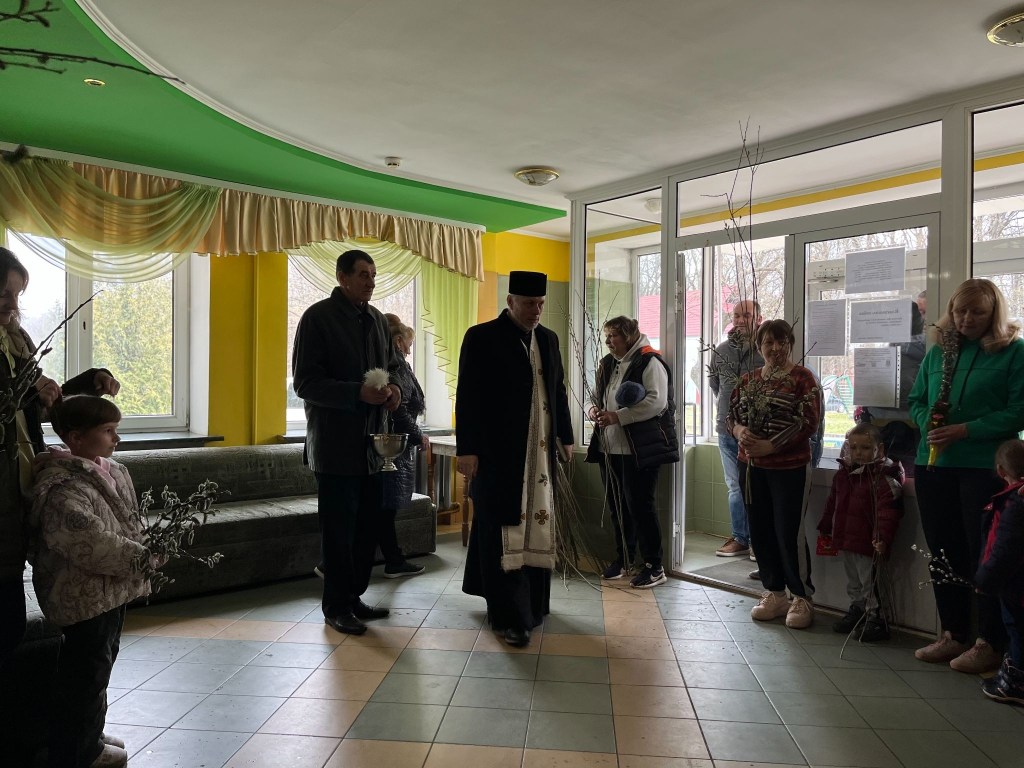
A priest came, robed in Orthodox garb, with a stack of palm fronds in his hand. In the foyer of the sanatorium he passed the fronds around, and we bowed our heads with the refugees as the priest spoke and flicked holy water on our heads and the leaves of the palms. Lunch was meager, and supper too, and we watched some anime show Zafer managed to pirate off the internet. Sam had squirreled away a few bottles of beer and we broke them out.
Then the next day the good weather held and we showed the Zaliztsi Territorial Defense proper attacking strategies. “If these lads are spearheading any sort of assault, they’re fucked,” Dan said. But we trained them anyway. And as before, they began slowly and soon became accustomed to the rhythms of war and the patterns of it. It was hot and humid and uncomfortable, and during their breaks they smoked and traded patches with us that bore the image of Mother Mary and the name of the village, Zaliztsi, spelled out in a sweeping banner in Cyrillic above her head.
We had two more days with the men. The rain came again on Tuesday. Now we had them split into two teams and pitted against each other. They conducted imagined scenarios of attack and defense, shouting “Bang!” when they fired their empty rifles. Zafer, Justin, Sam, and I moved among them with Dima, tapping the shoulders of men who would play wounded, screaming “Прилот!” and tossing rocks to simulate incoming artillery or mortar fire. The men dove to the mud in their ragtag uniforms. They dragged each other to safety. They applied tourniquets and carried the wounded off.
It was a pretend war, but all war is pretend until the blood is real and the men are really dead, and the only way to learn it was to imitate it.
Their unit was due to deploy to the front the day after Easter.
We trained the rest of the week. The squelching mud, the pouring rain, the digging of positions into the sucking earth, and the lack of food all coalesced into a state of perpetual misery for us and the men.
“They’re more ready than they’ll ever be,” I said to Justin as they lined up into ranks, water dripping from the brim of my hat, my sleeves hanging heavy with rainwater on my wrists.
“They aren’t nearly ready enough.”
“Aye,” Dan said, “but we done what good we could do.”
“Cheryl satisfied?” I asked.
“I’m off to L’viv soon as we dismiss them.”
Zafer gave them some sort of speech that was meant to inspire them, and I could see in their eyes a stronger resolve than they held when we first met them. They were soaking wet, their chests heaving. They smiled. They looked proud. They looked strong.
✶
On Good Friday we finally washed our clothes in the bathtubs of the sanatorium. We strung up the crusty uniforms in the yard between the steel cylinders of the monkey bars to dry in the sun. We smoked. I wondered how many cigarettes I had inhaled since coming to the country. I thought of a line from Tolstoy that said there was no one better suited to idleness than a soldier, or something like that.
Dan did not show on Friday. He did not show on Saturday either. We began to wonder whether he would come back at all, if maybe a lucky Russian missile had gotten him in one of his meetings with Cheryl. But early Sunday, we heard his truck pull in. He parked in the first solitary shaft of sunlight and smiled at us, standing on the bed of the truck with his hands on his hips. “I’ve got the goods, boys.”
He did. He had racks of smoked beef that someone had stayed up all night cooking. He had several large sweet rolls called paska that were decorated with white frosting for the holiday, sacks of rice, bundles of potatoes, crates full of vegetables, and so many eggs that we had to count the trays several times to make sure.
“One-hundred-ninety-two!” Sam shouted. He sounded like he was so happy he could cry.
We rushed it all to the kitchen, where the cooks had been moping around, and they broke into huge grins. “Дякую,” they said. “Дякую. Дякую”
We left them to prepare an Easter meal.
We joked with each other. We ran around the courtyard with the kids. There had been no breakfast or lunch, but around four in the afternoon a woman came around to inform us that the food was ready.
They had brought the tables outside into the sun. White tablecloths covered them. Plates were piled high with beef and rice and bread and pearled barley and sweets. There was a rainbow array of vegetables in many colors. Some of the Zaliztsi TDF joined us with their families for the meal. There must have been nearly fifty of us gathered there. Children were laughing. Mothers cooed to their infants. Fathers nodded their heads in appreciation of the spread. The tables were crowded and the people were happy and talked with each other excitedly. Sam, Justin, Zafer, Dan, Dima, and I smiled small smiles of satisfaction, and then Justin saw the eggs.
“You have got to be fucking kidding me.”
The eggs were still in their trays. All of them. They had each been boiled and dyed and finely decorated as if a team of artisans had been flown in for the occasion. Ornate patterns of white were laid on shades of pastel, of orange and blue and yellow and red and purple. They were beautiful. There were one hundred and ninety-two of them. They had all been cooked. There was no way that they’d be eaten before they went bad. The children were picking them from the trays and turning them about in their hands as other refugees took to the tables. Their parents admired them like museum pieces. They were smiling, laughing, pointing at their favorites or ones they had made themselves.
“This is the most backwoods villager shit I have ever seen,” Zafer said as he sat down.
“How stupid can you be?” Dan said. He hefted an egg in his hands while the priest blessed the meal. “All that.” He shook his head at the food that would be wasted.
But the beef was savory and cooked to perfection. We had our first salad in weeks. The food was a kind of decadence we were unused to and we should have relished in it. Instead a pall hung over our heads as the refugees talked amongst themselves and laughed and the children ran about.
I took another piece of beef from a large silver plate. “All those motherfucking eggs,” I said. It was like someone had spat in my face.
“All the rain. This weird rash I’ve got on my ass,” Justin said. “They could’ve fed us all for two weeks on those eggs.”
Sam and Dima were quiet, eating their fill.
We helped clean and put the leftovers away. Then we squatted on the porch and sat, smoking again.
“You all really ought to quit those things,” Dima said.
We nodded silently, watching ten or a dozen kids in the courtyard running across the grass with colored eggs in their hands, their mothers and fathers chasing them and laughing with a gilding of joy we had not seen in our six weeks at the sanatorium.
Soon Sam got up and went to play with the twins. Their mother and Sam pretended to be monsters and cornered them into the jungle gym and fell upon them with an attack of tickles. The twins shrieked with glee and feigned fear. Zafer started talking about the week of training, how we could expand our services and move to a part of the country closer to the action and maybe help many more unprepared soldiers. Justin and Dima thought this was a brilliant idea. Dan said we should think about heading south and east in the coming week, that he knew of some people working in Zaporizhzhia and Odesa. Maybe we could find a unit to fight with. I could hear the twins laughing as we talked of the war and I looked at Sam still chasing them through the green.
“I can’t believe they wasted all those eggs,” Zafer said.
Justin flicked a rock with the toe of his shoe. “They don’t have any idea what it took to get that food.”
“For one meal. And some decorations.”
“No, lads,” Dan said. “You’ve got it all wrong.” He pointed at Sam running with the children. Then he slowly moved his hand and pointed at their mother, her arms finally uncrossed and her smile bright and wide. It was the first time I had seen her happy. “That right there is worth everything,” Dan said. He got up and went out to join them at the seesaw.
“Let’s go,” I said. One by one, we finished our cigarettes and headed out to join them. We played like boys with the sun warm on our shoulders, well into the evening, until nighttime came and the air raid sirens began to howl their menacing scream.
It is hard to remember all the good we did through the troubles that would follow. Sam Newey was stricken by a hail of mortarfire in Bakhmut and died in the process of freeing Ukrainian prisoners of war. Dan Burke went to a training range one night in Zaporizhzhia with a fellow international, where they smoked a cigarette, and the other international inexplicably pulled a pistol from his belt and shot Dan in the head and hid his body in a storm drain nearby. Justin, already nearly blind in one eye, was defending a trench somewhere in the Donbas when a Russian grenade rolled into his bunker and a piece of shrapnel lacerated the cornea of his good eye. I injured myself while running through the streets of Mykolaiv during an air raid, stumbling into a shell crater and tearing ligaments in my knee. Dima, somehow, fiercely intelligent, was the only one among us who avoided any injury or wounding. Zafer, known otherwise as Michael Maldonado, advanced on Russian positions in Kherson later that year when Russian self-propelled artillery fired on him from point blank range and hit him in the head, but he would miraculously survive, recover, only to return to action in Luhansk in 2024, where, with his finger holding down the trigger of his rifle, spraying bullets to fend off a Russian assault, he was struck by an enemy round square between his eyes and died instantly.
✶✶✶✶
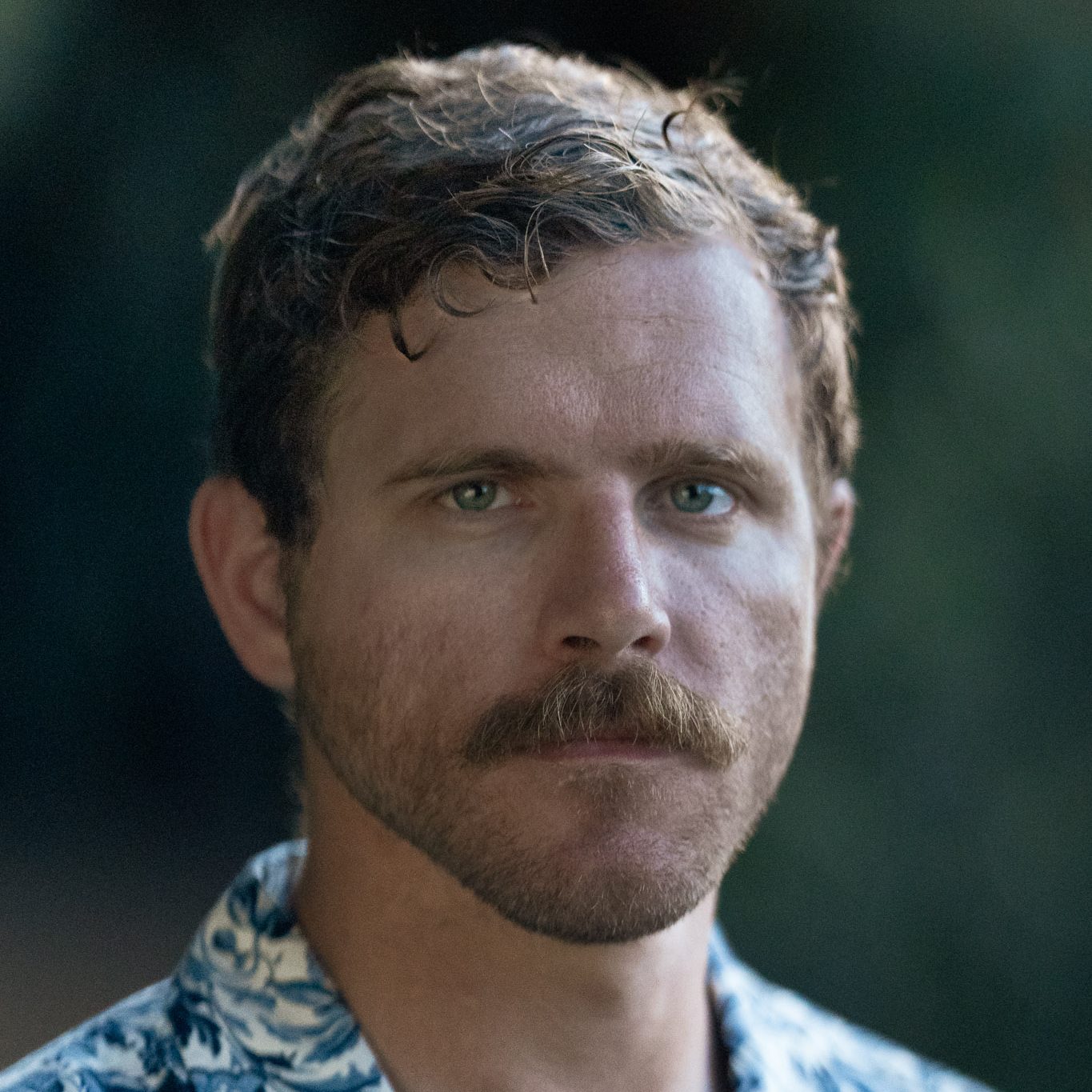
Following his graduation from Texas State University in 2018, Warren Stoddard II traveled to Syria to fight as a volunteer member of the Kurdish YPG in the war against ISIS, where he was later wounded in action liberating the city of Ash Sha’fah. After three years in the United States, he participated in the international response to Russia’s 2022 invasion of Ukraine. Stoddard’s short work has been published in numerous literary magazines around the world and was listed as Notable Literary Nonfiction in The Best American Essays: 2021. He is the author of two books: No Birds in Yesterday, and A Good Place on the Banks of the Euphrates. Warren is currently an MFA student at San Diego State University, where he is a Presidential Graduate Research Fellow. He received support from the Hemingway House in Ketchum, Idaho while writing this piece.
✶
Whenever possible, we link book titles to Bookshop, an independent bookselling site. As a Bookshop affiliate, Another Chicago Magazine earns a small percentage from qualifying purchases.

