
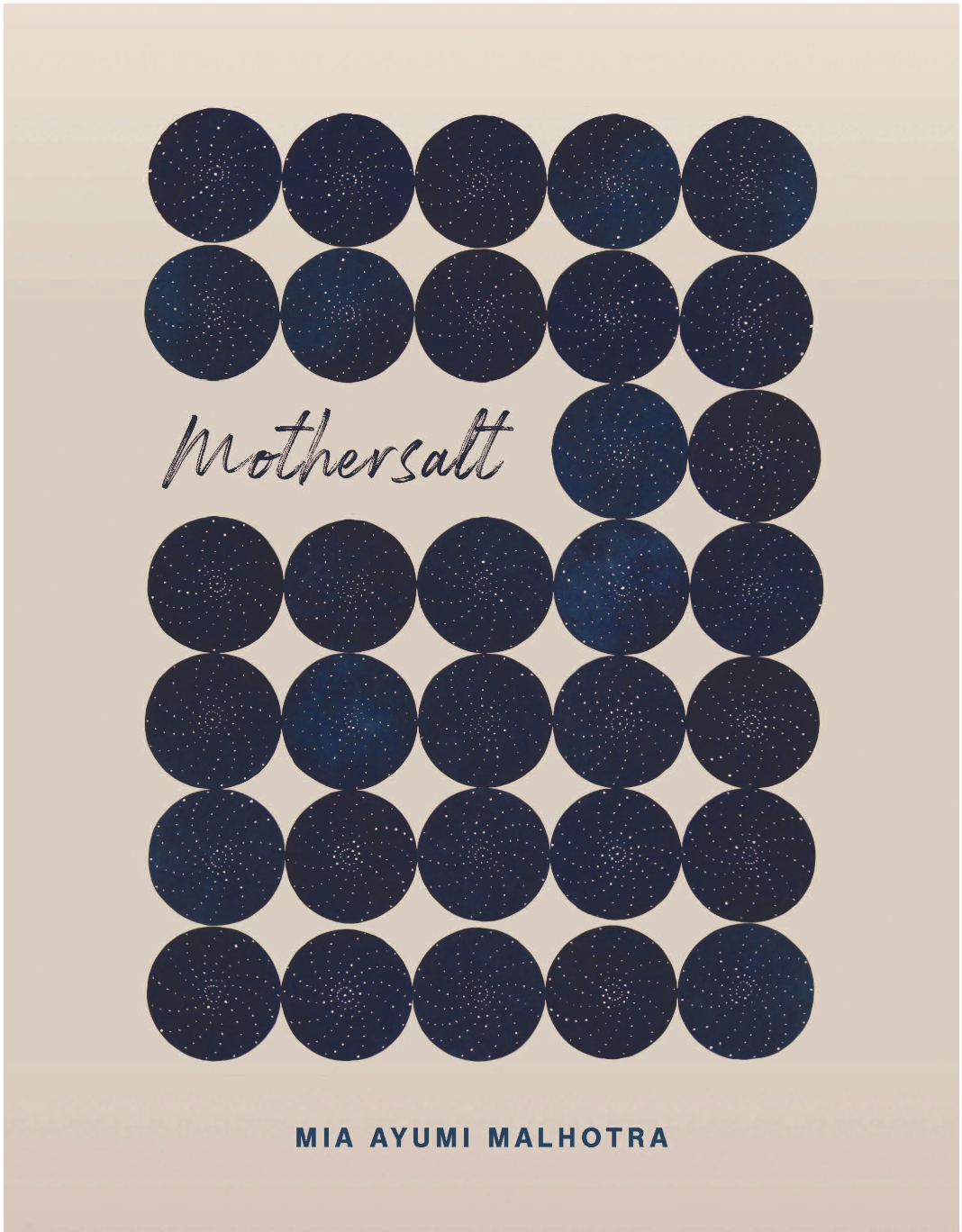
Alice James Books, 2025, 100 pp.
Mothersalt by Mia Ayumi Malhotra is a ruminant, inventive collection that reckons with the recursive possibilities of childbirth and early motherhood. At once ode, ghost story, and manifesto, Mothersalt explores the “private lexicon” of birth language to reflect an experience that is both deeply embodied and impossible to name. These poems chafe against rigid confines and categorical boxes, against singularity and linear progression. They ebb, flow, and spill out, revealing their messy, amniotic contents all over the page.
Even the collection’s title embraces this ineffable quality—attempts to distill, define, or pin it down fall short. “Mother” is a word so familiar it’s almost negligible, part of the furniture; then “salt”—elemental, necessary—again, ordinary. Combined, there is a shift ever so slight, a new frame through which to look. Its language is liquid ambiguity: perhaps a reference to tears, sweat, birthing fluid. What it is is less important than the form it takes.
This philosophy of embodiment guides the collection. The poem “On Form” describes a system of deconstruction and refashioning:
When I became a mother, my lines began to grow less regular, less sculpted—and this itinerant prose did not adhere to shapeliness.
Instead it spilled from birth into death and questions of beauty, arranging itself as it wished.
An artful, yet imperfect text.
Mothersalt suggests the coming together and pulling apart of disparate elements to create a new text, one that is less formulaic and more organic. A desire to move towards an expression of motherhood’s form as much as its content.
In “On Mothering,” Malhotra’s speaker tracks her own shifting identity in the wake of motherhood, becoming “that impossible beast, that mother who also writes.” This coincides with a transition from poetry about motherhood to poetry in motherhood—an experience embedded within the form itself:
After I left the birth bed, I began to want a poetry in which motherhood was not so much its subject matter but its growing medium—the infrastructural condition of the poet’s feeling and speaking mind.
This identity transformation, and the inherent tensions of being a mother-writer, inform the poet’s search for a medium that can contain the impossibility of it all. Its pulsing, chimeric quality is reflected against, and through, the structure and constraints of poetry.
“On Bewilderment” extends poetic form to a more personal level, as the speaker contends with her own birth story and “its lapses and failures.” The speaker recounts a highly medicalized birth, “drugged and disoriented” with “a nagging sadness, that I cannot remember the exact moment of her birth.” At the poem’s end, Malhotra returns to the concept of circularity, in contrast to the hard, clean line of traditional narrative:
The lie about birth is that it is a singular, isolated occurrence. That once you are done with it, it has done with you.
When perhaps it is more of a bloom or smear.
Long after the act is complete, birth lives on in our bodies, persisting like an enchantment—or a bad dream, depending.
This poem confronts the impossibilities inherent in our portrayals of motherhood. How can a poem, forever fixed on paper, truly reflect the perpetuity of the event, its ever-expanding nature? Mothersalt answers by breaking free of the shackles of traditional narrative structure.
The poem “Bad Birth, A Retrospective” asks, “How many mothers, after giving birth, feel like a ghost in their own story?” Charting the traumatic history of birthing—twilight sleep, leather restraints, unnecessary medical interventions—this poem traces how birth stories are repeated and rooted in our bodies, before and beyond memory. And while Malhotra notes that childbirth bears many “hallmarks of a good story (exposition, rising action, climax, and resolution), just because a baby has been delivered doesn’t mean the story is resolved.”
The poem ends with an explicit call to action: “We cannot fight old power in old power terms only. The only way we can do it is by creating another whole structure that touches every aspect of our creation.” Storytelling becomes the means to break free from tired old narratives of motherhood and complicit institutional frameworks.
Malhotra challenges the colonialist masculinist perspective, circumventing a tidy narrative arc with something discursive and more faithful to lived experience. The “weird circularity” of postpartum days, their blurred containers and rooms, the many parts and wholes of the mother-writer. The resultant “new literature”—this “slow, painstaking assemblage”—reveals the messy collage of motherhood and its endless creative possibilities. Digressive and non-linear, Mothersalt resists definition in favor of an atmospheric language that continues expanding, forever circling off page, watercolor seeping through paper.
✶✶✶✶

Brittany Micka-Foos is a writer living in the Pacific Northwest. She is the author of the poetry chapbook a litany of words as fragile as window glass (Bottlecap Press, 2024) and the short story collection It’s No Fun Anymore (Apprentice House Press, 2025). Her work has been published in Ninth Letter, Witness Magazine, Epiphany, and elsewhere.
✶
Whenever possible, we link book titles to Bookshop, an independent bookselling site. As a Bookshop affiliate, Another Chicago Magazine earns a small percentage from qualifying purchases.
 Another Chicago Magazine