
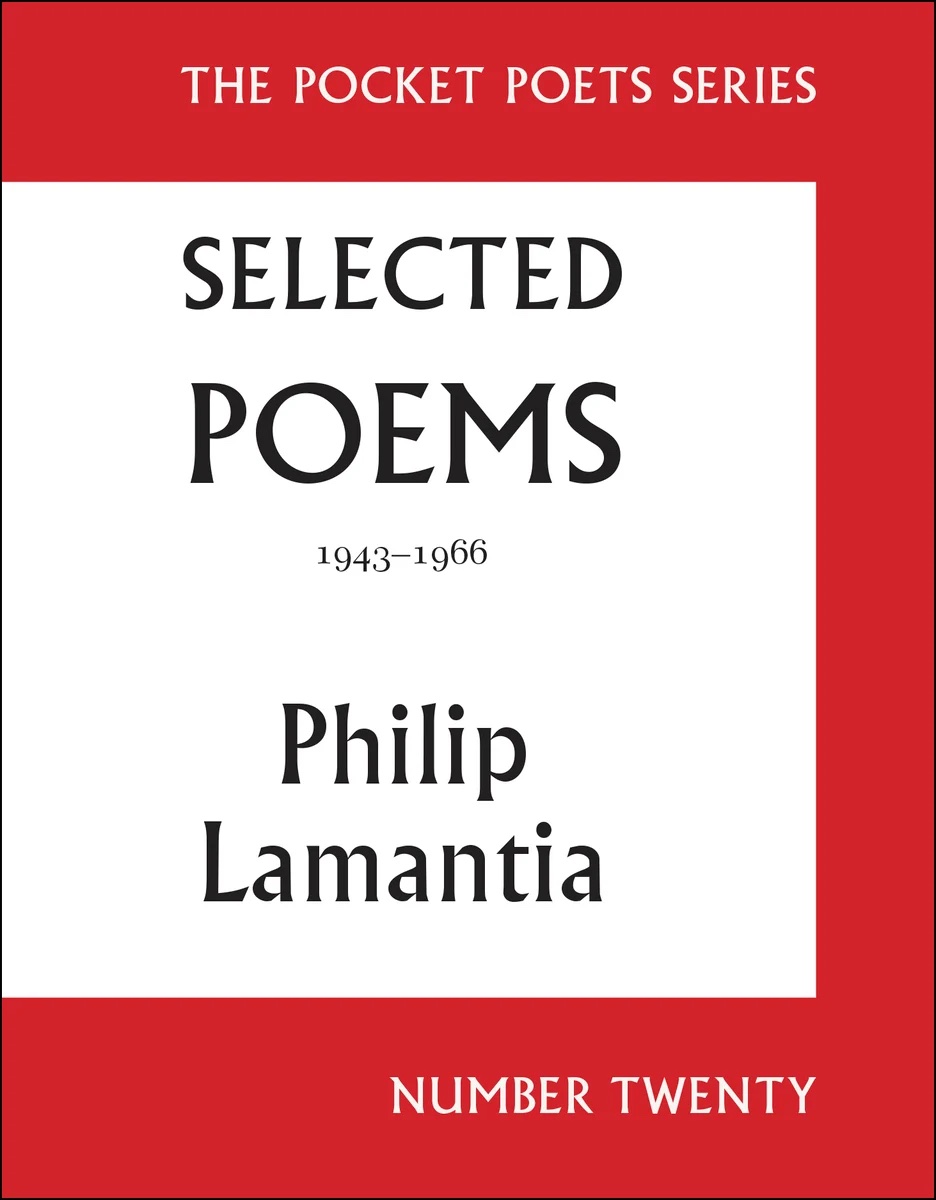
“Selected Poems: 1943-1966” 2025, City Lights Books, 128 pp.
The newly rereleased Selected Poems of Philip Lamantia is a historic treasure of the American poetry canon. Arriving at an impeccable time, this quintessential collection offers a prism through which to parse our present reality; poetry that defined American surrealism in the mid-twentieth century feels at home in our decaying and violent timeline. It once again presents a counterpoint poetics for ascertaining truth and confronting the beauty and horror of a disjointed global ecosystem — at once utterly massive and achingly personal.
Three sections make up the body of Selected Poems; they altogether provide an intimate portrait of the poet’s life: “Revelations of a Surreal Youth (1943-1945),” “Trance Ports (1948-1961),” and “Secret Freedom (1963-1966).” The choice to preserve this structure as it appeared in the original 1967 publication affords twenty-first century readers a glimpse into the raw, unwavering textures of Lamantia’s writing within a society seemingly as isolated and frenzied as that of 2025.
The book takes a historical view of global conflicts — namely World War II and the Cold War — and Lamantia’s reactions against the imperial war machine, both in the United States and within globalized systems, emerge as a precursor to the apocalyptic themes often present in Western poetry.
Firmly established but in need of revisiting, the book’s new edition offers an opportunity to revisit the surrealist’s masterful collection, complete with a fantastic new afterword by Garrett Caples, in which he explores the relationship between Lawrence Ferlinghetti and Lamantia, as well as the utterly challenging process of bringing Lamantia’s voice and works into the City Lights canon. Concluding this back matter is a sequence of archival, black-and-white photographs revealing the correspondence between the publisher and the writer.
The essay and its visual accompaniment are remarkable addenda — despite the core text, Lamantia’s poetry, continuing to stand on its own in the contemporary context — bringing new illumination to the intricacies of the enigmatic surrealist’s life. The text’s expansion lends certain humanizing qualities to the distinct, dreamlike anti-war poet; we learn about his elusive lifestyle and ambiguous relationship to his poetry and the publishing process — playing cat-and-mouse with the publisher, described by Caples as its own flurried structure of intentionality, liveliness, and chaotic timelines.
The collection’s poetry and new afterword sit alongside each other in mild juxtaposition, foils that reinforce one another but are not necessarily connected. In 2025, Lamantia’s rabbit holes and vortexes of musing — his astounding and rapid-fire confessions, proclamations, and reflections that move through each poem as a mass of life, both real and imagined — feel familiar and alive, connected with all we face. There is an occasional sense of supreme joy found in these poems, but it is unraveled and challenging, as seen in “The Sun Is Bleeding over the Sky!”
The sun is bleeding over the sky!
Beauty be my prophecy and
youth my analog of wisdom,
to strike notes of wild wondrous song
where the rays of childwood eyes
extend far beyond the enemies of all natural ecstasy!
Lamantia contrasts blood with light, pairing the wisdom of elders with the wildness of youth, all to counter “the enemies” that strike at the core of a surreal life — a life connected to all states of being — and the possibilities of all consciousness.
The text, revisited and refreshed, brings new waves of existential questions about cycles and progress, and the value of undiminished poetics. As readers, as poets, and as people of a society of poetry, where have Lamantia’s war machine warnings become resonant? Where is there risk for us to lose our ecstatic moments of awareness and connectedness?
Lamantia’s writing evokes a sense of timelessness and poses questions about the potential for us, as readers, to lean on the voices of the past and figures greater than ourselves to recognize historic underpinnings and cultural narratives that are far from over. We see this in poems like “Hermetic Bird,” which leans into the proto-leader — the matriarch, the mother. There is collectivism in the use of “we,” and there is a bounty of connection-making, as Lamantia offers us the passion of knowing that things always outlast, always are forever, and the connections that forever makes are incredible:
you and I
will ride over the breasts of our mother
who knows no one
who was born from unknown birds
forever in silence
forever in dreams
forever in the sweat of fire
There is a charming quality to a collection that moves across time and space and lands into the hands of today. It feels both encompassing and precise, utterly universal in its intimacy. Through this dynamic of history and proximity, we are left holding a book that is utterly personal and phantasmagorical. It is a portal into possibility, into an exploration through the exquisite, proclaiming voice of the surreal seer and offers us the opportunity to connect with a person, a figure, or a structure of ideas and frameworks through which we may explore and grow.
The connectivity between readers and Lamantia is reinforced by the format of the text: a pocket edition that binds to us as toolkit. To be able to engage with a text as an object, as an extension of self, kept close, aligned with the breath — to be able to move fluidly in and out of reference with this tool, this adornment — is one more way to explore surrealism, embody it, and become it through the flashes and lanterns of Philip Lamantia.
✶✶✶✶
Greg Bem is a poet, librarian, publisher, and labor activist in Spokane, Washington, where he co-organizes Foray for The Arts with poet Sarah Rooney, and serves as publisher of Carbonation Press. His work concerns ecologies and natural environments, and often bridges literary forms with sound poetry, field recordings, ambient and noise music, and performance art. He is the author of several books, including Of Spray and Mist (Hand to Mouth, 2019), Green Axis (Alien Buddha, 2019), Like salt. Like a spine. (with Maung Day, 2019), Pushing Through Glass (Carbonation Press, 2023), and Emerge: Poems (Bottlecap Press, 2025). He regularly writes book reviews for places like Rain Taxi, International Examiner, North of Oxford, and Exacting Clam. His experimental sound works can be found on Bandcamp under the project name Talus Field.
✶
Whenever possible, we link book titles to Bookshop, an independent bookselling site. As a Bookshop affiliate, Another Chicago Magazine earns a small percentage from qualifying purchases.

