
Review by Christian Trevor Lisa
In the immediate aftermath of COVID, I interviewed to be a digital copywriter at Salesforce. I was fresh off a surprise “digital-only” MFA and felt like the universe owed me a win. What I got—when I was unexpectedly hired—was a parade of work assignments I couldn’t have conjured in my most freewheeling whimsy: a celebrity athlete’s YouTube series, horoscopes, a retro View-Master for conference guests. I was given a vacation allotment I might only otherwise see by moving to Sweden. It was all nearly enough to make me forget that I’d ever wanted to be a real writer.
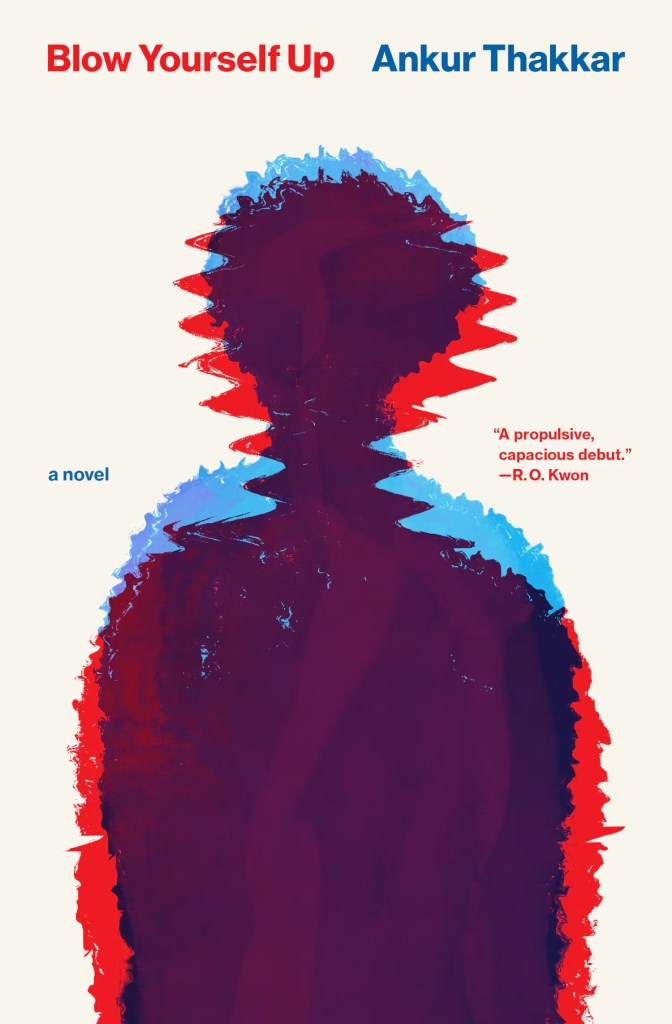
Layoffs have brought that fantasy world to an end. If politics and private equity hadn’t obliterated the beanbag optimism of tech’s twenty-teens, a satirical novel like Ankur Thakkar’s Blow Yourself Up (Triquarterly Books) would have been more than capable of shattering our illusions.
Ankur Thakkar worked in content design at YouTube, Google, and Vine. But a person’s Labor and their Work are two distinct things, and in the case of the latter, Thakkar has amassed considerable international recognition for both his writing and his visual art. His video collage “Representation,” which was featured in the Palais de Tokyo in Paris, juxtaposes video clips with lifeless metadata-style descriptions, escalating to bodycam footage of a Black teenager being murdered by a police officer. The work is a raw, focused commentary on the internet’s flattening of human experience, and Thakkar’s novel pursues the same line of inquiry with the added depth of a tech-insider’s perspective, mining for details, archetypes, textures—“inside baseball”—which he puts to work with a deftness rare in debut novels.
The novel’s co-protagonists are Payal Bajwa and Arjun Vohra—two artistically inclined, first-generation Indian Americans, fallen in and out of love, both of whom work for “Boost,” the novel’s proxy for Vine. Payal and Arjun have entered the company at vastly different levels: Payal, an actor, unexpectedly goes viral after a series of bedroom Bollywood parodies and is backed by the Boost Creator Fund in New York. In Chicago, Arjun, a failed avant-garde musician lamenting the death of Wicker Park, works as a lowly content moderator—a job he fibs his way into by claiming fluency in Hindi.
The whole content moderation team, we learn, are Indian American contractors sub-managing an Indian offshore team so that their department head has time to go surfing in Lake Michigan before work (which, I must admit, is a hobby I had never heard about in the five years I lived in Chicago—it’s a real thing). Content moderation is a matter of pulling snuff films, porn, and animal abuse off the app; it’s grueling and traumatic, yet somehow the best job Arjun’s ever had.
The novel is told in chapters of alternating points of view and thus built on juxtaposition. When we get Payal’s intro to the Boost headquarters, the contrast in perspective is stark:
She followed Jess through the door, and the space opened up into the sky, an enormous glass dome supported by a grid of curving beams. Workstations dotted with silver monitors surrounded a life-sized yacht … There were display refrigerators with every kind of drink, a kombucha tap, commercial espresso machine, and shelves upon shelves of snacks roughly ordered by nutritional impact.
The details are astoundingly real, especially the mashup of optimized in-office nutrition and absurd decoration flourishes. It’s difficult to read descriptions with this level of acuity and not imagine the author, half a decade or so in the past, furiously scribbling observations in a pocket notebook in a glitzy cafe between meetings.
It might be fair to ask, “Why Vine?” in 2026 (or, perhaps, “What is Vine?”), but Thakkar makes the six-second looping video format thematically relevant. One of the co-founders of Boost, Tyrell, delivers tech bro sophistry on the subject near the novel’s halfway point:
You hear storytelling and imagine some Criterion-ass shit. Which isn’t wrong. It’s just traditional. Stories that have beginnings, middles, and endings all work the same way because they necessarily have to end. But Boosts don’t. They loop. And that’s where the art is … On the level of code, they’re eternal.
Tyrell is one of Arjun’s former bandmates, and the statement is a repurposing of their aesthetic creed as musicians, which, we are told, is informed largely by the work of John Cage. The philosophy is frustratingly esoteric as music, but, when applied to video, it ends up spawning an entire medium of short-form content.
The novel’s main “loop” covers Arjun and Payal’s romance over an eight-year timeline. In the braid of alternating chapters, we see each character missing the other and feeling totally unmoored in the digital-first decade. If love is a matter of finding home in another person, Payal and Arjun’s arc back to one another is an odyssey across the internet’s sea of charlatans, myopia, and aggravated politics.
The politics of Blow Yourself Up are straightforwardly critical of Hindu nationalism. Arjun’s Gujarati identity functions as a barometer for India’s politics at home and in the diaspora, especially when juxtaposed with his family. He is, by all accounts, a secularized American leftist. (During a wedding reception, we get this wonderful line: “Arjun often got the sense the next thousand years of Hinduism would persist in bulleted lists. How else would they know what to do?”) At one point, Arjun tries to school his parents on India’s history, which gets particularly tense in a dinner table debate early in the novel:
“Gandhi gave the country away to the Muslims,” Dad said. “India was supposed to be a Hindu country.”
“What about Sikhs?” Arjun said.
“That is a subset of Hinduism,” Mom said.
“Come on, Mom. No, it isn’t.”
“This is what the Bajwas are teaching you?” she asked. “That’s where he is all the time.”
Dad looked at him.
“I’m just friends with—and Mr. Bajwa helped me with my college applications,” Arjun said. “He used to be a professor.”
“And teaching you about India?” Dad asked.
“No, I read books.”
“I don’t need your books to tell me about my own country,” Dad said.
It’s the kind of politically charged interaction that lands exactly as intended both for Thakkar’s Indian and non-Indian readers (most of whom, we can assume, have fought at least one fraught battle of post-2020 dinner table politics).
Overall, Thakkar’s rejoinder to Hindu nationalism is a kind of census taking, painting a panorama of India’s many ethnic relations and identities across the novel’s 200-odd pages. Payal is Sikh and leads the high school’s bhangra team. Arjun’s attempts to join the team are met with suspicion until he proves that he has the chops to play the music (“He wasn’t Punjabi, but he played like he was.”); but, naturally, he’s only made the effort to get close to his crush. Arjun and Payal’s high school courtship functions as a kind of tutorial in Sikh traditions. This becomes relevant in the novel’s climax, when a Sikh prog-punk musician Arjun idolizes is the subject of a viral ethno-political lynching (a callback to Thakkar’s “Representation” video?). Arjun is responsible for scrubbing the video from the Boost app and keeping quiet, but he’s learned enough about injustice to not let that stand.
As a prose stylist, Thakkar is a master of montage. On the novel’s opening page, he introduces the reader to the setting in such a way as to imbue the place with a full historical backdrop in one epic sweep:
The South Asians began near the airport in Queens, flourishing in Jackson Heights until a sister city formed across the river in Jersey City … Each time the South Asians moved, they brought along the same grocery stores, electronics shops, and sari boutiques, but the people changed. Parents passed their businesses to their American-educated children who learned to franchise and, in turn, raised their American-born children in bigger houses so they could study contemporary poetry and compete for work with the hungry doctors, engineers, and MBAs immigrating from the same country their grandparents fled all those years ago.
In a story where characters struggle to navigate the tectonic social shifts of a society ever more online, the histrionic bravado of the narration grounds the reader. The world is changing, people are in motion, and the novel invites the reader to join the journey.
By the book’s jacket copy, Blow Yourself Up is a romance, but I wouldn’t hesitate to call it a novel of ideas. It’s also a version of speculative fiction. It’s a Künstlerroman, too, and offers a critique of the kinds of art and writing native to the internet (there’s even a thinly veiled dig at Rupi Kaur). It’s Pankaj Mishra’s Run and Hide (Picador) meets Calvin Kasulke’s Several People Are Typing (Vintage). It’s a novel that manages to be many things in a small amount of space, not unlike a TikTok or a Vine.
✶✶✶✶

Christian Trevor Lisa likes his words sharp and strange. He wants misshapen words like outdated surgical instruments for the shelves of his brainspace. You can find his work in Hypertext Magazine, Non-stalgia, MASKS Literary Magazine, and other places. He earned an MFA from Columbia College Chicago. When he isn’t writing, you can find him running, reading, rollerblading, or playing air drums with cooking utensils. He writes ad copy for a living in the verdant, tree-tangled city of Atlanta.
✶
Whenever possible, we link book titles to Bookshop.org, an independent bookselling site. As a Bookshop affiliate, Another Chicago Magazine earns a small percentage from qualifying purchases.

