
Review by Sara R. Burnett
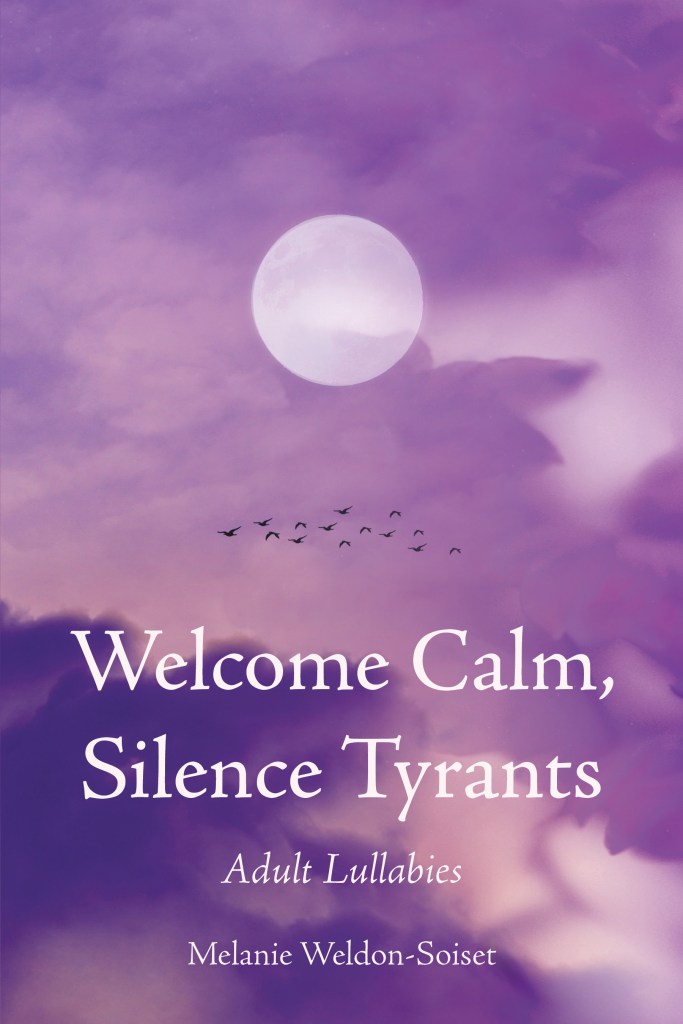
Melanie Weldon-Soiset’s debut poetry collection, Welcome Calm, Silence Tyrants (Shanti Arts Publishing), arrives as a necessary reprieve from the noise, chaos, and uncertainty surrounding our daily lives. The book is ambitious in its scope: a series of lullabies written for adults divided into nine structurally distinct sections—where “Play and Delight” sits right alongside “Sadness, Rage & Taboos.”
The collection works its magic with finesse. Weldon-Soiset achieves this by enlisting the often overlooked but nearly universal mode of the lullaby. Deceptive but alluring blends of sound and song, traditional lullabies promise the deepest sense of intimacy alongside a chilling sense of dread. They often combine adult themes of separation, loss, and poverty with a syncopated, lulling rhythm. In this formally diverse collection, Weldon-Soiset employs lullabies to build containers—eighty-four poems altogether—meant to hold our shared grief, delight, calm, and fear, raking daylit nightmares smoothly against the timeless currents of meter, rhyme, and song.
To get a sense of how Weldon-Soiset weaves heavy societal themes with the buoyant lightness of wordplay, take a look at an excerpt from “Jury Duty.” Written in the traditional ghazal form—a chain of self-contained couplets tied together by a rhyme scheme and a refrain—the poem repeatedly hinges on the word “bias” to examine angles of implicit prejudice:
Juror number 6, you are a middle-
aged white woman. Do you doubt bias?
Sometimes I act out of self-protection,
or out of habit. Sometimes, I spout bias.
When the Bible never describes what Jesus
looks like, does that flout (or shout) bias?
60-minute lunch break, and no Reuben
on site. Ugh, I have a sauerkraut bias.
The speaker reflects on the role of bias in the jury system and is not above extending that gaze onto herself. While the stakes of jury selection are profoundly real, Weldon-Soiset also injects a playfulness into these lines. The Bible that does not describe the historical Jesus—which flouts (or shouts) bias—is followed by a couplet of a missing Reuben sandwich, a sauerkraut bias. Taken together, the poem demonstrates how the collection as a whole disarms and enchants the reader—using rhythmic repetition to look directly at systemic and individual discomfort.
In keeping with the lullaby mode, not all the poems in the collection are social commentary. Many of them delight in wordplay for the sake of delight itself. “A Lullaby Patchwork Quilt,” for example, is a cento composed entirely from lines taken from other cradlesongs. The poem is a bucolic escape into dream and reverie. Similarly, “Love Note from an Heirloom Dictionary” conjures a comforting dreamscape. Written in the form of an abecedarian—a poem where each line begins with a successive letter of the alphabet—“Love Note” glides the reader toward sleep using archaic, obscure words that almost seem like a nonsensical incantation:
Ah, my dear, we’ve reached the twilight hour,
Betweenity. The coals in the fireplace whisper,
Come cloff; relax beside my flames.
Dare to sink into
Easedom, and notice when your body
Finds the soothing rest of focillation. Such comfort!
Go ahead: glad-warble if you like. Glee-dream.
Here you can feel houffy, like flannel pajamas…
These poems feel like auditory sanctuaries lulling the mind to calm and slowness even as other poems in the collection breach that sacred space to startle, soothe, and temper.
Suffering from insomnia herself during COVID lockdown, Weldon-Soiset writes in the introduction that she turned to lullabies as a way to calm her nerves and get to sleep. She was far from alone: According to data from the National Sleep Foundation, roughly forty million Americans experience insomnia annually. What started as an antidote becomes, in her words, a creative “obsession,” for which readers will be profoundly grateful. Weldon-Soiset has delivered a one-of-a-kind collection: one that acknowledges the profound worries and anxieties of our moment while also offering a formal remedy for them. Like a mother singing to a child, these poems cannot stop the toothache or cure the fever or the ailment, but they act like a vital balm to soothe, distract, and wash over the spirit.
Welcome Calm, Silence Tyrants is not a book to experience just once, but a sanctuary to return to many times over.
✶✶✶✶

Sara R. Burnett is the author of Seed Celestial, winner of the Autumn House Press Poetry Prize. She has been published or has forthcoming publications in Barrow Street, Copper Nickel, PANK, RHINO, Southern Humanities Review, and elsewhere. She holds an MFA from the University of Maryland and an MA in English Literature from the University of Vermont. She is the recipient of a 2026 Maryland State Arts Council Artist Grant and scholarships from the Bread Loaf Writers’ Conference. She also writes picture books and curates Poems to Carry You, a biweekly, free Substack of three to five poems to fortify the spirit since the 2014 election. She lives in Maryland with her family.
✶
Whenever possible, we link book titles to Bookshop.org, an independent bookselling site. As a Bookshop affiliate, Another Chicago Magazine earns a small percentage from qualifying purchases.

