
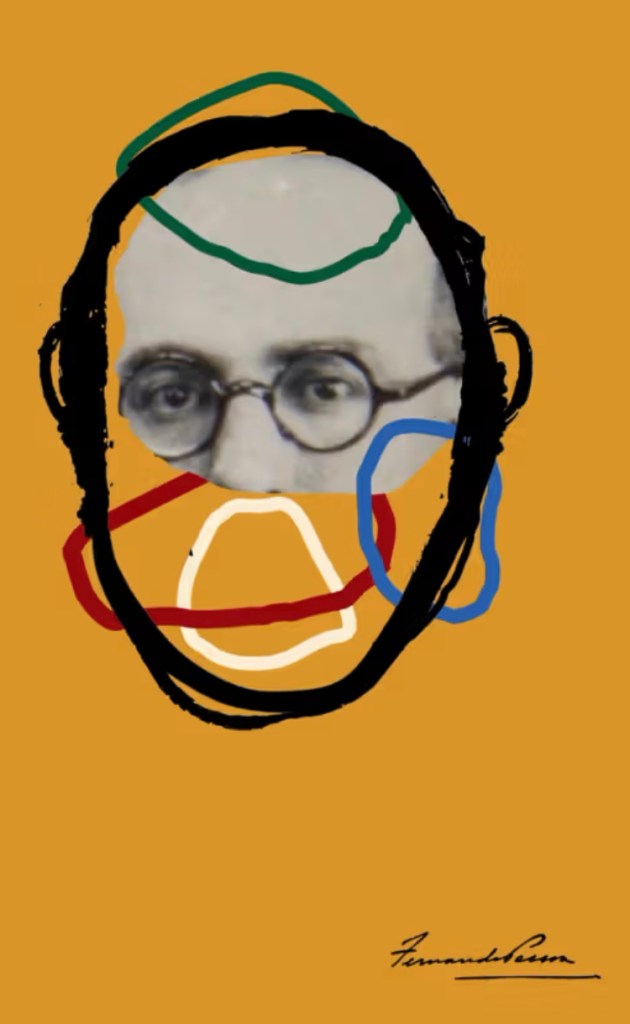
The Complete Works of Ricardo Reis, translated from Portuguese by Margaret Jull Costa and Patricio Ferrari
Review by Matt Martinson
In his “Ars Poetica,” Horace recommends the poet keep their work tucked away for at least nine years before sharing—basically the exact opposite of Kerouac’s “first thought, best thought” approach to writing poems. Horace, the Roman poet who loved a good ode, is suggesting the would-be author take the time not only to edit but also to marinate on the poem’s language and themes, not to rush into publication.
Nearly two thousand years later, Fernando Pessoa took the implications of Horace’s advice to the extreme, famously filling two trunks with thousands of pages of unpublished writings: poetry and various styles of prose, works written by a host of heteronyms, some of whose identities were more established than others, with two fictional authors sometimes sharing different sides of the same piece of paper. It’s what makes Pessoa a continuing source of fascination, a web of meaning and identities and aesthetic choices that will keep scholars busy for decades to come as they dig through piles of handwritten documents whose authors are often vague, sometimes even having their names crossed out and replaced by the moniker of a different heteronym.
In recent years, New Directions has been busy publishing works by some of Pessoa’s more well-established heteronyms: thus far Bernardo Soares, Alberto Caeiro, and Alvaro de Campos. Now, in 2026, we get The Complete Works of Ricardo Reis, translated by Margaret Jull Costa and Patricio Ferrari, two of the aforementioned industrious scholars working their way through the labyrinthine literary universe of Pessoa’s mind.
Ricardo Reis was a doctor and likely born in 1887, though at one point, Pessoa imagined the poet both being born and dying in 1914. Like many Pessoa heteronyms, he was a devoted disciple of Alberto Caeiro, who exists at the top of the metaphorical Pessoa-heteronym org chart. Reis was conservative in most things, including his pro-monarchist stance. In fact, he may have moved to Brazil in order to find more space and freedom to promote his political ends. Reis’ conservatism extended to his writing as well, as he was a classicist and particularly fond of writing odes in the Horatian style.
Horace’s odes tend to be inoffensive, offering tidbits of quotable wisdom without taking any bold stances, and the bibliobibulic, hyper-imaginative Pessoa is able to take on, through Reis, such a voice again and again in The Complete Works. Here, for instance, are two representative stanzas taken from the book’s first poem:
Time passes,
And tells us nothing.
We grow old.
Let us learn, almost
Mischievously,
To feel ourselves leaving.
[…]Sunflowers eternally
Staring at the sun,
We will leave life
Tranquilly, not even
Regretting
Having lived.
The poems are old-fashioned, even for Pessoa’s time, yet retain the lovely thoughtfulness of his Roman precursors, focused as they are on nature, beauty, and living life fully. And like those who came generations before him, Reis’ didacticism is non-offensive, apolitical at best or, at worst, silently supporting the status quo, like the following, excerpted from the book’s third poem:
This man, working his scant field,
Or, grown weary, pausing to gaze
Like a father at his son,
Lives life contentedly.
If you have heard of Pessoa’s famous heteronyms and wondered what it was all about, this should provide some indication of the difference. These poems sound nothing like the flâneur Pessoa or the existentially lost loner Bernardo Soares, of Pessoa’s masterpiece, The Book of Disquiet. And though Reis was a disciple of Caeiro, their poems were nearly diametrically opposed—the former restrained and focused on nature as teacher or guide, the latter a futurist who saw nature as “an end in itself,” as Richard Zenith writes in his biography of Pessoa.
Indeed, Reis sounds almost exactly like the ancient Romans and Greeks whom he admired so much. Poem Three above ends with a comparison of the rich with the gods, saying both just might walk amongst us, in disguise, quietly offering us blessings just as the natural world, “[o]f sky and land and the laughter of wheatfields” blesses us. In other words, be grateful for the rich and powerful, not to mention caesars and gods like Zeus, as they are oh, so good to us.
The translators, Costa and Ferrari, do an excellent job of following the spirit of the poems, putting imagery, tone, and overall purpose over punctuation or exactitude. But it’d be quite easy to see how that last paragraph ends and wonder if this book isn’t a bunch of garbage. I can enjoy reading Virgil’s unquestioning allegiance to Augustus, for instance, because of the massive distance in time between then and now. But to read such lines from Pessoa feels far different.
This would-be issue, though, brings us back to the joy of the heteronymic experience. To read Reis is to read Pessoa’s persona, akin to something like Roberto Bolaño’s Nazi Literature in the Americas, where you get both the story and the story behind the story. Here we have the poems themselves, which are a genuine treat to read, as well as the mysterious, half-finished biography lurking beneath the poems, the questions regarding this author, Reis, with his anachronistic poems and beliefs.
Having finished—and thoroughly enjoyed—the book, I’m left with a wonderfully difficult question: Is this Modernist poetry?
Yes, The Complete Works of Ricardo Reis is Modernist in the same sense that Ezra Pound’s translations are Modernist. Pound approached ancient—and less ancient—works with a modern sensibility, translating in a way that attempted to connect past works with modern languages, much as a poem like “In a Station of the Metro” attempts to parrot the imagistic poetry of ancient China for a modern audience. Reis does something quite similar, borrowing from ancient modes but doing so knowingly, with a self-aware wink directed at the audience. We are, I would argue, meant to enjoy the poems for what they are while knowing they are intentionally old-fashioned, like going to a square dance and having a good time, both genuinely and ironically. After all, here is Reis praising the rich and longing for monarchy and ancient gods as if Marx, Bakunin, Freud, Darwin, not to mention revolutions in France, Russia, the US, etc., hadn’t preceded his work.
However, I would simultaneously argue that The Complete Works of Ricardo Reis is, ultimately, not Modernist poetry but is instead part of a larger novel, one book in a never-ending work of fiction. Much as In Search of Lost Time is a single novel, or Pale Fire, despite its long poem, is a novel, so too are the collected works of Pessoa, creating a universe akin to those found in the collected works of folks like Roberto Bolaño or Antoine Volodine.
The Complete Works of Ricardo Reis ends with Reis’ essays—but not all of them; readers who wish to read the actual complete works of Ricardo Reis are directed by the introduction to go online to the New Directions and Pessoa Plural websites. There’s a certain irony here, and it’s a small gripe I have with the book—it’s an incomplete complete works. However, you don’t have to read much of the essays to get the gist: a) Reis idolizes the work of his fellow Pessoa heteronym, Alberto Caeiro, and b) Reis is nearly Nietzschean in his dislike of the Christianized West, and he very much wants us to return to Greek and Roman beliefs, particularly as concerns aesthetics and the gods. So as much as I want The Complete Works to include Reis’ complete works, I doubt most of us will really miss those extra essays, to say nothing of the fact that more Reis works may show up in the future as scholars continue to make sense of Pessoa’s oeuvre.
Part of me wishes the book had placed at least one of Reis’ essays at the beginning, letting his own words and beliefs set up the collection. However, the placement of these essays, which total only twenty-five of the book’s 266 pages, at the end is part of what makes the text feel like a novel to me, no matter what the editors, publishers, or author(s) originally intended. And, indeed, this is what makes The Complete Works a universal book: One reader may read the lovely collection of poems as a thing in itself; another can read the essays and enjoy a wild philosophy that matches the verve and brio of Pessoa contemporaries like Nietzsche and Cioran; others can read the text much as one might read Nabokov’s Pale Fire; but those whose obsessive reading habits come close to Pessoa’s own can read The Complete Works as part of a larger literary work, the never-ending novel that is slowly becoming the Pessoa Literary Universe. It continues to prove itself to be a profound and worthwhile work, and New Directions’ newest addition is one I highly recommend. The more Pessoas the better!
✶✶✶✶

Matt Martinson is a senior lecturer at Central Washington University and regularly reviews books for Another Chicago Magazine and Heavy Feather Review. His piece “Trout and Trout Remain” was listed as a Notable Essay in The Best American Essays 2024. Check out his Substack to follow his decade-long attempt at reading every book ever published by Dalkey Archive Press.
✶
Whenever possible, we link book titles to Bookshop.org, an independent bookselling site. As a Bookshop affiliate, Another Chicago Magazine earns a small percentage from qualifying purchases.

