
Review by Chloe Lutts Jensen
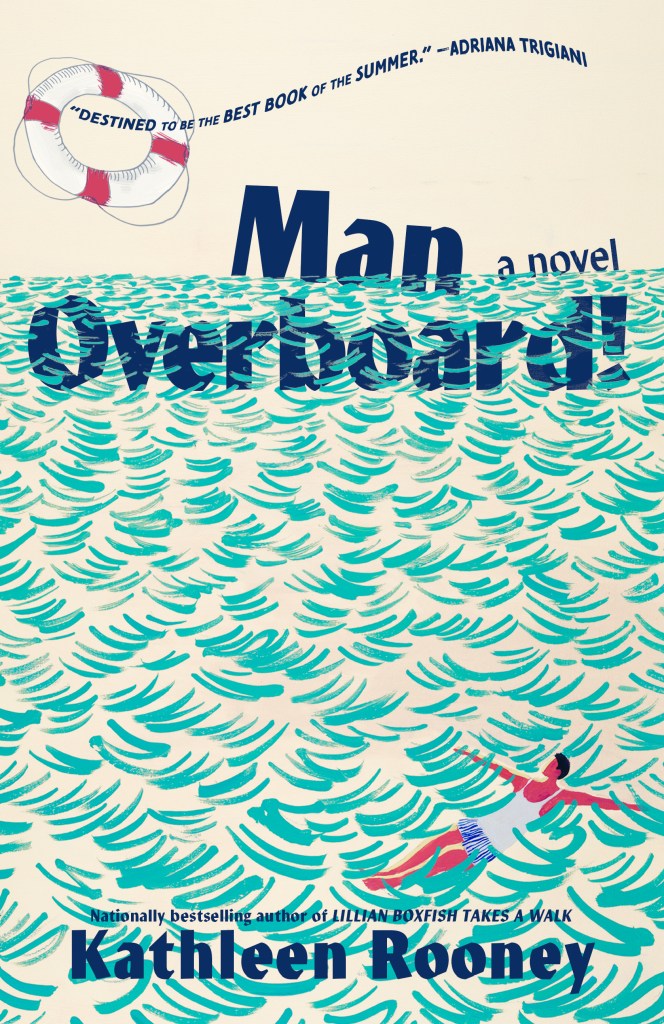
Kathleen Rooney’s Man Overboard! (Gallery Books) is both a quick dip and a deep dive, a focused and efficient novel that tidily alchemizes just under 200 pages of flashbacks and reflections into a final message of interconnectedness. And while the themes are heavy, the delivery is buoyant.
The novel unfolds over just under twenty hours, as Patrick “Kick” Kilpatrick, having somehow become separated from his cruise ship, treads water for his life in the middle of the Gulf of Mexico. Sometime between Thanksgiving eve and Thanksgiving morning, thirty-something Kick went from being a drunk and reluctant passenger on a family vacation to a rapidly sobering and regretful piece of jetsam, adrift sans life jacket or flotation device. At first, he doesn’t remember if he jumped or fell, but as the slap of seawater sharpens his memory, Kick grudgingly confronts the deep despair underlying his outwardly successful life. Under interrogation, Kick finally abandons his insistence that he’s got it all—a car, a job, a condo, and a hot bod—and cops to a debilitating lack of fulfillment. Now he just has to figure out how to find it—if he doesn’t drown first.
Cheeky handling of serious themes is a hallmark of Kathleen Rooney’s works, which include four previous novels as well as multiple books of poetry, an essay collection, and a memoir. Her best-selling Lillian Boxfish Takes a Walk (Picador) also features a reflective, reminiscing protagonist on the move—though in that case, she’s walking the length of Manhattan. Whether writing poetry or prose, Rooney has a talent for leavening weighty existential questions with humorous observation, plenty of unexpected facts, and a pleasant levity of language. Man Overboard! is no exception, and the story is peppered with references to historical shipwrecks, long-distance swimmers, and marine science.
Ultimately, Man Overboard! is about how to live a meaningful life beyond the basics—readers with any psychology background will recognize a strong reliance on Maslow’s Hierarchy. Kick has good looks, good health, a cool job—yet something is missing. He’s looked for it in the Manosphere—admitting that, at some level, he “wanted to be pulled into a supportive posse on my own quest for meaning”—but claims to have found most of their advice fatuous. He’s still unhappy and even more unhappy about being unhappy, describing himself as “sick of the stink of my hopelessness and anger, my self-hate and self-pity.”
He could come off as a sad sack—but Rooney deploys several clever conceits to keep the story from getting bogged down in broody introspection. The most entertaining, easily, is the cast of chatty sea creatures who step in to serve as Kick’s interlocutors, facilitating several chapters of self-administered talk therapy that manage to avoid feeling like navel-gazing, thanks to the sharp and witty voices of the passing sea turtles and hive-mind jellyfish blooms.
The novel is divided into hour-long chapters, creating a tangible sense of both momentum and increasing desperation, and distancing it further from sad solipsism. The structure also helps balance Kick’s free-flowing, associative narration, as he floats from inspirational aphorisms to facts about sea life or paddles in circles around major incidents in his life. The links between Kick’s predicament and his life-to-date are myriad, facilitating a tidal glide between the two. Waves remind him of his grandparents’ waterbed, whitecaps remind him of his grandparents’ horses, faceted sunshine conjures mom’s sapphire necklace, and the prospect of unintentional burial at sea prompts Kick to recall the circumstances surrounding his mother’s disappearance from his life. Yes, absent mom looms large here, and the parallels between her disappearing act and Kick’s own are among the book’s sustaining metaphors.
Marine metaphors also abound, as Rooney invents new ways to describe an identical setting across twenty-one chapters. Figurative but grounded language—“the sea, a rough uncle”—and blunt descriptions—“The sea keeps flinging its wet chaos at me”—capture the impersonal punishment of a choppy ocean without straining Kick’s matter-of-fact voice. Other, more awkward terrestrial metaphors either serve as segues into backstory (“the waves run over themselves like the ants in the ant farm my cousin Leo got me one year”) or highlight the contrast between Kick’s previous Nebraska-based life and present situation (a school of small fish is at one point compared to “confetti at a Huskers’ parade”). Still other comparisons—as when “the ocean shimmies like a YouTube instructor teaching a dance”—let us in on the world and mind of Kick Kilpatrick, who, in his ordinary life, is a personal trainer and physical therapist quick to describe himself as “a perfect physical specimen.”
His vanity and vapidity are among the lesser demons Kick faces down over the course of his ordeal, though it becomes steadily clear that they’re primarily symptoms of—or even coping mechanisms created by—his avoidance of deeper trauma.
Luckily for Kick, twenty hours of alone time in the face of uncertain survival turns out to be just what the doctor ordered to finally address his inner child wound—which is where that parade of talking marine life comes in. Kick seems to have kept most of his marbles for an improbably long time, given the circumstances, when he suddenly encounters a talking whale shark. And she doesn’t just talk: She’s as wise and incisive as a very good therapist.
The whale shark is only the first in a parade of insightful aquatic animals, each of which nudges Kick a little further along his journey toward self-actualization. Rooney doesn’t linger on their illusiveness; they’re here to serve a purpose. Which they do, drolly. It’s a lot more entertaining—and refreshing—to hear a dolphin tell a manchild to “grow the fuck up and be an adult person” than to hear the same advice coming from a psychiatrist, or, even more predictably, the man’s girlfriend. Though, in this case, the marine mammal is only repeating, more bluntly, something Kick’s erstwhile girlfriend has vocalized. Her voice—as Kick remembers it from conversations and one particularly on-the-nose breakup text—surfaces another major theme of the book, which is the discrepancy in the burdens, expectations, and privileges faced by men and by women.
As an example, Kick’s response to the looming threat of death is contrasted with his mother’s reaction to her own possibly fatal cancer diagnosis—which catalyzed a very different reckoning with her own life. Where she was a wife and mother, Kick has remained largely responsibility-free, a passive choice that becomes harder for him to defend the longer he’s interrogated by sentient sea creatures. Kick’s self-centered existence finds additional female foils in his marine biologist sister, Kelly, and recently-ex-girlfriend, Justeen, both exemplars of ambition and intention. All three women’s lives contrast starkly with Kick’s relatively shallow existence, a fact suddenly made literal by his fight to stay on the surface of the fathomless depths.
The book’s title—Man Overboard!—can likewise be read in a new, literal light as the end approaches. Just as he kicked off his waterlogged boxers, newly enlightened Kick sheds the golden shackles of macho manhood, vowing to make a series of life- and relationship-embracing changes—if he survives. Along with his iPhone and most of his clothes, Kick is ready to leave gendered expectations—and a good chunk of his ego—behind in the Gulf. The intended resonance of his resolution is crystal clear: It’s advice to anyone (of any gender) holding their life at arm’s length.
While ultimately unsubtle, it’s good counsel, made all the more palatable by coming from the mouth of a pregnant male seahorse.
✶✶✶✶

Chloe Lutts Jensen is a writer originally from Salem, Massachusetts. Her fiction and book reviews have appeared in Story, Barrelhouse Magazine, and The Colorado Review. She received her MFA from Arizona State University, where she was the social media manager for Hayden’s Ferry Review, and currently teaches at Oberlin College. Insta @cljensen_
✶
Whenever possible, we link book titles to Bookshop.org, an independent bookselling site. As a Bookshop affiliate, Another Chicago Magazine earns a small percentage from qualifying purchases.

