
I am the son of a snowstorm, one who wanders the earth on the wings of eternal wind on winter nights
—Pak Jeong-De
I.
After a long hospitalization, my father returns home to die on January 2025’s coldest day—the Thursday after Orthodox Christmas. The packed snow on the steep, gravel driveway leading to his house is a slick, icy sheet. The ambulance transporting him cannot make the driveway’s incline, and the drivers have coordinated with the Mathias, West Virginia fire and rescue department for an adequate ambulance to meet them. Yesterday, when I visited my father at the hospital, as he drifted into sleep, he told me, “Nikola, you and I have so many more adventures to come.” Now, as I walk carefully towards him, I think how, of course, this is only appropriate: My father’s last adventure finds him lying on a hospital gurney inside an unmovable ambulance, surrounded by snow.
II.
As a child, I walked with my father through Pennsylvania’s frozen, snowy woods and fields. I, tired and annoyed, would whine in Ukrainian, “Tato, it’s cold.” He would laugh, and we would trudge onward, watching snow fall from high branches or following the wind’s sidewinding trails on top of a snow field’s wind-whipped crust. He would counter my whining with, “Yes, it is. Soon it will be spring.” My father’s words did not warm my nose or my fingers. By the time we returned to his pickup truck—despite the knit hat and scarves and gloves and heavy winter jacket and pants in which he had dressed me—I wanted nothing more than to return home and to sit beside my grandmother on her bed, where the massive heat from our home’s coal furnace rose through the heavy grate in the floor.
II.
When I open the ambulance’s side door, my father turns his head. I tug my toboggan tighter as I climb in beside him. As I close the door, he protests.
“No, don’t close it. Leave it open,” he mutters.
I tell him, in Ukrainian, “Tato, it’s cold.”
“Do as I say,” he commands, pointing to the ambulance’s ceiling, so I leave the door ajar, and the frigid air seeps inside. My half-brother stands outside, talking to the ambulance drivers. He sees the open door and comes to close it, but before he can, I stop him.
“No, don’t. Tato wants it open,” I say. My half-brother shrugs, walks away, and I tuck more blankets around my father, who pushes the blankets away.
“I want out of here,” he tells me, pointing towards the snowy bank. Pine limbs, weighted by tiny icicles, droop. My father fusses, keeps pointing outside, keeps demanding that I leave the ambulance door open, and when I close it, he turns away from me.
“You’re not my friend anymore,” he says. I know he does not mean what he says.
“I’m not? Why?” I ask.
“Because you didn’t do as I told you,” he answers.
IV.
In 2022, on the first morning of Russia’s full-scale invasion of Ukraine, I found my father standing in his kitchen, crying. Throughout my life, despite the close relationship I had always had with him, I rarely saw him cry. As he stood at the kitchen sink, his head in his hands, he said, “Nikola, I’m so glad you went home when you did.” By then, it had been three years since I had last stepped foot on Ukrainian soil. My father wiped tears from his cheeks and poured his coffee.
“I won’t live to see the end of this war,” he said, gazing out the kitchen window and into the woods outside.
V.
My father died only two hours after an adequate transport finally arrived, and a team of local paramedics eased him onto a thin-mattressed hospice bed from the clunky gurney. His time: 1605. I was holding him. Only minutes before, surrounded by his four beloved cats, he had looked at me and said, “I love you. I am so proud of you. You’re a dandy.” Before the funeral director arrived, I washed and dressed him—just as he had requested years ago, when he also made a different plea: “When I die, spread my ashes in Ukraine. I want to return to the homeland.”
VI.
Nearly ten months after my father’s death, via Instagram Reels and messages from friends and family, I watch the season’s first snowfall in Lviv. I think of my father, who, each year when winter reached our family’s beloved Ukraine, would say, “Isn’t it so beautiful? I’m sure it’s cold.” The snow covers streets and sidewalks. In the Carpathians, it whitens trees and fields and bends the branches of oaks and beeches and pines. Because of the war, I have not been able to return to Ukraine and spread my father’s ashes, and yet, as snow falls in Lviv and the mountains, I know he has somehow found his way home.
✶✶✶✶
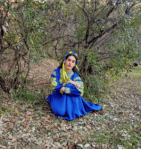
Nicole Yurcaba (Нікола Юрцаба) is a Ukrainian American of Hutsul/Lemko origin. Her poems and reviews have appeared in Appalachian Review, Atlanta Review, Poetry Ireland Review, The Belfast Review, Abridged, Seneca Review, New Eastern Europe, Euromaidan Press, Chytomo, and The New Voice of Ukraine. Nicole holds an MFA in Writing from Lindenwood University, teaches poetry workshops for Southern New Hampshire University, and is the Humanities Coordinator at Blue Ridge Community and Technical College. She also serves as a guest book reviewer for New Eastern Europe, Tupelo Quarterly, Colorado Review, and Southern Review of Books. She is the author of The Pale Goth, Have Your Eyes, Hutsulka, and Not Sleeping in Newark.
✶
Whenever possible, we link book titles to Bookshop, an independent bookselling site. As a Bookshop affiliate, Another Chicago Magazine earns a small percentage from qualifying purchases.

