
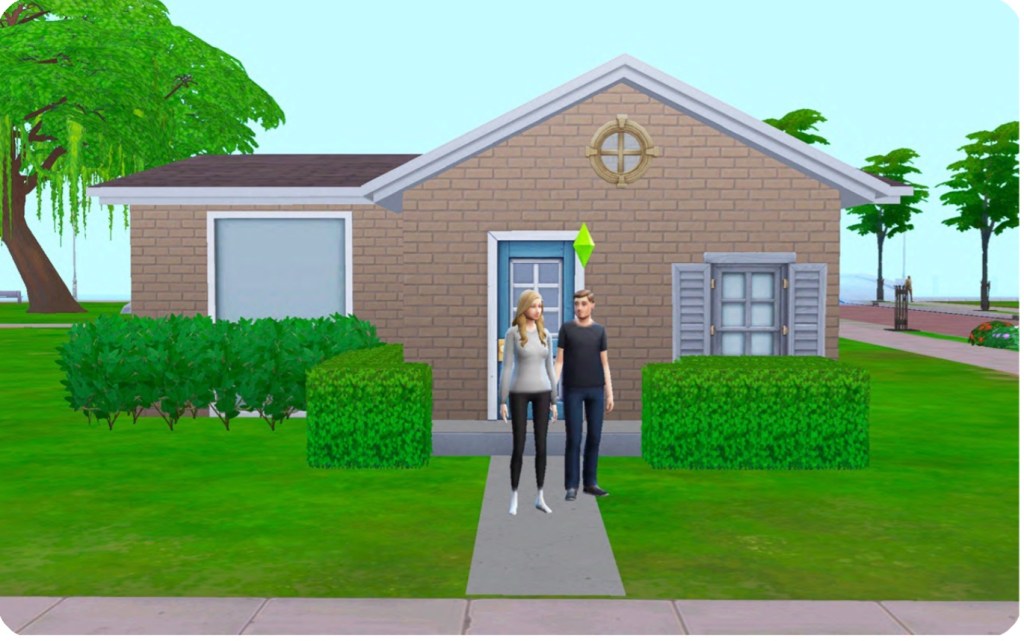
I lean back against the pillow, a cannabis gummy in my bloodstream, Canadian whiskey on the nightstand. My laptop’s on another pillow that’s atop my legs. It’s almost three in the morning. I’m playing The Sims again.

“You play really weird.”
My daughter, Elizabeth, once told me this. She’s a fan of the game herself and follows various Sims-related YouTube channels.
I probably do play really weird. And because The Sims is, in a way, both a simulation of everyday drudgery and also the vast, wild scope of a lifetime’s arc, what she’s saying—without knowing it or meaning to—is that I live my actual life in a weird way, too.
On June 9, the day after my forty-fifth birthday—during the deepest, most pandemic-laden troughs of 2020—my then-wife unexpectedly left work in the middle of the day, pulled into our driveway, and threw open the door to my home office, just as I was logging onto a Zoom session with my therapist. We needed to talk, she said.
I didn’t know it, but our marriage of twenty-five years was blowing up. She told me she was having doubts. That she’d met someone else. The next day—after she’d slept on it and talked to people close to her—she asked for a divorce.
So to survive my strange new existence, the weird ways in which I’d played The Sims became my blueprints.
The Sims is a life simulator. You make your character—your Sim—and drop into a virtual neighborhood, where you move into an existing house or build a new one that you furnish and design in countless ways. You choose career tracks. You level-up skills. You socialize with neighbors. And you engage in myriad other activities, ranging from the prosaic, like washing dishes or jogging, to the absurd, like hanging with aliens or seducing the Grim Reaper.
The gameplay, art style, and music make for a bouncy, joyful world that’s part midcentury American Dream and part Adult Swim. But for all of its brightness, humor, and acclaim (it’s one of the most successful video game franchises in history with over 200 million sales), The Sims was born out of personal upheaval. Born out of a need to start over.
After losing his home and nearly all his possessions in the 1991 Oakland firestorm, game-design icon Will Wright suddenly had to, as he said, “reacquire a life.” He was forced to reflect on the idea of happiness, on Maslow’s hierarchy of needs. “Rarely do you do that in your real life. When something like this happens, you get a big picture. Where do I want to live? What sort of things do I need to buy? You see your life almost as a project in process.”¹
For decades, I’ve viewed my own life—rigorously designed around impossible-to-achieve daily to-do lists—as a project in process. And for decades, I’ve been playing The Sims, usually for long stretches followed by months or even years without playing it at all. But when I play, I always do so the same way.
“Really weird,” according to my daughter.
The Sims is a sandbox game, meaning users have tremendous freedom as to how they live in its simulated world. So I guess it makes sense that—given its traumatic origins—all my time spent playing in that sandbox would help me, like Will Wright, reacquire a life.
Here’s how I play:
First, I make my Sim, of course. And just like every other game where I’ve created a character (whether my head coach in Madden, my wrestler in WWE 2K, or my farmer in Stardew Valley), I essentially make myself. Sim Adam is a friendly looking guy. He wants people to like him. And his sartorial choices have changed little over the decades. Jeans or gray chinos. Quarter-zip sweater. Black Oxfords.
Casual professor. Dad chic.
If at any point it’s unclear whether I’m talking about Sim Adam or Real Adam, just know that we share the exact DNA. There is therapy in this.
Both Adams have changed over the decades. Although a humbling experience, I’ve made the necessary adjustments, morphing my slim, twenty-something avatar into the current graying and paunchy version of my digital self.
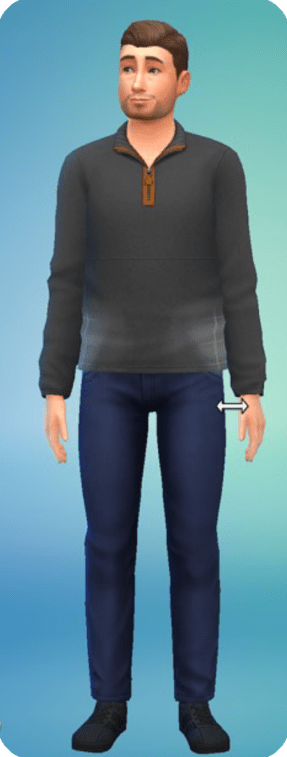
It’s not a great likeness. I’d kill for that hairline. And the chiseled jaw should be more of a double chin. There’s an art to refining the in-game physical traits so that they mimic real life, but I have neither the skill nor patience to pull that off. Where I excel instead is in creating my Sim’s characteristics, aspirations, and personality traits.
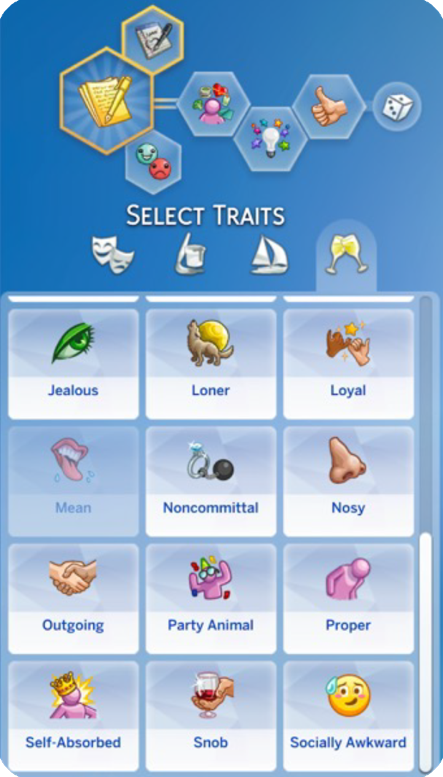
Reader, I was made for this. Take fifteen years of therapy plus the writer’s knack for introspection and pile on all the clichés of the recent divorcé plunging into self-help: Headspace, Noom, interior decorating, wellness journals, Eckhart Tolle, Yoga with Adriene, Alan Watts lectures, cringe Instagram posts, long walks in the new neighborhood, a self-curated Spotify playlist of confidence-boosting anthems, and podcasts. So many fucking podcasts.
Sim Adam aspires to become a bestselling author. He likes funny and cerebral people but not those who are argumentative. He likes compliments and deep thoughts but dislikes small talk. He finds pleasure in gardening and cooking but none in rock climbing and fishing.
And in the immediate aftermath of the divorce, Real Adam understood that if ever there were a time to start again—to remake himself—it was now. Among friends, I took to calling my new experience Life 2.0. Like a software update.
Like a game.
Here’s how my daughter, Elizabeth, plays:
Now twenty, she mostly focuses on creating and customizing her characters. “I have so many mods.” She concentrates on storylines, making a family and controlling all of its members. “But then I feel bad because I get tired of the parents when the kid becomes a teen, and then I just want to play as a teen because that’s more fun.”
Elizabeth started playing around age ten, with The Sims 3. “When I was younger, I used to do, like, the Hunger Games thing where you’d see how long they can last.” She laughs. “I’d have them all in their own rooms and then I’d put one plate of food out.”
“And then the others would just die?” I ask.
“Yes,” she says, laughing again.
“Oh my god…”
Elizabeth’s at the age when nostalgia first creeps up on a person. She’s suddenly an adult missing childhood things. She’s aging up, navigating new emotions.
The famed symbol of the Sims franchise is the plumbob, a shape that most of us would probably describe as a gem or crystal. It hovers and glows above the head of our playable Sim. By its color, the plumbob reveals what we so often fail to interpret in reality: an honest appraisal of our every emotion.
On the packaging, loading screen, and marketing materials, the plumbob is the deep green of happiness. The game is meant to be fun and joyful, after all. And when we begin the game, the plumbob above our character is this same green. Our Sim’s dreams and opportunities unfurl before them. With this fresh start, anything is possible.
That is, until our Sim grows hungry, feels bored, or needs a bathroom. Or when the baby keeps crying in the middle of the night. Then our plumbob lightens and turns yellow.
And because life is life—even in virtual life—there are bad days. Tough stretches. Times when plumbobs go orange. Our Sims get poor grades. Lose their jobs. Get in huge shouting matches with the people they love.
Sometimes, the pain is deeper and wider, and our Sim tumbles into a profound sadness. They grieve a parent’s death. They fall short of the goals they’d set in their youth. They grow older and more distant from people they’d loved.
And their plumbobs glow urgently, dreadfully red.
Here’s how my friend, Evie, played:
Evie was nine when their older brother first showed them the game. And as a young child of a recent divorce, Evie was understandably drawn to all the possibilities it provided for conjuring up a household. A home.
“I secretly made my entire family. Living in the same house. I just liked the little tasks, like my mom in the kitchen making food and stuff. It was all of my family together: my brother and me and my dad and my mom.”
The comfort of seeing the most everyday acts—meals, heading to school, going to sleep and waking up and the whole family there, intact—brought incredible comfort to Evie. And of course it did. There are probably a million children of divorce out there who experimented with the game in this way. If my daughter was nine when her mom and I had divorced, she likely would have done the same.
“So, one time I was just playing,” says Evie, “and I had my mom doing something in the kitchen, and all of a sudden there was a house fire. And I didn’t know what to do. I’m not very good at video games. So, I’m trying to figure it out. And then she dies. My mom dies in The Sims. You know, like, the Grim Reaper comes? And I just got out of there and went to my room and I was just, like, freaked. I had just killed my mom in this comfort space that I had created. I think there was a level of ‘I’m in control of this situation.’ And then when that happened, I thought, Is my mom actually going to die in a house fire?”
Evie didn’t play the game again for nearly five years.
Sometime in 2000, a few months after the original game debuted, my ex-wife and I first experienced its addictive pull. She rarely played or expressed interest in video games over our twenty-five years of marriage, but I think the home renovation aspects drew her in. Whatever it was, we both got so hooked that we needed to set a kitchen timer to ring every thirty minutes, meaning whoever was playing had to save their game, stand up from the Gateway computer, and make way for the other.
What I remember most was how we both marveled at the time suck, how fast each half hour flew. “No way that was thirty minutes!” we’d say, eyes large and glassy from total Sims immersion.
As I get older, I find the rapid passage of time to be one of life’s greatest wonders and most acute heartbreaks. How did Elizabeth just go from preschool to sorority house? How did my grandma’s Alzheimer’s become my mom’s Alzheimer’s? How did a skinny, twenty-year-old me in a tuxedo—too young to drink at his own wedding—become the middle-aged husk in the bathroom mirror, alone for the first time in his life?
You can speed up time in The Sims, from normal to fast to ultra. For those moments when the game’s no fun.
The divorce was one of those out-of-the-blue, never-saw-it-coming shocks. From my perspective, there was no buildup to it. No recent arguments. I hadn’t suspected there was someone else in the picture. But maybe I should have seen it coming.
The pandemic accelerated the inevitable. My ex-wife and I had been living separate lives under the same roof for years, closest and most engaged with one another when co-parenting. But when Elizabeth turned sixteen, she got her license and gained a new level of independence.
During a family dinner, shortly before the pandemic, Elizabeth left to hang out with friends. My ex-wife and I ate in silence across from each other, without our daughter as the fulcrum of our conversation. And I said to her, “Is this what the rest of our lives looks like?”
In the immediate aftermath of the divorce, the present and future felt unfathomably brutal. Mere minutes and hours felt crushing. To endure years of this? Impossible. I wanted to go to sleep and wake up with those years having passed without my having to endure them. Leapfrog the intensity of pain and all the awful changes and transitions Life 2.0 required. Live in fast speed. Ultra speed.
Friends and acquaintances who’d survived their own divorces would reach out and say things like, “The only way out is through.”
And I wanted to throttle them.
Because I couldn’t get through this. I needed to escape. Hence: whiskey and gummies.
Hence: The Sims.
In the game, you can zoom out to see your house from a bird’s-eye view. And I could imagine doing the same with my new, real-life house—escaping the pain of the present to obtain some lofty perspective. Zooming out. Rising higher. Seeing the entire world and my tiny place in it.
Eight billion lives, just trying to have their needs met.
When I play, I always begin with just one household member: Sim Adam. He has no relationships. No children. Not even any pets to start.
And he has very little by way of cash. Most players want to kick off their game by moving into a big house furnished with fun, high-end items: luxury bathtub, futuristic fridge, Starcruiser X Jungle Gym. So they use cheat codes like “motherlode” to amass instant riches. But for whatever psychological reason—my Catholic upbringing? the American bootstrap myth?—I avoid the cheats, start from the bottom, and work my way up.
Sim Adam lives in a one-bedroom starter house, sleeps on an uncomfortable bed, and decorates his surroundings with modest possessions that reflect the very modest number in his bank account. He also starts on the lowest career-ladder rung, leveling up skills and gaining promotions, slowly accumulating wealth and prestige through an honest day’s work.
In the game, I find a strange pleasure in this early, Spartan existence. Sim Adam’s life is simple and—by my own strange standards—“perfect.” He wakes and immediately makes his bed. Then he showers. Then he eats breakfast, cleaning up after himself. Finally, it’s time for work, where he will greet the workplace refreshed with an emerald-green plumbob. He has mastered daily routine in ways that Real Adam admires and, frankly, envies. I closely monitor my Sim’s needs: sleep and food and socialization. His hygiene is always great. He finds time to exercise and read for pleasure. He learns guitar.
I escape my real-life to-do list by checking off a virtual to-do list. And… okay. I see where Elizabeth’s coming from.
It’s pretty weird.
I imagine most players would also find this style of play incredibly boring. I imagine the whole point of the game for most is to experience things that real life can’t provide. Make your own Hunger Games. Make your broken family whole. I suppose virtually living only for routine, predictability, and slow-but-steady growth sounds boring at best and kinda troubling at worst. Sim Adam’s life is simple. Austere, even. Probably reclusive.
So what does this say about me and my failed marriage?
After the initial storms of anger and betrayal, I began examining the divorce in uncomfortable ways, wading into obvious introspections like What could I have done better? and Which parts were my fault? As I’ve said, I’d grown comfortable living a separate life under the same roof as a spouse. I’d enjoyed having the house to myself before she’d return home from work. In the evenings, I’d often close the door and spend hours alone gaming in my home office. And I’ve always found pleasure in solo travel when conducting research or attending a conference. I’d often fantasized about having my own space, a house I could make completely mine, living however I wished. I’d craved—more than I’d ever admitted—order and control.
When Sim Adam does get married and have a child (usually just one child, because more than that feels overwhelming, and Real Adam agrees, having happily raised an only child), I tend to let the AI control the other members of the family. This leads to my Sim child staying up all night and going to school exhausted, or my Sim wife forgetting to take a bathroom break and wetting herself and the kitchen floor. But I simply don’t want to deal with my own tasks while having to worry about their tasks, too.
Which… sounds sort of bad as I reread it.
Yet all of this means that, after the divorce, I should have immediately reveled in my new existence. Freedom! I could finally live just the way I wanted. I could finally live like my sim.
Instead, I experienced the deepest fear, grief, and despair of my life. It didn’t feel like “getting to be alone.” It felt, instead, like I’m alone, I’m all alone.
We’d married very young, so I’d essentially gone right from the comforts of my childhood home to the stability of a partner. I guess I couldn’t conceive of existing untethered, as an individual. Even now, I don’t fully understand the intensity of this anguish. But my logic in the moment was that having a partner meant that at any given moment, even if we were not physically together, that other person might be thinking about me, and by them thinking about me, my existence was somehow more real or more valid. Thus, in the early aftermath of the divorce, I would sometimes dwell on how No one in the world is thinking about me right now.
Of course, having a partner can make this just as true. And having no partner can still mean plenty of others are holding you in their thoughts. But my fear overwhelmed all logic.
And again, this was during the pre-vaccine autumn of 2020. We wore masks. Gathering indoors was a problem. I taught all my classes via Zoom, desperate for students to simply turn on their cameras, to give me any real sense of social connection.
I cried daily—and deeply—for months. Then again on and off for a few years. The sobbing would rush over me in an instant. Sometimes, just the act of sitting down across from my therapist would trigger a Pavlovian response. I cried seas of tears. I cried like I hadn’t since I was a young child, with an intensity and frequency that began to scare me. It was like I’d tapped some deep aquifer of the heart—the tears always replenished. There was no bottom.
Is this shameful, both the crying and the confession? In this age of renewed American hypermasculinity, what could be worse?
How about being a middle-aged man who plays The Sims?
Of the ten million active players of The Sims 4, 60% of them are women between the ages of 18 and 24, like my daughter.² At its inception, the game was even described as a virtual dollhouse.
So, what am I doing here? How is this helping? When do I turn a corner and make progress in real life instead of just escaping from it?
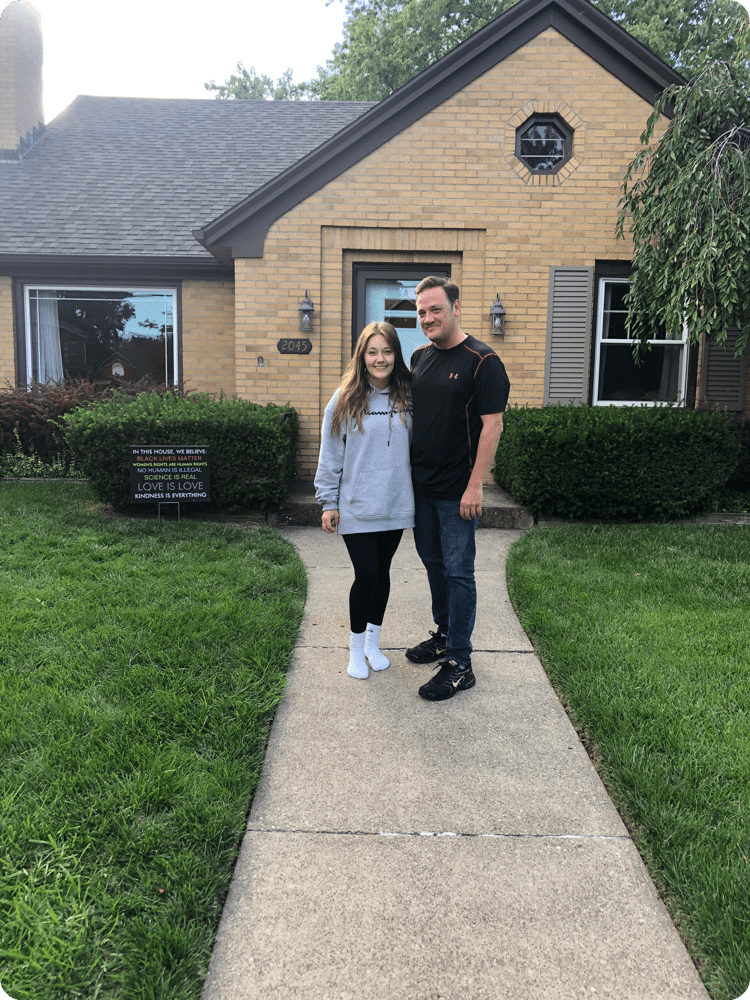
On my Instagram you’ll find a photo from September 19, 2020. It’s a day I still mentally mark as an important anniversary in my life, when Elizabeth and I (she would split time equally between parents) moved into our new house. Several friends, family members, and colleagues helped us lug furniture to and from a U-Haul to get us settled.
As the primary work concluded and people started heading home that day, someone took a photo of Elizabeth and me outside our 1950 brick Cape Cod. We’re smiling. I have my arm around her. I’m physically and emotionally clutching her tight. In that moment, I’m proud and relieved to have bought a house by myself. But just under the surface runs a current of panic and perpetual dread. Because I knew Elizabeth’s other house was larger. Her bedroom there was nicer. She had her own bathroom right outside her door. Over there, she lived just three minutes from her high school, while over here she’d have to commute a half hour each way through downtown traffic.
I wouldn’t cry that day until later, when I’d go back to Elizabeth’s other house one last time to pick up my beloved cat, Benny.
But that photo from September 19, 2020, brought me comfort and joy then and still does now. It captures a pivotal moment—the true beginning of Life 2.0.
And, looking at it now, I’m struck by something else: the way it resembles the start of a fresh game, when your sims first arrive at their own new home.
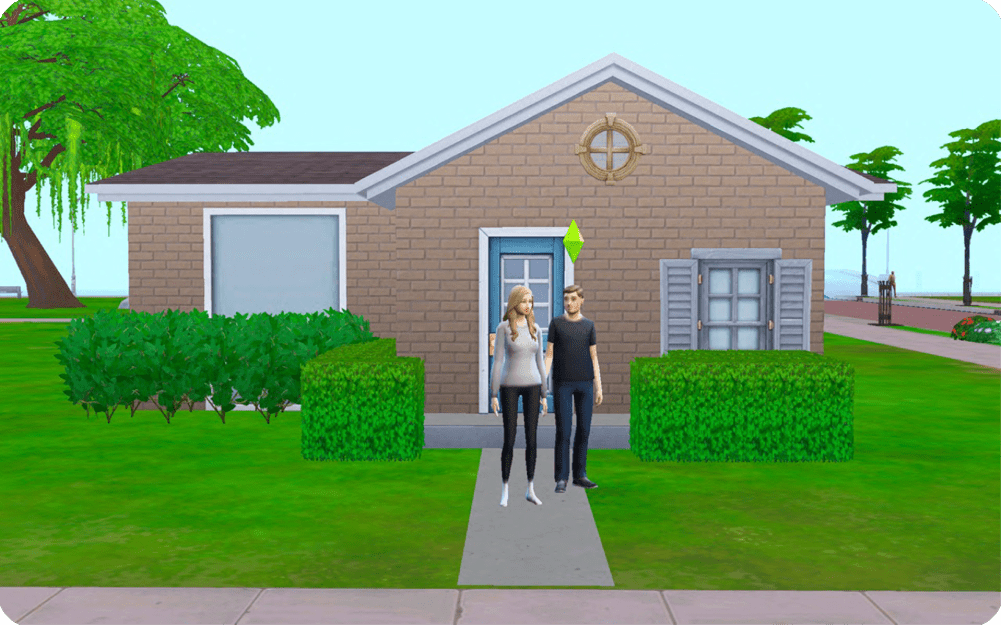
I wanted the new house to be a place of comfort and refuge for both Elizabeth and me, and for our relationship to remain as strong as it had been prior to the divorce. To make things homey, I’d light candles in the living room and have upbeat music playing. For Covid Thanksgiving we got turkey takeout from a local restaurant and FaceTimed with family. I tried making board games a thing for us, and though we played Kingdomino quite a bit, we didn’t connect with other games and eventually put them away. Jigsaw puzzles went unfinished. I persuaded her to watch some shows with me: Billy on the Street, The Umbrella Academy, WandaVision. She kindly obliged, but I worried that she sensed my terrible loneliness and was only taking pity on me.
I thought about Lorrie Moore’s “The Kids Guide to Divorce,” narrated from the point of view of a daughter spending time with her newly divorced mom as they watched old movies and ate popcorn and goofed around with each other. “When the popcorn is all gone, yawn. Say: I’m going to bed now. Your mother will look disappointed, but she’ll say, okay honey.” And then the mother sheepishly inquires how things are going at the other parent’s house.
How often, in that first post-divorce year, did I put my daughter through those uncomfortable emotions? How often did I make her feel guilty, as if she were responsible for my own?
Today’s Monday. She’ll be coming over this afternoon and spending five days with me before returning to her sorority house for her junior year of college. The school is only a half hour away; I can theoretically see her any time. But the busyness of life will happen to both of us and a month will easily slip past without that happening. Life will seem to move at ultra speed.
Fortunately, I’ve gotten better at giving her space. Tears no longer surface when she leaves for a week—or a semester—as they did in those early days of the divorce. And I’ve stopped clinging and clutching, because—as in the game—I only control myself. She has her own wants, needs, and whims. May she forever level up.
EA released The Sims 2 in 2004, and what I remember most from when I first played it was the grilled cheese.
The leap in both visuals and gameplay from the first edition of the game were significant. While Sim Adam got comfortable in his new home (because, even twenty years ago, I was playing the game this way), I had him make a grilled cheese sandwich. I remember zooming in as far as I could—zooming in on the stove and the frying pan—and marveling at the detail of the grilled cheese sandwich. What graphics. So lifelike.
Grilled cheese is one of the first recipes your Sim can make. Even before they’ve accrued a single level in the cooking skill, they can at least attempt a grilled cheese. As in real life, the first attempts often lead to burnt, blackened meals that the Sims find unappetizing.
As he settled into his new home in the fall of 2020, Real Adam was reassessing every part of his life. And I came to the awful discovery that I had no real hobbies. The things I did that others would consider hobbies (like reading, writing, and running) were all things I did because I felt I had to do them.
And the things I did for fun—like playing The Sims or watching Bob’s Burgers with a drink in hand—weren’t activities I was comfortable labeling as “hobbies.”
So, soon after moving into my new house, I decided on two new activities for myself: I started a vegetable garden, and I got more serious about cooking. With cooking, I trained myself on fundamentals while also experimenting with new recipes. Often that meant attempting, over and over, to perfect one simple dish. I made omelet after omelet, trying to get each just right. I did the same with hashbrowns, poached eggs, and pizza crust and am still not happy with any of them.
And, yes, grilled cheese was something I’d been making since I was a teenager, but I’d never tried to make it really well. Never used proper bread, like good Texas toast. Never used the right cheeses or blend of cheeses. Never experimented with mayo instead of butter. But now I did. And in time, like Sim Adam in his Sim kitchen, I began to level up.
Flash forward to when Elizabeth—then a sophomore in college—moved out of her parents’ two houses and began living on her own for the first time. One day, out of the blue, she sent me a text: a photo of a perfect grilled cheese sandwich and the words, sims level one cooking skill.
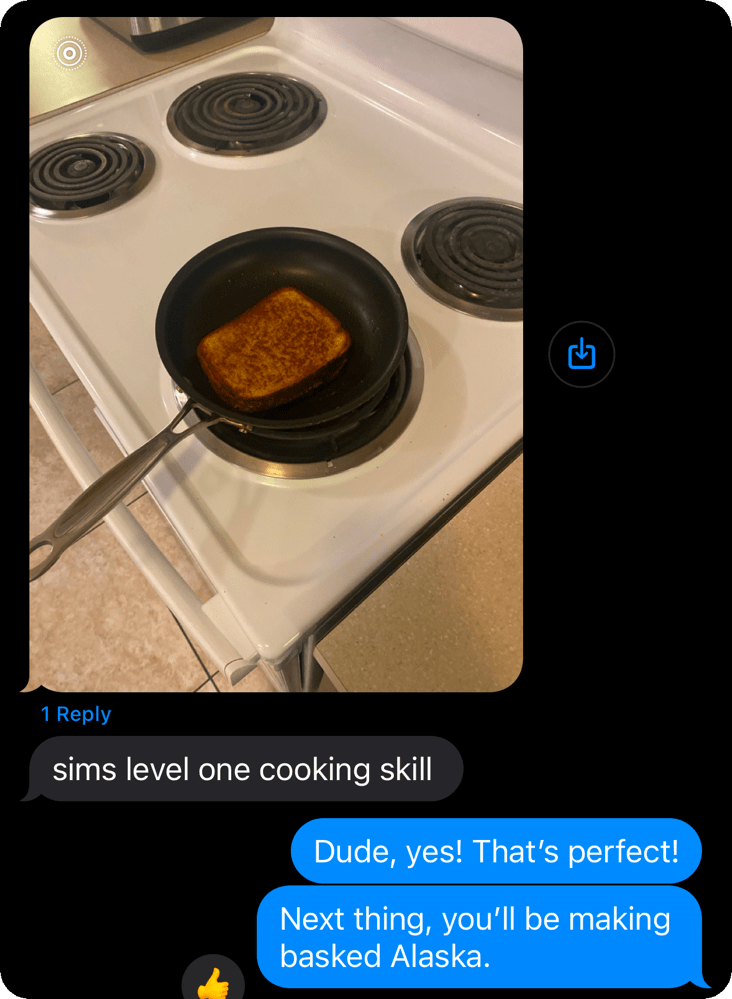
She was making progress, accruing skills for her Life 1.0.
Like most fans, Elizabeth’s eager for an eventual Sims 5. But as of this writing, EA remains focused on where it really makes its money: expansion packs.
High School Years. Discover University. Get to Work. City Living.
And so on. Expansions provide new furniture and designs, new clothing options, new objects and settings and activities.
But where is Sims: Sudden Solitary Living? Why no Sims: Marriage Explosion or Sims: Pandemic Divorce? They could come with an array of flannel pajama pants that your Sim will wear all day. There might be increased insomnia options. Quicker weight gain. Your Sim child could disappear for a week at a time to live at another house. Your Sim could go into town to sign papers with your Sim lawyer. Make social connections with other Sims whom they barely know, but who share the experience of having gone through a divorce.
How about Sims: Dating in Your Forties? Go shopping for age-inappropriate fashions! Put your middle-aged Sim in ripped jeans! Now your Sim can do anything they want! They’ve broken free from the Sim shackles of their past! All it takes is for them to get out of bed before noon. To take a shower, for fuck’s sake.
To stop. Ordering. So. Much. Pizza.
You’ve done it! You’ve arranged your Sim’s living room with midcentury modern furniture that earns them praise from pitying acquaintances on social media. Your Sim’s plumbob climbs—just barely—from orange to a dim yellow, like an old basement lightbulb flickering in the gloom.
It can eviscerate you.
It took me a while to understand that, at its root, divorce is grief. It’s grief for the death of a twenty-five-year marriage. It’s grief for the loss of in-laws who were like your second parents. It’s grief for the enormous amount of time you lose with your child. It’s grief for the end of all the memories and small rituals and inside jokes that you shared with a partner over a quarter of a century. It’s grief over the loss of the person you once were.
And it’s taken me a few years and an inordinate amount of time with my wonderful therapist to untangle most of it. In the meantime, I’d developed habits—both healthy and unhealthy—to cope with the pain at its most acute.
There are no therapists in The Sims, nobody you can sit across from to reveal all of your hurt and fear, shame and gloom. There are no recreational drugs, and alcohol provides just a brief boost of fun before making your Sim have to pee.
When I played the game in the early days of the divorce, what I found most poignant was how Sims cope with grief. Your Sim can call a Sadness Hotline, where they’ll speak to someone on the phone, alleviating some of their despair.
They can also cry. Although Sims will often automatically cry right after a friend or family member dies, there’s another option called “cry it out” where—depending on the Sim’s personality and circumstances—the player may deliberately select to have their character go under the covers of their bed and sob. There’s a therapeutic intentionality to it. This was especially true at those times when I numbly played at three in the morning. I’d click on Sim Adam, and he would cry it out, and his mood meter would go up a little bit.
When I cried in real life, something similar occurred. Afterward, there was space—a gap between me and the sharpest edges of the pain. I could live within this gap. It would be uncomfortable, but I could survive. And with each month and year, the gap would grow larger. I could live and move without brushing against the sharp edges as often.
Eventually, there was room within for two people.
I had not been on a first date since I was seventeen—since I had literally been a child. The prospect of meeting new women—flirting with them, dating them, sleeping with them—was equal parts thrilling and terrifying.
And again, this was late-2020 and early-2021. Peak Covid. Pre-vaccine. Socializing even within our inner circles was a mess. Connecting with strangers on dating apps and then trying to meet amid the stress and uncertainty of social distancing, mask mandates, and restaurants at limited capacity made it all an even greater mindfuck than what newly divorced Adam would have gone through had the world not been on fire.
Now, you may be wondering, was I bad at dating during this time?
Oh, reader. Oh heavens, yes.
Believe me when I tell you that the noxious cocktail of anxiety, neediness, terror, isolation, lust, doubt, and grief swirled through me for months. Pity the poor women I met at this time, who had no idea what a cacophonous mess roiled just underneath the surface of this dude they’d met on Hinge.
Because for all the ways in which The Sims had prepared me for other areas of my newly single life, the game’s idea of romance is probably its most fascinating and delusional. All relationships in the game begin with basic interactions—saying hello, making small talk. As the relationships grow, more options for interaction appear. You can tell jokes to other Sims. Give them hugs. And, as things grow, make moves for romance. It all leads to what I imagine for so many pre-adolescents playing the game was their first foray into learning about sex—or, as it’s called in The Sims, WooHoo.
The Sims get in bed and dive under the covers. A fair amount of what seems like wrestling occurs underneath, with animated hearts rising from the bed and popping like small fireworks to signal climax before our Sims emerge from the covers, sighing and content.
Needless to say, the game grossly lacks the nuance and intricacies of actual human relations. Sim Adam never paces the room, staring at his phone, wondering why the woman he’d recently met hasn’t yet texted back. He doesn’t worry about the weight he’s gained and how he now appears in the eyes of potential new partners. He doesn’t break out in a flop sweat on a second date and try, feebly, to dry himself in the bathroom with paper towels.
But neither does it capture the thrill of real human connection, including when real time seems to move at ultra speed. The thrill of receiving a message on a dating app at ten at night, engaging in a little back-and-forth, and suddenly it’s four in the morning and the texting has gone on for six hours and it’s all very clearly the start of something.
How my partner, Abby, plays:
Like many, she takes pleasure in the design elements of the game. She likes to take existing homes and properties that come with the Sims world and flip them like someone on a house-renovation show, stripping them down to their bones—even removing the doors and windows—and building the space back up from there.
Her Sims are fictional characters—often randomized by the game—and, based on their interests and personalities, she’ll renovate to their needs. “I like to create a space that’s good for the people who live there. I’ll create a family that I think will vibe well with the property.” In real life, Abby works in politics—public service—and this is the same way she views her community as a whole.
In nearly every way, she plays the game differently than I do. She uses cheat codes not just for extra money but so that she doesn’t have to waste her Sims’ time with things like showering and sleeping. And, in general, the day-to-day lives of Abby’s Sims don’t interest her as much as the homes themselves. But she admits, “I’ll sometimes create two people who are really different and see if I can get them to fall in love.”
“Like a romcom?” I say with a laugh.
I don’t think that describes the two of us. I suppose, like most couples, we’re very similar in some ways and very different in others. After three years together, we still live separately, forty minutes away from each other. I know I’ve put up some emotional walls since the divorce—and by living alone, especially, I know that I’ve created something like a fortress. A safe space. A place to exist where, I can almost believe, nothing can hurt me again.
Abby’s spin on this is more positive. “You have your oasis,” she says in terms of how I’ve structured my life and home. It’s taken me a long time to adapt to Life 2.0. But, as with her Sims, Abby succeeds in arriving at this existing place—with this existing guy and his weird ways—and happily adapting to it.
I want to learn from her. I know there is joy and possibility in how others play the game.
Healing comes quickly in The Sims. When your Sim is sick with something like the flu, they can order meds and receive instant relief.
Healing is slower in the real world, of course, especially when the ailments are psychological and the meds are antidepressants. Twice a year I have to see a psychiatrist to renew my prescription, and a couple years ago I sat sobbing at his desk.
But right now?
“What percentage of the time would you say you feel content or better?”
I shrug. “I don’t know. Eighty?”
He raises his eyebrows, fingers rattling across the keyboard. “Wow.”
He asks the normal series of questions. How many drinks do I consume a week? Do I ever feel helpless or worthless? Do I feel hopeful about the future?
When we’re finished, he says, “Well, you don’t really check any of the boxes for anxiety or depression today.”
I nod. “Good. Yeah,” I say. “Today.”
Afterward, I walk out to my car. It’s a blue-skied, springtime afternoon in 2024. The end of the academic year approaches, and landscapers spread mulch amid bursts of daffodils. I want to give Abby a call. I want to text Elizabeth a meme. And hell if I can’t sense it: a green glow, hovering just above my head.
It’ll fade to yellow again soon. At times, it’ll briefly turn red. But for now, I’ll drive back to my house—the house that I bought by myself, furnished myself, and where I’ve planted my very own vegetable garden.
It’s lunchtime and I’m hungry. I will make a grilled cheese sandwich.
¹Tracey Taylor, “Will Wright: Inspired to Make the Sims After Losing a Home,” Berkeleyside, October 4, 2022, https://www.berkeleyside.org/2011/10/17/will-wright-inspired-to-make-the-sims-after-iosing-a-home.
²Rory Young, “60% of Sims 4 Players Are Women Aged 18-24,” Game Rant, September 27, 2021, https://gamerant.com/sims-4-players-majority-young-women/.
✶✶✶✶

Adam Schuitema’s new novel, Half a Million Minutes, is forthcoming from Regal House Publishing in 2027. He’s also the author of the novel Haymaker (2015) and the short-story collections Freshwater Boys (2010) and The Things We Do That Make No Sense (2017). His works have twice been named Michigan Notable Books by the Library of Michigan. Adam’s stories have appeared in numerous magazines, including Glimmer Train, North American Review, Indiana Review, TriQuarterly, and The Southern Review. He earned his MFA and PhD from Western Michigan University and teaches writing and literature at Ferris State University’s Kendall College of Art and Design. He lives in Grand Rapids, Michigan.
✶
Whenever possible, we link book titles to Bookshop, an independent bookselling site. As a Bookshop affiliate, Another Chicago Magazine earns a small percentage from qualifying purchases.

