

A group chat I’m in for parents of trans kids in our city lights up my phone. Often the chat will be silent for days. Is it something in the news? As the Trump administration moves swiftly with executive orders targeting trans life, I worry for my six-year-old child Ora.
But I can’t read the messages now. I’m wrapping up a lesson on sonnets, discussing Claude McKay’s “America.”
I glance at my phone. Thirteen new messages.
✶
At the bell, I hear the clang of metal lockers opening and closing. I should be heading home, but I’m concerned about what’s happening so I open my phone.
The first message is from Bera, who plans craft nights for trans kids and started this group chat.
Hello My Dear Friends, I am so sorry to inform you that Lizzie, one of our amazing and precious children, is no longer with us.
I know this hits very close to home for all of you. You are not alone.
I reread the sentence, struggling to believe it.
Dr. K can talk to us tomorrow at 7pm for anyone that needs some space to process this. She will focus solely on mental health.
Here is a note from Lizzie’s mom.
Hug your babies a little tighter tonight. I lost mine yesterday. She just couldn’t take the weight of the world anymore. We had everything set up, name change, surgery and she still didn’t feel well mentally or physically. Please tell your kids you love them and move mountains for them.
I close my eyes and open them again. The classroom’s still here, the chalkboard full of notes, the chairs askew.
The lights, controlled by vacancy sensors, flick off and the room goes dark. I didn’t know Lizzie but I’m wobbly with this news.
And then—it passes. Ora and Colby have piano today, I think. We’ll have tacos for dinner. I’m somewhere else but I don’t know where.
I circle the classroom, picking up candy wrappers and pushing in chairs. The lights flick back on.
I picture my children waiting in the schoolyard for my husband Ray. Colby’s playing basketball, the swish of the net, and Ora’s spinning with a friend, their arms flung out. When they spot Ray, they run to him, faces smiling, open.
✶
I don’t know how to hold onto the warmth of the image of Ray picking up the kids, dappled in sunlight, with the statistics of suicide that run through my mind as I think about Lizzie.
In the U.S., suicide is one of the leading causes of death among all teens. Suicide rates for trans teens are higher, a direct result of discrimination, violence and restrictive state-level legislation.
In just over a year, following an election cycle in which the Trump campaign and its allies spent over $215 million on anti-trans ads, over 1,000 bills have been introduced that target all aspects of trans people’s lives.
✶
Leaving school, I walk my bike to a spot I love overlooking the river and call my mom. The wind’s shaking the white petals of the dogwood trees onto the bike path.
I tell my mom about Lizzie’s death. As I do, I feel very little.
My mom, on the other hand, is furious. She pays attention. She recites a litany of crimes the Trump administration has committed. My breath falls in sync with the staccato of her words: “I’d like to sit. The people down. Who are doing this. And make them feel. What they are doing. So they know.”
I picture Trump and his cronies in a conference room on cushioned chairs, my mother giving them a piece of her mind.
✶
Ora and Colby have turned the living room into a fort, flashlights illuminating the pastel patches of the quilt over their heads. “We’re playing Magic Tree House,” Ora announces as I open the front door.
“I’m Jack,” Colby says, his voice gravely.
“Yeah,” says Ora. “You’re too scared to go first out of the tree house. I’m brave—I’m the first to ride a Pteranodon, the first to parachute into Normandy where there were Nazis, the one who says we have to search for the lost library when Mount Vesuvius is about to erupt and all the animals are fleeing!”
“Hey!” Colby says.
“It’s true! Come on. Admit it,” Ora insists.
Light dances around the quilt. I sigh and peek inside. Colby’s wrestling Ora for their flashlight, a new scrape on his knee, likely from basketball at recess. Ora’s long, blond hair is a tangled mess, their shirt stained with chocolate.
In a moment of triumph, Ora pries the flashlight back out of Colby’s hand and sticks it into their mouth so their cheeks light up.
“Can we get along?” I ask.
I’m thinking, suddenly, about Lizzie’s older sister. I want to say to Colby and Ora, Be grateful you have each other. And— There’s more, but I can’t even write it.
✶
Ray and I are brushing our teeth at the bathroom sink. He hasn’t said anything about Lizzie. From the outside, all looks copacetic. His smile. His signature calm.
“Did you see the email?” I ask. I don’t like talking while I’m brushing my teeth but the question falls out of my mouth. In the brief moments in which I register what I’m carrying, I feel alone with the weight of a death that feels like a state-sponsored murder. But I’m not alone. Ray feels it too.
He stops brushing. “I did,” he says, his voice grave. “The call with Dr. K tomorrow night will be helpful. I think I’m waiting for it to let myself feel.”
✶
The next morning before teaching, I head to the barn. I don’t want to think about Lizzie’s death.
It should be no surprise that the pony I like to ride seems wary of me as I approach, backing into the far corner of his stall. I’m dissociated, frozen up inside, and he knows it.
A horse can hear a human heartbeat from four feet away—its intensity, speed, and rhythm. They have the profound ability to synchronize their heartbeats to ours. In a herd, this helps them to sense and respond to threats with immediacy.
In the ring, when I try to trot a few straight lines, the pony veers sideways, almost knocking us into the jump standards. Wake up, he seems to be saying. But I’m not listening.
I steer him out of the ring to canter through the bright grass, ducking beneath the branches of budding trees. Do I feel grief that Lizzie isn’t here to enjoy the spring day? Do I mourn the many other trans teens who have died this year? At the top of a hill, I feel a pressure in my chest and the pony stops, refuses to move. I don’t know how to do it, how to transform this too-hot-to-touch pain. I lean forward and wrap my arms around his neck, my face in his thick mane.
✶
It’s been two days since Lizzie’s death.
After teaching, I find Ray and the kids in the backyard.
Ora’s helping Ray shovel compacted soil from the chicken run into a wheelbarrow. Colby’s resting on the stone wall, tasked with keeping the chickens from pecking the pea and radish sprouts.
Colby has strep again, the tell-tale white dots appeared last night—the fourth time since February, despite three rounds of antibiotics.
“How did it go at the doctor’s?” I ask, sitting down beside him.
“The nurse put a stick down my throat, a long, long tampon,” Colby whispers. I hold back a laugh.
“Wait! What?” he says. “Oh,” he blushes, “not a tampon—a Q-tip!”
✶
As I tuck the kids into bed I think of Lizzie’s mom’s words, Hug your babies a little tighter tonight. I tickle their backs, sing them a lullaby, kiss their foreheads. From their little mattress on the floor, Ora reaches for my hand. I sit beside them. After a moment, when I go to pull away, they grip my hand tighter, so I stay until their fingers relax in sleep.
I think: Ora falls asleep holding my hand. This constant narrating is a coping mechanism. It gains me a little distance from the pain.
✶
I slide into bed, legs tired from riding, mind tired from spinning. Beside me, Ray opens his computer to the call with Dr. K: the ding of arrivals, the flicker as parents turn on their cameras.
Dr. K begins by sharing that she works as a psychiatrist at the gender clinic in our city. “How do we honor this beautiful child?” she asks. Restless with emotions my body doesn’t know how to contain, I adjust the pillow at my back, tug off my socks.
“Things can be hard in so many ways that it can feel like it strips us of joy,” she says. “Consider what brings you joy. Ask your child, ‘What brings you joy?’”
“Empathic kids often don’t want to upset you, so be clear that what causes you stress is not knowing how your child is doing,” Dr. K says. “Ask your child, ‘How are we going to communicate if you need to tell me you’re not okay?’”
I think: My children would never commit suicide.
And in that so-sure-voice I hear my fear. When I look at it, I remember that, struggling with depression as a teenager, I imagined jumping off a fire escape to the concrete below. I wondered if the building was tall enough. If, for it to work, I’d have to dive head-first. What held me back? I didn’t want my death to hurt my mother.
I remember cutting my wrists, not to kill myself but to get back to my body.
When she saw the marks, my friend Rose, who had spent a month in a psychiatric clinic advised, “Try a cold shower instead.”
Cold showers had the effect I wanted: They shocked my nervous system, woke me from numbness, brought me back to my body.
I still haven’t told my mother about this. I still haven’t told her the depth of my pain.
“Our children always know more than we think they do,” Dr. K says. “They see more; they feel more.”
✶
Last week, at the start of April, Trump issued a proclamation for National Child Abuse prevention month on the White House website. In it, he calls the “the sinister threat of gender ideology” child abuse—one of the only examples he names. He vilifies parents, public school teachers, and doctors who support trans children, referring to us as “evildoers” and threatening “swift justice” to “the fullest extent of the law.”
Ray and I were terrified—as were the other parents in our group chat—that CPS would use this as grounds to come to our homes and take our children.
Even after civil rights lawyer Chase Strangio responded to the proclamation, “It is vile and upsetting, but importantly, it is just a press release. It does not change the law or direct any agency action,” we remained shaken.
✶
While eating cereal, rain clothes scattered across the floor, I ask the kids what brings them joy.
Ora says dancing to music on the boom box, building on the worktable, watching Free Rein, playing Pokémon, making collages, going fishing, talking about getting a kitten.
Colby says basketball, basketball, basketball.
I say I would very much like to get a fluffy kitten.
✶
At drop-off, I ask Ora’s teacher if he has a minute to talk. “Of course,” he says, and steps into the hall.
I tell him about Lizzie’s death, that I’m rattled, that I want Ora to be accepted, loved, for the school to be a refuge from the violence of this administration. The sweet, yeasty smell of bread from the kindergarten classroom, the sounds of children stacking wooden blocks, laughing, the gentle presence of Ora’s teacher beside me—my eyes fill with tears. I’m finally able to cry.
I tell Ora’s teacher I’m grateful that he has made his classroom a loving space for my child, for all of the children. He frowns, “That’s the basics. Nothing to thank me for.”
✶
On the bleachers at the basketball court, I call Adam, one of my closest friends. Adam’s a brilliant writer and thinker, and he’s trans. We’ve known each other since we were 16.
He has notes for me on the opening chapters of the book I’m working on. It’s about a writer, the parent of a trans child, narrating her family’s experience in order to counter the energy of violence and erasure from this political regime.
I don’t want to mention Lizzie’s death, but I don’t know how to talk to Adam while holding something like this unspoken.
A young couple passes a basketball back and forth to their toddler. When the toddler sees me watching, he breaks away, taking little running steps toward me.
My voice sounds far away and not my own as I describe the meeting with Dr. K, her saying, “I worry that this might not be the first time we have this conversation. I wake up every day knowing I’m not going to catch every kid.”
“Oh, Isa, this must be devastating. What are you feeling?” Adam says, his dog barking in the background.
I want to ask about his dog, the weather—anything else. But I know I have to look at it. “Dr. K’s words keep echoing through my head, I’m not going to catch every child.”
“What does it bring up for you?” he asks gently.
I’m silent, trying to find my way back to feeling. “I don’t know. I’ve been so dissociated I can’t tell.”
“This is what I’m noticing in your book,” he says. “There’s a really scared mom who we don’t get to hear very much about. There’s a way you disappear because everyone else is the story.”
The toddler’s standing in front of me and I high five him, his hand sweaty and small against mine.
✶
A creche of downy goslings waddles along the edge of the riverbank. I stop my bike to watch and realize that Adam likely had a sense what Lizzie’s death was bringing up for me.
I text him, “I don’t know how to protect Ora.”
In college, my friend Rose overdosed and died. I had known her since eighth grade; we’d been inseparable.
After Rose’s funeral I called her mom weekly, visited when I was home. It was Adam I talked with about my visits. How I said yes to the clothes she offered though Rose was five inches shorter than me and, aside from a few t-shirts and a pair of birthday cake pajamas, I knew none of them would fit. How I learned that, one night, Rose’s sister snuck into the cemetery with a shovel to dig up her body. How, on the two-year anniversary of Rose’s death, her mom showed me her newest project: she’d taped photos of Rose to her bedroom walls, from the floor to the ceiling, as high as she could reach with a step-ladder. There was no space between the photos, no space to see anything else.
✶✶✶✶
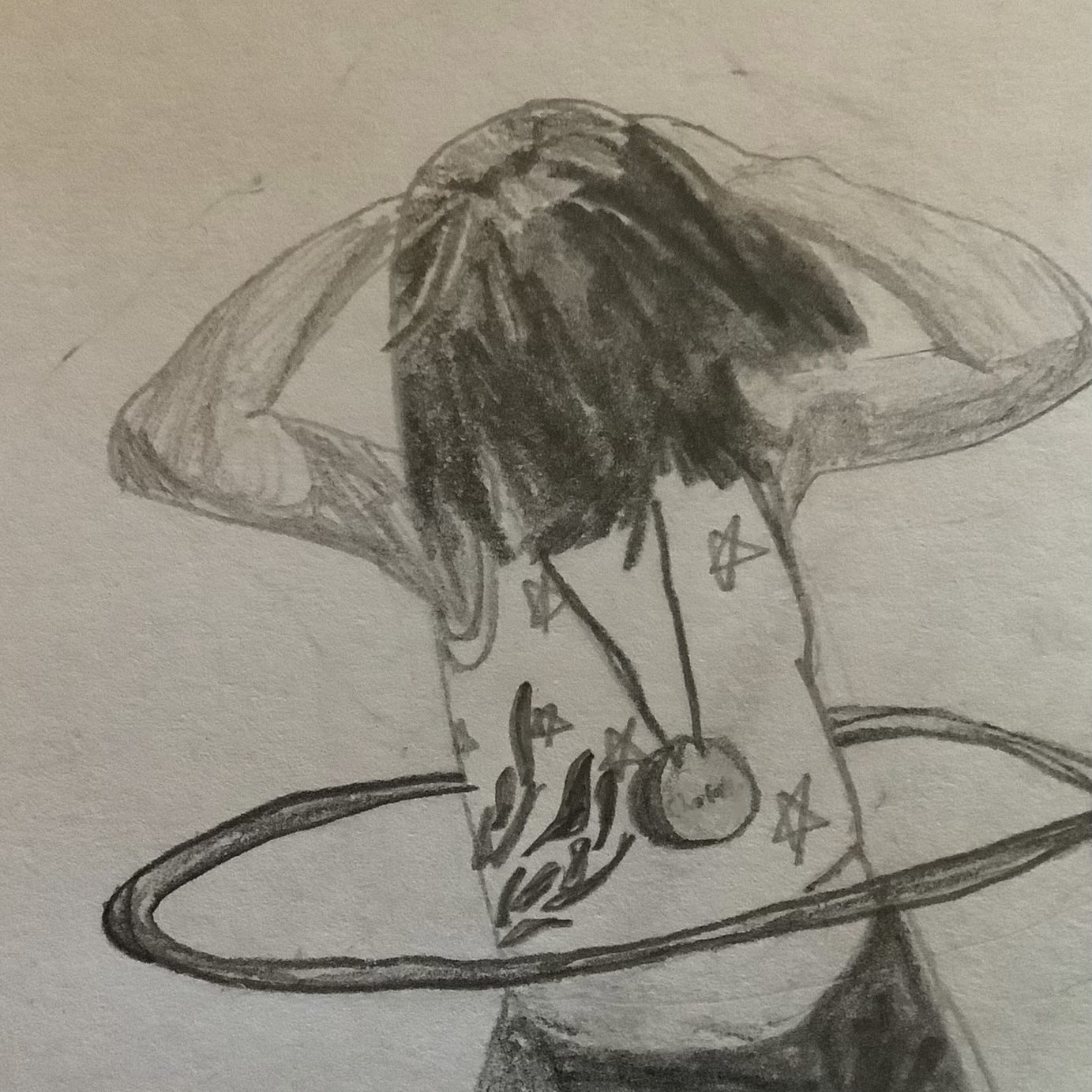
Isa Lichen is at work on When Leaving Home, a book about life under the current U.S. administration as the parent of a trans child, which explores questions of immigration, including their great-grandfather’s flight from Germany after he brushed shoulders with Hitler in WWI.
✶
Christine Naprava is a hobby photographer based in New Jersey.
✶

