
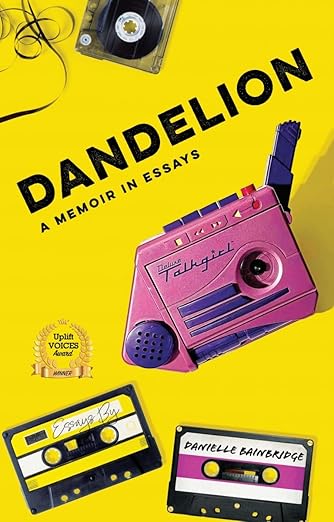
“Dandelion: A Memoir in Essays,” Jaded Ibis Press, 2025, 280 pp.
When I was in my second year of undergrad, I went through a major depressive episode. I was sleeping fifteen hours a day and hardly eating. The usual simmer of my thoughts had boiled to an acrid, smoking paste. I kept my phone off, dodged friends. I nested in a carrel in the windowless nosebleeds of the library with a handful of novels and the hope that in reading them, I would find a way back to myself. Reading was the only thing I had space for. I had dropped all my classes. I thought if I could make myself small, my problems would shrink with me.
Danielle Bainbridge’s collection Dandelion: A Memoir in Essays is a book I wish I’d had with me in the library those days.
“If you are reading this,” she writes, “I hope that you can stay with me… I hope that this version of the truth reaches out to you, even if it can’t quite cover the distance to reach you. I invite you to stay, to share space with me.”
✶
Dandelion (winner of the Uplift Voices Nonfiction Prize) is by Chicago-based writer and academic Danielle Bainbridge. This is Bainbridge’s first book. But the publishing of books is a famously unpunctual enterprise. The earliest essays in Dandelion were published in literary journals roughly a decade ago, where they garnered enough awards that listing them in their entirety would call for a smaller font—not to mention her three Daytime Emmy nominations writing for PBS. In its assembled form—a personal essay collection on the intersections of Blackness, queerness, and bipolar depression, written with a special attention to language and structure—Dandelion is a work of crucial relevance in our political moment.
Dandelion belongs among foundational mental health memoirs like Kay Redfield Jamison’s An Unquiet Mind. But what keeps Dandelion from feeling like a riff on a well-trodden genre is the way Bainbridge expands its scope and form. Memoirs often rely on linear narrative to lend structure to memory, but Bainbridge eschews that scaffolding, bringing the reader into the fragmentary, digressive intuition of memory itself as she moves freely through time in a series of interlocking essays. The trajectory of the collection is full of double-backs and reverberations, the way one memory naturally spills into another.
The core essay, “I Could Only Say Thank You,” runs up the spine of the book in three parts. By the end, the reader has witnessed events from Bainbridge’s entire life: from accidentally wandering away from home as a child, to teenage trips to her ancestral homeland of Jamaica, to hospitalization for mental illness, to her time in Italy as a stage manager for an American opera. Almost none of these events are presented chronologically, and a single essay will jump between them freely. But the text is always grounded in the lucidity of Bainbridge’s narration, which guides the reader through these kaleidoscopic landscapes with a steady step.
✶
As an act of space-making, Dandelion is a forum for Bainbridge to let memories reverberate and echo across a “sprawling archive of emotions.” And speaking of archives (and archivists), as a stylist, Bainbridge’s writing deserves comparison with the rhythms and cadences of Carmen Maria Machado. Haunting lyricism flows through Dandelion, and you’d be forgiven for seeking out a misty, moon-drenched patch of woods to read the book aloud.
One passage in particular that deserves attention is the opening paragraph of “Strike Through Ghost Light”: “We survive among ghosts,” she writes, “on the lower frequencies, deep down in our marrow, where our cells live and die and multiply, we sense the heaviness of them.” As an opening, the poetry of the sentence elicits a feeling of mystery—ghosts? lower frequencies?—that guides the reader into the meditative tenor of the essay. The “we” primarily serves as a direct address to the memory of her Grandmother, but on a secondary level creates a kinship with the reader. Here are my memories; now tell me yours, it seems to imply.
In other areas, she trades lyricism for innovation, though never at the expense of the reader. The phenomenal essay “The Hospital: The Spit in My Mouth Heals the Wounds on My Tongue” (winner of the Cutthroat Barry Lopez Creative Nonfiction Prize) employs first-, second-, and third-person point of view to cover all the shades of intimacy and distance needed for the author to recount her hospitalization: “She is and is not me,” she tells us at the outset. The narrative flow of “Wounds on My Tongue” is interrupted by a lengthy detour into a letter to Maya Angelou. Elsewhere, in “Goat Mouth,” the reader is presented with a collage of non-diachronic journal entries surrounding a period in her twenties when she had a psychotic break. “I was so afraid. But I want to tell you the truth,” she writes. Thoughts ramble and rampage across a range of topics from names for future children—“Manifest (for a boy.) Nickname Manny”—to Jamaican patois etymologies, to transcriptions of ranting voice memos. The rawness of the work is as palpable as its perspective is essential.
✶
Every essay about America has a specter haunting it just off the page—a question Ralph Waldo Emerson posed around 200 years ago: “Where do we find ourselves?” In 2026, we find ourselves in a culture of political frustration and racial violence. Dandelion opens with a meditation on the murder of Jordan Neely, a young Black man who was strangled to death while having a psychotic break on a New York Subway in 2023. “I do not watch these types of videos anymore and I haven’t for years,” Bainbridge tells us. “The type where Black people are killed… Because I am neither disbelieving nor lacking in empathy for the dead.”
As a Black woman living with bipolar depression, Bainbridge recognizes that she has displayed public outbursts. The difference between her and Jordan Neeley is the ways in which her communities—academic, familial, Black, Queer—intersect to support her. “I am sure I have made people afraid when I was in crisis,” she tells us. “But does someone else’s fear of mental illness need to necessitate Black death?”
By all accounts Danielle Bainbridge’s memoir and larger body of work are coming into the world at a time when we all need to be paying attention to it. She’s a voice to look to, a light in the gloom.
✶✶✶✶
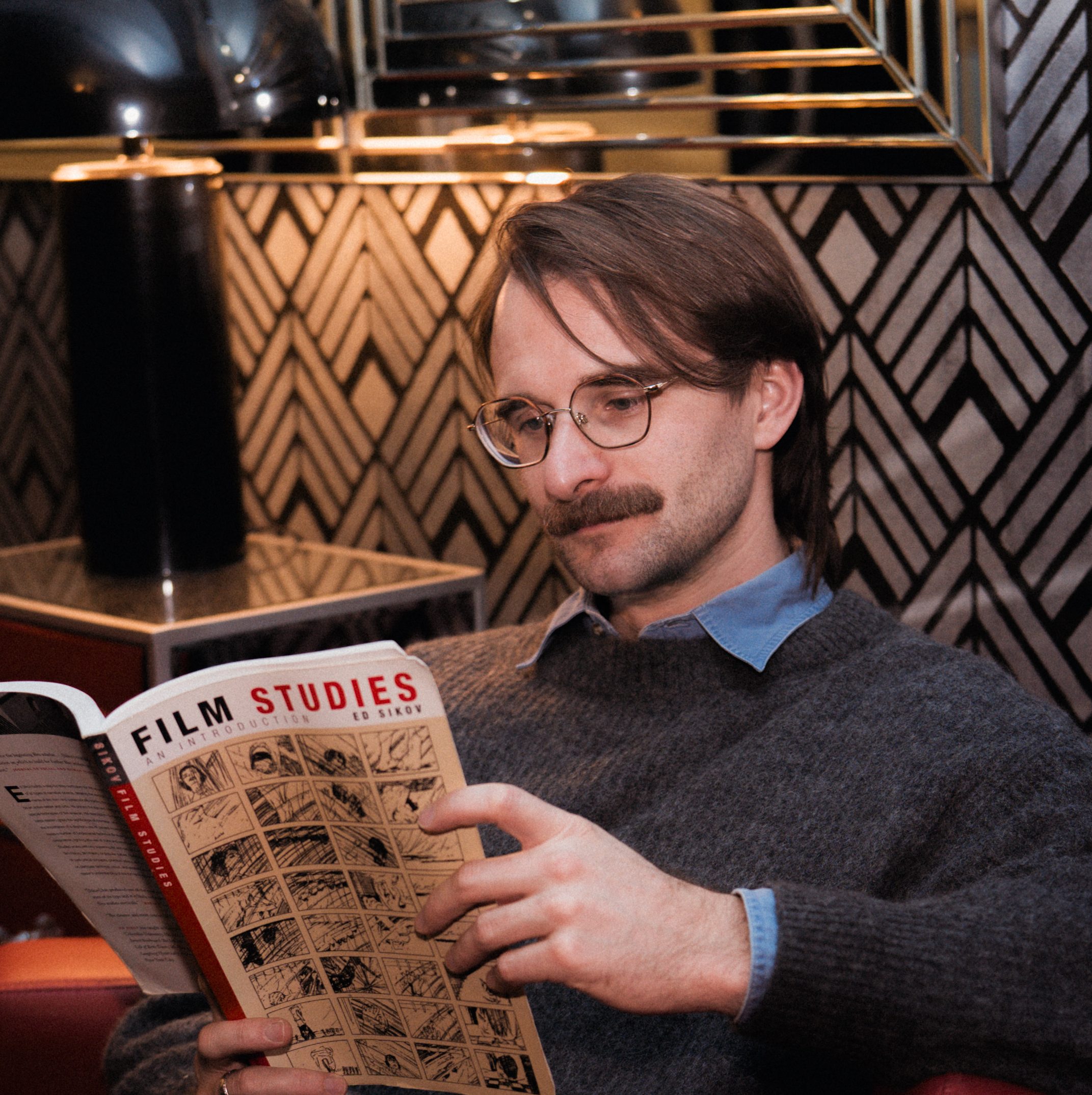
Christian Trevor Lisa likes his words sharp and strange. He wants misshapen words like outdated surgical instruments for the shelves of his brainspace. You can find his work in Hypertext Magazine, Non-stalgia, MASKS Literary Magazine, and others. He earned an MFA from Columbia College Chicago. When he isn’t writing, you can find him running, reading, rollerblading, or playing air drums with cooking utensils. He writes ad copy for a living in the verdant, tree-tangled city of Atlanta.
✶
Whenever possible, we link book titles to Bookshop, an independent bookselling site. As a Bookshop affiliate, Another Chicago Magazine earns a small percentage from qualifying purchases.
 Another Chicago Magazine