
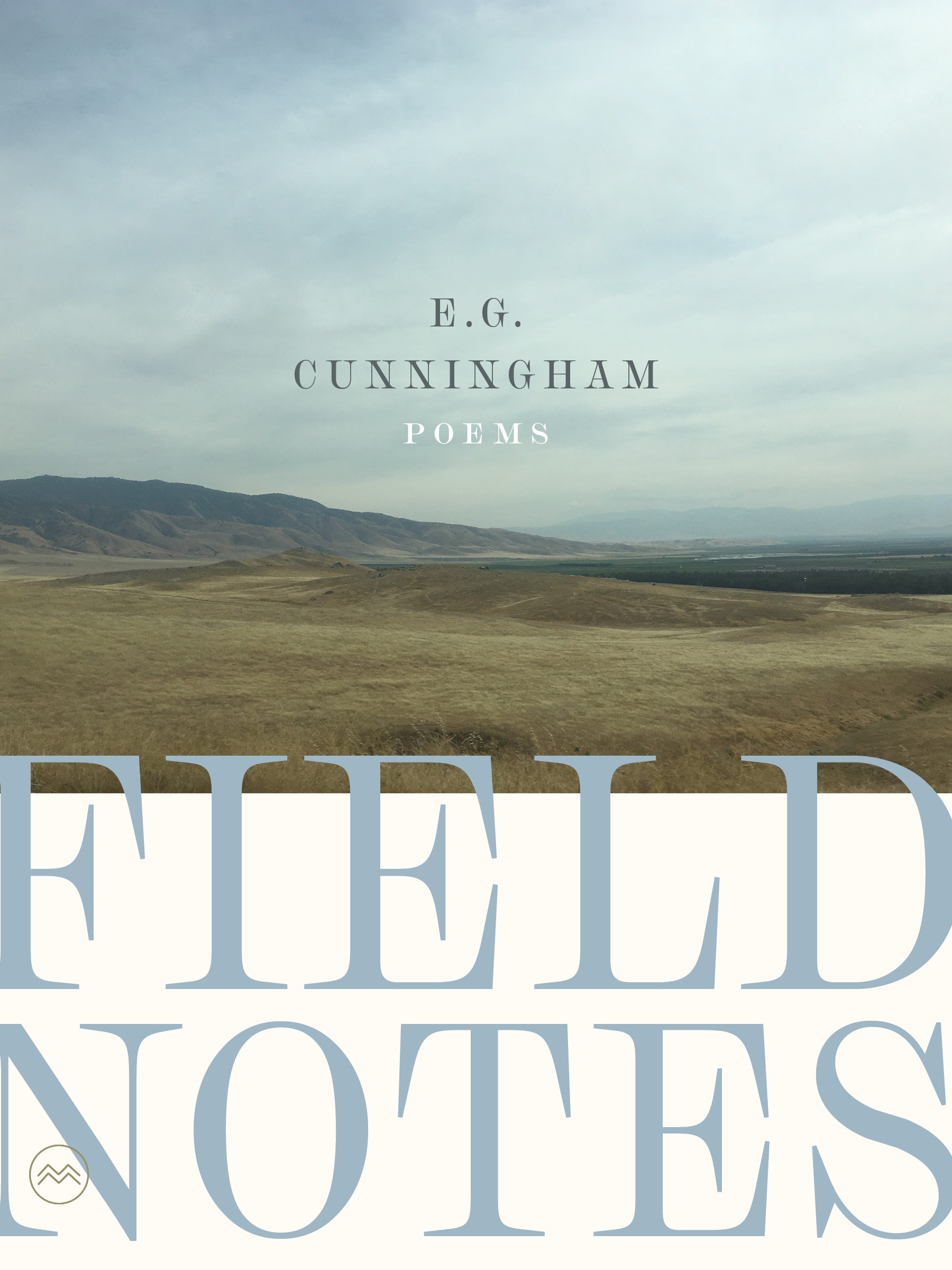
“Field Notes,” River River Books, 2025, 76 pp.
What draws us to the field? What questioning or disturbance renders the field useful, even indispensable, to one’s life? This is a central theme of E.G. Cunningham’s newest collection, Field Notes, where the field becomes the engine through which the speaker interrogates complex relationships between self-understanding, memory, desire, and the possibility for more.
Each of us, at times, is estranged from our own life. We interact with others, we make choices, we are dealt blows, and how we absorb and respond to what happens can create a rift between the head and the heart. In this way, the field becomes a grounding force, its permanence contrasting the vicissitudes of life and offering a protected space to self-engage—a place, as the speaker describes, to hold our psychic material, including her own:
I observe [the field] from the window:
there it lies, framed by sunflowers and rotting fence
posts, in swatches of beryl green and arid bronze. A
flash of sky, a long road. I remember the opiate haze
of childhood in patches. That absence does not rest
peacefully.
Nor does the field, which never yields completely to the speaker’s will. What, then, are the implications of this contact? What do we learn about the self, the field, and the histories they might share?
In both concept and practice, we ask a great deal of the field, making it an adaptable metaphor in poetry and art: the open field, the blank page, the blank canvas. The field suggests potential, something unspoiled and limitless where growth is inevitable. It is “a symbol of paradise,” stripped of its own narrative and committed to the speaker’s aspirations.
While this notion of the field is seemingly innocent, the reality is almost always heavy, dark, and textured. The field is also a battleground, a site of violence and erasure: felled trees, cleared land, the erection of buildings, houses, fences. Each field has a specific history that can be purposely hidden or disregarded, making it an illusory space—one that is tricky, appealing, and consequential.
This illusion is echoed in the collection’s structure. Each poem is set side by side with a photograph of a field, the photograph on one page and the poem on the next. The poem is a tight, justified square centered on the page, mimicking the size, shape, and placement of the photograph. There is deliberate consistency, as if a slight breeze is scattering seeds across the collection with each turn of the page, allowing something of the previous passage to settle onto the next.
It is a subtle, quiet transformation; it becomes difficult to pinpoint what has shifted in each new iteration, though you sense something has. “Residual fields cross back and cross over,” and the same images and phrases resurface across poems, each time with slight variation: shades of blue and yellow, unlit matches, a wet horizon, the sound of a bell ringing. Likewise, each field is singular, but the materials that compose it—brush, grasses, wildflowers, swaths of wheat edging into expanses of cloud and sky—disguise that singularity, imbuing the field with a natural camouflage.
Hence, we must pay attention. We must look: look closer, look again, then look once more. In this way, the photographs contextualize the poems as well as hold the reader accountable. Do we contemplate the field on its own terms, for ourselves, or do we rely on the speaker to make sense of what we behold? At the same time, without great care, “[t]he field transforms looking to wanting … a steely want left over from some internal destruction.” It is unresolved, compulsive, godlike, ready for battle, and it “extends forever.”
But inevitably, the field cannot give what is asked of it. It cannot provide repair, continuity, or the return to a former self, so wanting becomes a means to avoid the wounds that produced those feelings of longing and emptiness in the first place. In this way, the field becomes a mirror for the deficiencies of the speaker rather than a source of fulfillment.
Executed properly, however, the act of looking allows the speaker to recognize the field’s distinct life as separate from her own. She articulates this outright, making a pact with herself:
I do not want to own the field. Nor walk through
it. Nor pluck from itself any flower. Nor discard
anything into itself. Nor leave any trace. The field is
itself when I take nothing. Instead, I observe at arm’s
length.
From this distance emerges the speaker’s exploration of the field’s many historical uses. The most resonant example is that of “Strawberry Fields,” a reference that speaks to a host of radically different narratives: a covert facility near Guantanamo Bay created to house ghost detainees, a children’s home run by The Salvation Army that later inspired a hit Beatles song, a dedication in Central Park established to honor John Lennon after his death, Rea Tajiri’s independent film that follows a young woman’s investigation into her grandfather’s experience at a Japanese internment camp. These examples all involve an element of domination or appropriation and are never entirely neutral, which contrasts with the speaker, who hopes to never “leave any trace” of herself in her entanglements with the field. She prioritizes listening over possession, and the ethics of her spectatorship are on full display.
At the same time, however, we learn that throughout history, the field’s autonomy has been tied to its function as a witness. The field as entirely itself is still beyond our grasp, despite our most well-meaning efforts. The collection’s title speaks to this, where “notes” figure as a compilation of brief, meaningful fragments or meditations that never impose too much of themselves individually, but together create an opportunity for the field to speak.
This aligns with the wisdom of the final poem: “History is an emergent field that goes backwards and forwards.” Anything can happen. Anything can be said.
✶✶✶✶

Susan L. Leary is the author of five poetry collections, including More Flowers (Trio House Press, 2026); Dressing the Bear (Trio House Press, 2024), selected by Kimberly Blaeser to win the Louise Bogan Award; and the chapbook, A Buffet Table Fit for Queens (Small Harbor Publishing, 2023), winner of the Washburn Prize. Her poetry has appeared in such places as Indiana Review, Cream City Review, Smartish Pace, The Arkansas International, Harpur Palate, and Verse Daily, and her reviews have appeared in New Orleans Review, Diode Poetry Journal, and Bear Review, among others. She holds an MFA from the University of Miami and lives in Indianapolis, IN.
✶
Whenever possible, we link book titles to Bookshop, an independent bookselling site. As a Bookshop affiliate, Another Chicago Magazine earns a small percentage from qualifying purchases.
 Another Chicago Magazine