
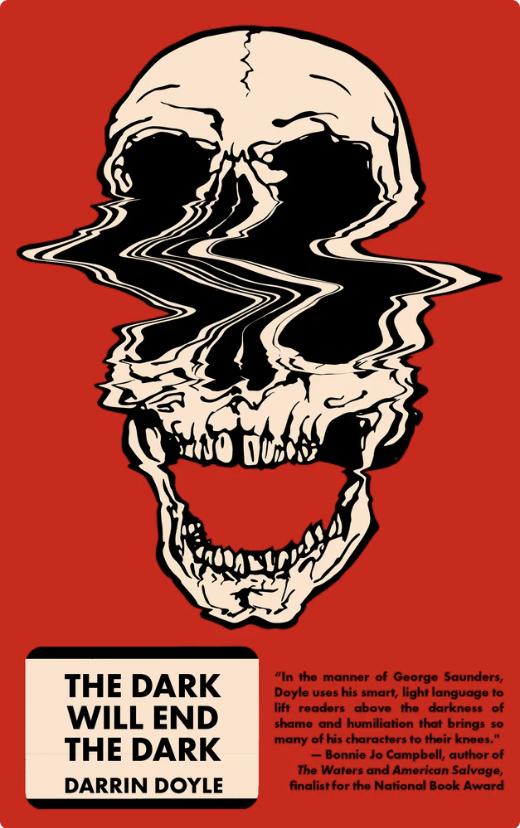
“The Dark Will End the Dark,” Tortoise Books, 2025, 220 pp.
Darrin Doyle’s genre-bending short story collection, The Dark Will End the Dark (Tortoise Books)—now celebrating its 10th Anniversary with a new edition—hews close to horror, featuring cannibal babies, dead heads, strange diseases, and, ultimately, a window to the cosmos.
Doyle, author of The Beast in Aisle 34 and Let Gravity Seize the Dead, has been a consistent chronicler of America’s horrors since publishing his debut novel, Revenge of the Teacher’s Pet, nearly twenty years ago. His work catalogues werewolves, invisible men, and at least one woman hungry enough to consume a city whole. Where other American writers, like Rachel Kushner, trot their protagonists around the globe or, like Jonathan Franzen, entangle them in the dramas of the nation’s institutions, Doyle places his characters in a nightmarish and bare Midwestern landscape. By setting his stories in the American interior among its many freaks, losers, weirdos, and burnouts, Doyle offers up a counterreading of the American archetype. His writing suggests an alternative to the ideal, something lurking under the bed or somewhere in the dark, real but overlooked and flown over. The Dark Will End the Dark thematizes the tension between the misapprehended kind of American character known from American fiction and the darker, stranger things living under the nation’s literary veneer.
The collection’s opening salvo asserts this tension in a whiplash, maximalist mad dash. Stories steer their readership past one visceral image after another: burnt oil engines, boiled feet, metallic screams, and fast food mutilations. The prose is labyrinthine, made up of compact, sound little sentences, the architecture of which is as pronounced as its imagery. Stories like “Ha-Ha, Shirt” and “Head” enact a gory nervous breakdown, chittering and pacing before jerking to the next blood-splattered image. They evoke the B-movie mayhem of Herschell Gordon Lewis and Lloyd Kaufman, something between Bugs Bunny and The Night of the Living Dead.
Nonetheless, they depict relatable people hung up on personal problems that spin out into universal conundrums—often about marriage and its frustrations, claustrophobia, and noise. There is no respite among the unhappy families of “Foot” or “Barney Hester.” Too many people are fighting too many fights in houses too small, too run-down, to spare room for any semblance of peace. The thesis of these pieces is written into “The Hiccup King”: “He had been focusing only on the hiccups, rather than the spaces in between.”
As the collection crescendos, the story “Arms” takes a quieter turn, treating its readers to a tender portrayal of brave but frightened children, a man who might be their father, uncertainty, and an ineffable pain. Thereafter, the book becomes much stranger and more abstract, as if the text’s figurative labyrinth suddenly disappears. The back end of this collection is roomier, dreamier. Given such surrealities as homes without exits, haunted childbearing hands, and quasi-enchanted jungles, these stories are less penetrable and thus more demanding of their audience, but yielding a more rewarding reflection. They read somewhere between Franz Kafka and William Golding. The second half transmutes the first’s blood and guts to heart and soul. It becomes sensitive and touching, as if Doyle doubles back on what he’s done so far, witnessing his unhappy characters and their damage, crying out as a man does in the story “Neck”: “I’ve hurt so many. I deserve this, Lord, but please make my suffering stop.”
The sum of these parts is a textured work. Its speculative-leaning horror runs the gamut from body horror to supernatural spectacle, dabbling along the way in incidents of high strangeness that are as muculent as they are Gothic. The carnivalesque opening may leave readers giddy or nauseous. It is a precisely engineered carousel of middle fingers. Then, with one hard shift, the ride takes its audience elsewhere—veering off the track to a place where the basswood carousel horses sing of things unknown, above the impossible worlds readers must consider.
The sudden shift is more than atmospheric. Doyle has swallowed his own contention with the status quo, metabolizing the tension between the pretty picture of ready-made luxury—Americans on a coast somewhere in California—and the very real, half-mad Milwaukee alcoholic repenting his night’s indecencies through the steady nine-to-five he promises to keep this time. The ugly thing about the ideal and the actual, as described, is the tension between them as they pull apart in opposite directions.
The fact of the matter is that there are precious few globe-trotters and characters out of history that have ever had a decisive hand in any institution. Doyle’s The Dark Will End the Dark is a loving gesture to the darkened and deformed hoi polloi who have always lived under the ostentatious veneer of the stories people tell each other—and themselves. Therein lies the tension, the constructed stress within this collection, the stress within this nation as seen through Doyle’s imagination: the thrilling, the greedy, the contemplative, and the generous. Pulling, creaking, and cracking musically, it is an accomplishment.
✶✶✶✶
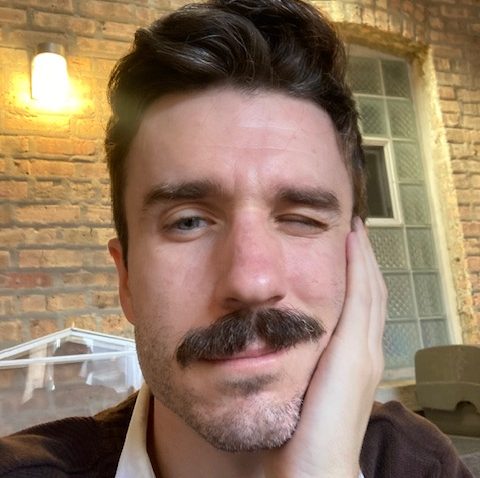
Taylor Thornburg is an author and essayist based in Chicago, where he hosts the Factory Setting Prose Workshop and After Hours reading series at Quimby’s bookstore. His debut novel, Agathe, 6:00 pm to 7:27, can be found at Lost Telegram Press. His other fiction can be found in The Garfield Lake Review, L’Esprit Literary Review, 13th Floor Magazine, Valley Voices, HeartWood, Disco Kitchen, and elsewhere.
✶
Whenever possible, we link book titles to Bookshop, an independent bookselling site. As a Bookshop affiliate, Another Chicago Magazine earns a small percentage from qualifying purchases.
 Another Chicago Magazine