
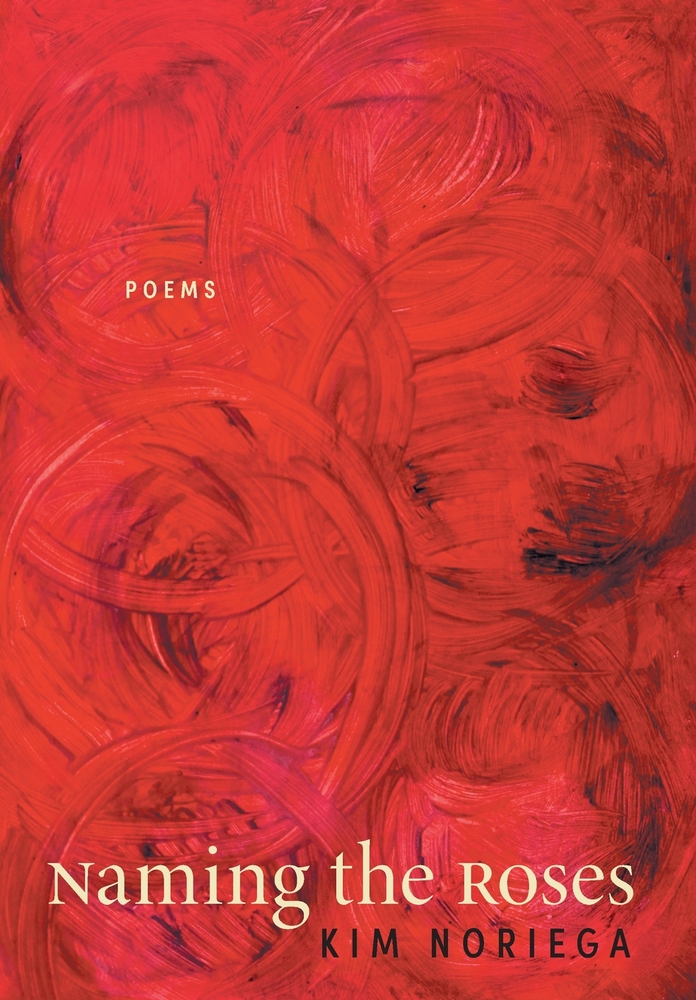
“Naming the Roses,” AIM Higher, 2024, 118 pp.
Naming the Roses is Kim Noriega’s profound debut collection exploring the power of writing to rewild and heal, offering a vivid progression of the cycle of domestic violence, emotional gaslighting, and societal judgment that battered women face. It is framed by an epigraph of feminist writer Ellen Du Bois, who writes (and cited in Elizabeth Dermody Leonard’s Convicted Survivors: The Imprisonment of Battered Women Who Kill), “The power of naming is at least two-fold: naming defines the quality and value of that which is named—and it also denies reality and value to that which is never named, never uttered.”
Drawing from the tradition of American murder ballads, the opening poem, “Name Me,” repeats the titular refrain as “the girl / with the slate-blue eyes” becomes “the woman / with the black-and-blue eye” and “sugar lips” become the “cunt / you tell not to make / a sound,” who “bought a 9-millimeter,” who “shows no remorse” and was named “guilty as charged.”
If “Name Me” is over-the-top in shapeshifting the innocent girl into the woman-villain, it also frames the interiority of a battered woman as a revenge dream sequence. Noriega’s speaker defies her objectification as a sex object and the labelling of her as a bad wife. By italicizing both the dialogue of domestic violence and the language of criminal proceedings, Noriega challenges the quality (“tramp, slut, ugly / ball and chain”) and value (“woman in cell C-15”) assigned to her speaker by her batterer and society.
In the collection, Noriega continuously names the speaker: a “sweetheart” with “baby curls,” “fast asleep” in her father’s arms, granddaughter of a man who found “deliverance in the shower,” lover of an ex who “pulled the trigger,” listener to a song with “some dead bitch” as a joke, a teenage mother whose “dreams didn’t matter.”
She also complicates her father’s role as her protector and her mother who struck her with each staccato word: “You know nothing.” In the prose poem “Dream?”, Noriega imagines responding, “but I did … [to be] just a girl, in the dark of your room—ears straining to hear silence but hearing instead the heavy footfall of a man supposed to be your protector.” In an all-expansive, out-of-breath modulation of poetic form, Noriega underscores the intergenerational pervasiveness of domestic violence as the man “covers you both with the white counterpane, embroidered with delicate violets.”
Noriega points to the limits of mother-daughter solidarity in the chasm of silence that had fallen between them over the decades. In “No Stitch in Time,” for instance, Noriega writes about the squamous cell carcinoma of her mother:
but the tumor had grown
internally, would require
too much tissue removed
for stitching back together.
The wound would never heal.
And this is the way of it between
you
and me,
Mother.
The poems in Naming the Rose draw from vulnerable, autobiographical elements mixed with the obliviousness of those around the speaker. The two-sectioned poem “The Light of Day” contrasts loving memories of pumpkin carving by the speaker’s daughter with the fear of the speaker-mother as her partner and the father of her daughter, “drunk,” “too drunk,” “rid[es] down the highway at 90 miles an hour” with “a huge stolen pumpkin on [her] lap.” It was only decades later that the speaker reveals what she has “never uttered a word of” in writing, “because the wind was in my hair, / because the moon shone on his shoulder, / because his hand was on my thigh / because the scent of milk thistle was everywhere, / and the light of day was gaining upon me.”
The metaphor of light permeates throughout the collection, drawing tension between the speaker’s desire for freedom away from her batterer— an alcoholic, wife-beating gaslighter who was concurrently charming: “We were lightning; we were wildfire.”
In “Wish You Were Here from Beneath the Full Room,” the speaker writes an ex-boyfriend: “Dave, / when I sent you my poems, I never dreamed / they’d cause you pain; could not conceive / of you not knowing about the holes in my wall in the shape / of his fists. You say you should have known about those dark / times.” The speaker does not blame him but rather uses poetry as a space to make sense of the self-loathing she has been taught to absorb and the violence she has endured, to give words to what she has always kept hidden.
The eponymous “Naming the Roses” has eight sections, the first making an allusion to H.D.’s “Sea Rose”—described as “harsh,” “marred,” “meager,” and “caught in the drift,” but also “more precious / than a wet rose / single on a stem.” In H.D.’s poem, the spareness and unadorned nature of the sea rose contrasts with the fragile spice rose, as she asks: “Can the spice-rose / drip such acrid fragrance / hardened in a leaf?”
This “little sea rose— / secretly blooming / in the ocean of her belly” becomes, by the last section, the “hardy saltspray rose” that “blooms there to this day—wild as a weed.” To me, that freedom, which similarly ends “Name Me” (“Name me free”), is “acrid” in its fragrance. At the end of the collection, the experience allows the now-wiser speaker to write a postcard: “I knew I loved apple blossoms raining down in spring; / I didn’t know I’d love my face, shining back up at them.”
✶✶✶✶

Tiffany Troy is the author of Dominus (BlazeVOX [books]) and the chapbook When Ilium Burns (Bottlecap Press). She translated Catalina Vergara’s diamonds & rust (Toad Press International Chapbook Series). She is Managing Editor at Tupelo Quarterly, Associate Editor of Tupelo Press, Book Review Co-Editor at The Los Angeles Review, Assistant Poetry Editor at Asymptote, and Co-Editor of Matter.
✶
Whenever possible, we link book titles to Bookshop, an independent bookselling site. As a Bookshop affiliate, Another Chicago Magazine earns a small percentage from qualifying purchases.
 Another Chicago Magazine