
This week, ACM is posting book reviews every weekday.
University of Chicago Press, 2025, 100 pp.
Ninety-nine years ago, Viktor Shklovsky published Third Factory, a politically astute, genre-defying work that ponders what it means to make art. At one point, the speaker laments that “[t]he rivers here are still being dredged and straightened; the swamps are being drained.” For Shklovsky, this line is not so much about the environment as it is about his views on creativity: how “an artist should avoid beaten paths,” and embrace“[i]nfusions of the peripheral.” In other words, as crooked ways are straightened and new technologies emerge to make life easier, the artist’s job is to avoid stock solutions and create new paths. Such a move is aesthetic, personal, and political.
Kristin Dykstra’s Dissonance overlaps with Third Factory in multitudinous ways, embodying the vision Shklovsky had for an engaged artist. This is an impressive feat for a debut poet, but Dykstra is not new to the scene, having translated more than a dozen Spanish-language books into English, most notably Reina Maria Rodriguez’s The Winter Garden Photograph, which won the 2002 PEN Award for Poetry in Translation; moreover, she is Distinguished Scholar in Residence at Saint Michael’s College in Vermont. Thus, the intelligent assuredness of Dissonance, which places itself in the Green Mountain foothills of Vermont, within the 100-mile zone of the U.S.-Canada border, and focuses particularly on those places where two geographic realities meet: road and woods, water and land, nation and nation. In Dissonance, peripheries are central.
Dykstra’s prevailing motif is the road. The book, at its core, follows the speaker’s daily journeys along a rugged mountain road over the course of a year, with the gravel thoroughfare and its environs serving much the way Thoreau’s Walden Pond once did— fueling reflections on humanity in general, and the present moment more specifically. With Dykstra, the road represents the ultimate act of dissonance—humanity’s need to make divisions: between nations, between ourselves and the natural world, between people themselves: “Enclosed commuters thump past what strange thing will she be doing in ten more years. Rapid repeat, all this from the car, from the next car, from the car still to come. Dirt to be sprayed sideways by the car.”
The book reminds us that roads—like most divisions—are human constructions. In Dissonance, there are also the paths of animals, “curtailed routes whose logic circles incessantly back…The edge defining one desire interrupts the forward motion of another.” Theirs are the natural lines, those not forced upon the world or in need of enforcement, a stark contrast to human roads and borders, hard lines often made without regard for natural landscapes or the migratory patterns of animals and humans. The paths of animals, along with the circuitous paths of the natural world in general, exist, Dykstra shows, in contradistinction to human lines. In fact, the entire book takes place in view of the ridgelines above, their lines defying the supposed orderly notion of lines that humans so often seek.
Meanwhile, on the larger scale, Dykstra situates the narrative within the 100-mile border zone, where jets circle and immigrants are hunted down to be caged. These lines, too, she reminds us, are human constructs—imagined boundaries that create imagined distinctions between peoples.
The “fractured habitats” of these foothills, the “partitioning of the forest” where “people are experimenting with rage”—all this Dykstra encompasses in a metonymic roadway. The road is in constant need of repair as rain channels new paths within it, as its borders weather away through the seasons. It parallels, yet exists in contrast to the river, which the beavers consistently dam, rendering the boundary between water and land porous—just as a gravel road is always in the process of disappearing, even if we struggle to admit it.
Our boundaries, Dykstra shows, are never as assured as the maps imply.
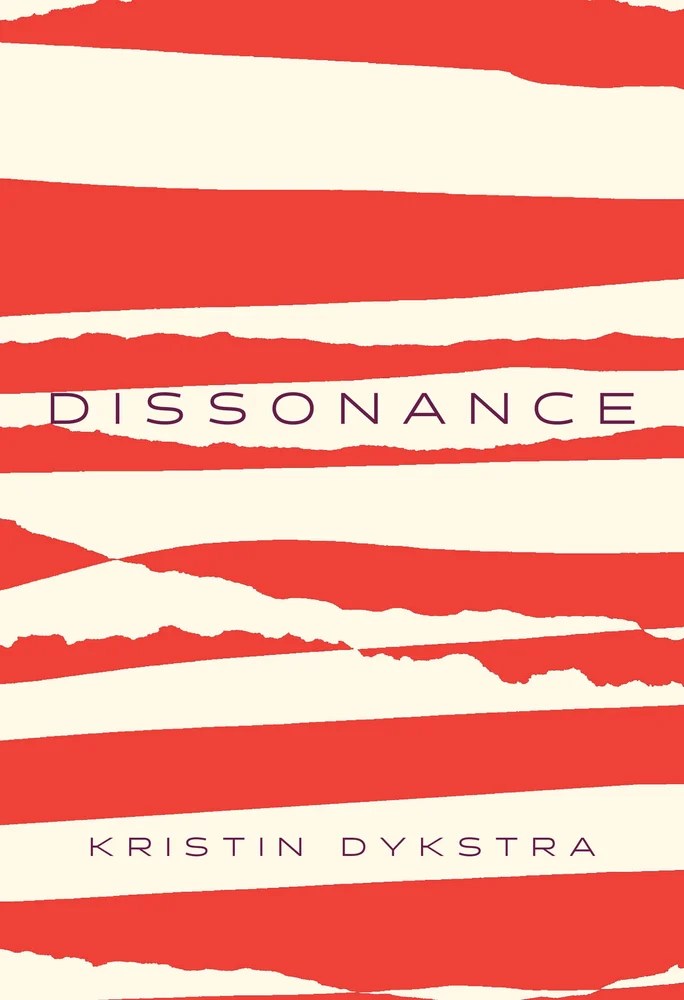
One of the great joys of Dissonance is its blending of form and function, the way Dykstra’s poems forego lineation to resist notions of what lines should do. But it’s more than that: It’s difficult to read these pages and not think of Rosmarie Waldrop’s “gap gardening,” the intentional use of white space. Most of these poems exist as small squares of black text within a field of white, like a path in the forested foothills, a small touch of human presence within so much absence of it. Some people grow upset “[w]here lines fail to connect,” but Dykstra, instead, revels in it.
After all, human presence does not always imply any real humanity. We live in a nation where an immigrant “ducks her head in the passenger seat” out of fear of what could happen:
To cage I cage you cage he cages she cages it cages they cage you-plural cage we cage keeping cages to ourselves. Are we still on the ground? A thousand deported mothers, would you meet them in their grief?
Such is the current reality in the US, Dykstra shows, where imagined lines determine who is to be allowed to walk the roads, freely, and who is to be caged. “The foundations of our homes tremble through trajectories,” she writes, and it’s difficult not to picture ICE agents in the age of Trump, where the border’s lines, determining who is allowed to stay in and who is not, continue to twist and bend according to one man’s whims.
And when the book moves to its conclusion, Dykstra directs our gaze to those asymmetrical hills, resistant to human lineation. And then she directs us to look down at the thick Vermont mud, eating away at the road—the caked surface a reminder that there is no firm division between road and non-road. Its puddles, too, remind us we don’t see as clearly as we imagine—that what we imagine as form is, in fact, merely temporary. And when the road dries up, after it “slaps life-forms all over your boots, all over the car, into the wheel wells of every last pickup,” the oh so permanent road has been altered.
Ultimately, Dykstra’s brilliant Dissonance is an aesthetically beautiful and timely book that speaks directly to our times while providing fodder well beyond this current moment. It is a fraught time in the United States, and though there were moments when I might have welcomed more outright anger—leaving the roads behind to more directly address the horrific injustices perpetrated in the name of imagined lines—the book overall merges political and aesthetic purposes in a powerful way. Just as Shklovsky asked, Dykstra quite intentionally chooses the peripheral over any predetermined path, and she invites us to do the same.
✶✶✶✶

Matt Martinson teaches honors courses at Central Washington University and regularly reviews books for Heavy Feather Review. Recent fiction and nonfiction appear in Lake Effect, One Hand Clapping, and Coffin Bell; his piece, “Trout and Trout Remain,” received a Notable mention in Best American Essays 2024.
✶
Whenever possible, we link book titles to Bookshop, an independent bookselling site. As a Bookshop affiliate, Another Chicago Magazine earns a small percentage from qualifying purchases.
 Another Chicago Magazine