
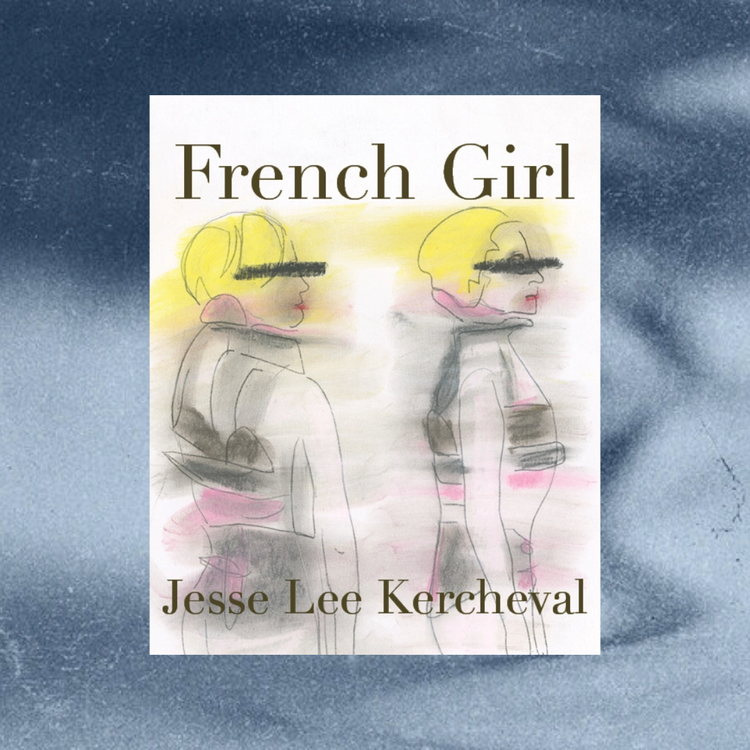
After writing translations and texts, and authoring over twenty books of poetry and prose (both fiction and nonfiction) Jesse Lee Kercheval has written her first graphic memoir, French Girl, a book drenched in spellbinding color. The colors are so rich that the pages almost look wet: deep pinks, vibrant greens, striking oranges, as well as crimson, blue, purple, and somber shades of black and gray. As much as I’ve loved some graphic memoirs, I’ve never had an urge to write a review of one until French Girl came across my desk. I wanted to spend time with the graphics and see if the prose lived up to them. It did. Succinct, often biting, the language imbues the stunning illustrations with meaning, and reinforces the emotional undercurrents suggested by the varied colors.
Focused primarily on her childhood, Kercheval’s memoir is told in a series of seventeen fanciful chapters—ranging from four to twenty pages each—on subjects including her parents, her imagined worlds, her body (as well as the bodies of others), and the events, people, objects, and entities that shaped her. Shifting metaphors abound. Forests both represent the freedom of being outdoors and the myriad menaces that lurk—such as the emptiness she feels and the silence, broken only by “the sound of guns.” Wolves are both predators and protectors. Kercheval employs a variety of narrative devices— including meditation, repetition, and fairy tale techniques—to form an arc that continually draws us back to the recurring motifs of pain, fear (and occasional joy) during a particular time in her girlhood.
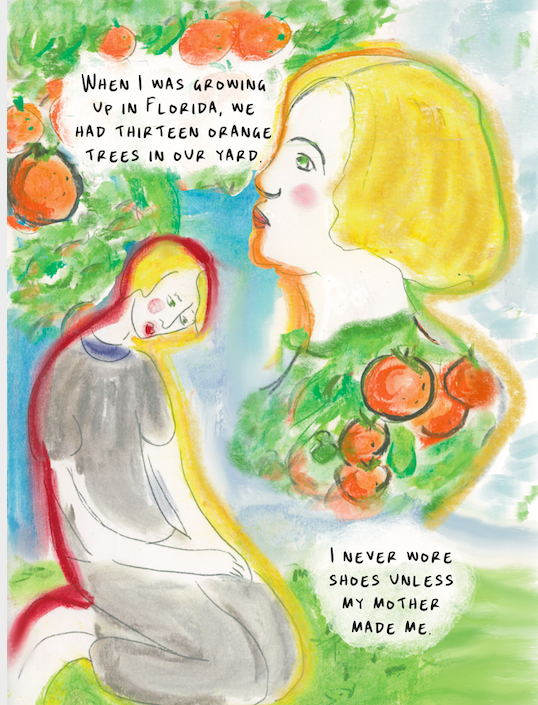
In the first chapter, “Oranges,” we learn of Kercheval’s early years in Florida, a sunny place where thirteen orange trees grow in her family’s yard. Her existence is carefree, spent mostly outdoors. She “never wore shoes unless [her] mother made her.” And then she breaks her back, is forced to wear a brace, and is seldom allowed outside. As her parents worry, Kercheval’s own world grows darker and smaller. She is only allowed to remove her brace to swim, but the ocean is too rough, so she is confined to a neighbor’s pool. Thus, Kercheval prepares us for themes of bodily fragility and the physical dangers that threaten the human form. This includes an entire chapter near the end called “Fallen,” which is populated by depictions of falling bodies: her father, her mother, and herself, over and over.
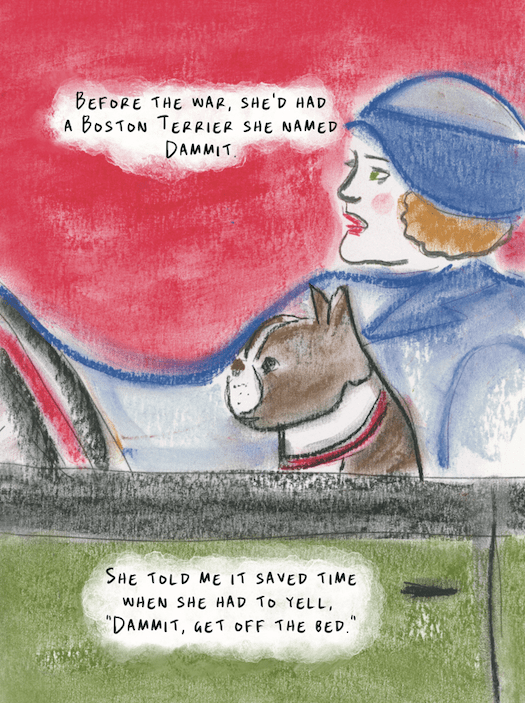
In the second chapter, “The Body is a Vessel,” Kercheval tells of her mother’s job during the war as “the officer in charge of bringing home soldiers who had lost limbs. Or their minds.” Presumably (and understandably), this contributes to her mother’s heavy drinking and her unhappiness for which she is prescribed Valium. A funny aside in this chapter is the information that before the war her mother named her dog “Dammit.” She said it saved time when she had to yell, “Dammit, get off the bed.” But the humor is quickly overshadowed when we learn that Dammit was washed away in a flood in Kercheval’s mother’s hometown, a flood where her grandmother drowned and her mother almost died as well.
My two favorite chapters, both for their intimacy and their radiant color, “Pink” and “Breasts,” occur in the middle of the book. In “Pink,” a meditation on the color itself, we learn that despite Kercheval’s hatred of pink, her mother always dresses her in it. To move past her disdain, she tries drawing pink in cool ways, including a picture of Gatsby in his pink suit. She explores the word’s origin, telling us it comes from “the flower ‘pinks’ named for their jagged or ‘pinked’ edges—like the pinking shears [her] mother used to cut fabric for [her] dresses.” The chapter ends with a large image of a blushing pink and red human heart, which helps ease us into the ensuing chapter “Breasts,” where the pages are also saturated in shades of fuchsia. Here, after recounting the story of St. Agatha—the patron saint of breast cancer, whose breasts were torn off with tongs—Kercheval reveals that when she was sixteen, her mother “went into the hospital and came home without her right breast.” What follows is her family’s ongoing relationship with breast cancer—Kercheval’s sister also undergoes a mastectomy, and both Kercheval and her daughter are continually monitored for signs of the disease.
“Not an Angel,” the darkest chapter in terms of palette—primarily gray, brown, and black—is perhaps the one that delves deepest into Kercheval’s imaginative world, a place she visits at night, though she tells us, “it’s not a dream.” In this magical place, there is a city she knows well where birds are bigger than humans and humans can fly. At the close of the chapter she invites her readers to fly as well. Just “stretch your arms wide.”
In “Ed,” the chapter devoted to her father, Kercheval underscores his role in the family with brevity, beginning the short chapter with “when my father was at the office, he knew who he was.” She ends the chapter with the same line.
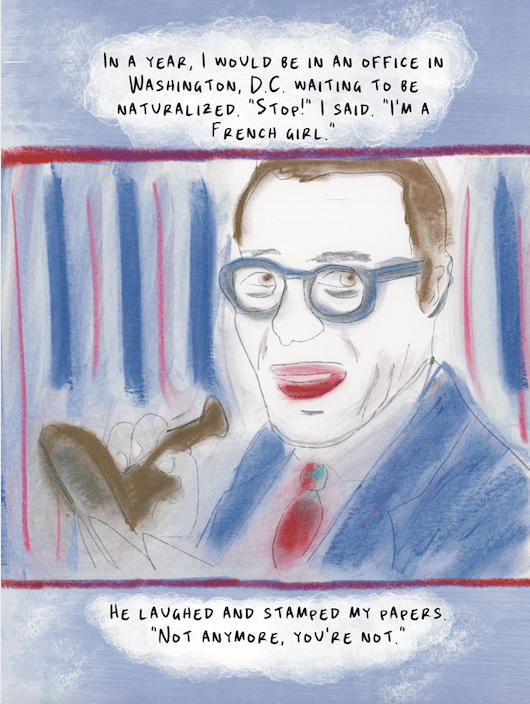
Not until the final chapter do we fully understand the meaning of the book’s title. Born in Fontainebleau, France, to American parents, Kercheval was naturalized as a U.S. citizen before moving to Florida. When her citizen papers are stamped in Washington D.C., she protests, “Stop…I’m a French girl!” A year earlier, she had slipped away from her mother during a walk in the forest of Fontainebleau and wandered off to the château where Napoleon had said farewell to his troops. The guards find her on his bed, and when her mother eventually claims her, they hesitate to hand over the “French girl” to an unmistakably American woman. Kercheval clearly has a profound connection to her very early years in France. (We aren’t told what year she moves to Florida, but we know she is walking and talking.) In one of the last lines of the memoir, she asks, “Is there a universe where I never left the forest?” In the final line, she asks if there is any way she could have gotten the lines around her mouth without “a lifetime of speaking French.” The book ends with a page of gray and green lines, representing a forest. I was not surprised to see this book made the Washington Post’s 10 Best Graphic Novels of 2024. This is not a book you want to check out from the library. This is a book you will want to purchase to give as a gift or keep to savor the enchanting drawings, over and over again.
✶✶✶✶

Garnett Cohen has published four books of short stories, most recently Cravings, from the University of Wisconsin Press (2023). The Midwest Review called this book “impressive…eloquent, original, moving, memorable.” Her short stories have appeared widely and garnered awards from Crazyhorse, Michigan Quarterly Review, december Magazine, and the Illinois Arts Council. Her nonfiction has also been published in numerous magazines, including Brevity, The Antioch Review, Memoir Magazine, The Rumpus, The New Yorker online, The Gettysburg Review, and elsewhere. Two of her published essays were named Notable Essays by Best American Essays. A Professor Emerita at Columbia College Chicago, where she taught for over 30 years and was named a Distinguished Artist, Cohen has served as an editor at six literary journals and is currently the prose review editor at Another Chicago Magazine.
✶
Whenever possible, we link book titles to Bookshop, an independent bookselling site. As a Bookshop affiliate, Another Chicago Magazine earns a small percentage from qualifying purchases.

