
Ruben Berteau has always been in love with his piano. It’s an emotional instrument and he’s an emotional man.
Sentimental. The sort of man who texts, “The Moon!” when there’s a full moon. Or an almost full moon. Or even sometimes when there’s no moon at all, but he’s just remembering a moon that really meant a lot to him.
You probably know his music. Not by name, but from hearing it at some point in the late 2000s. Maybe in a bookstore. Or a medical waiting room.
How I hated him.
His stupid earnestness. The little notebook he carried to write down lyrics. The way he was always marveling. It’s embarrassing. He should have been embarrassed, but he wasn’t—and that made me embarrassed, and then angry.
We were never lovers. I’m not sure he has lovers, other than the music. We weren’t even really friends, but I did once make him cry.
It was Paris. 1998. Study abroad. I was nineteen, there to learn French and drink wine, to see the Mona Lisa and to have sex with French people. There to live.
Except we didn’t. I shared, in the 5th arrondissement, a sixth-floor walk-up with Clara, who was also from Wisconsin. Our apartment was the size of one and a half Oshkosh walk-in closets. Our landlord was an elderly French woman who lived across the hall and hated us.
Ruben once said it would take a heroic effort to remain unmoved in Paris. Clara and I were those heroes.
We ate Velveeta. We watched TV. We spoke mostly to each other and mostly about boys, not French, but ones with names like Kyle, from other midwest colleges, who walked through Paris in baseball hats.
My single most transportive experience occurred at a bakery far from the tourist district, which I came to accidentally, and which refused me directions unless I bought something. And so I did: bread, which I ate alone, and which was so extraordinary—so soft and warm—that when I bit into it, eyes closed, standing on the sidewalk, I understood that everything I’d ever eaten in Winnebago County was wrong.
But, even this, I did not let stir me. I spoke of it to no one. Not Clara. And though for the rest of my life I would think, at times, about that bread and that morning—the sound of delivery trucks, Parisians bicycling past me in suits, smoking cigarettes on their way to work—I never returned to that bakery.
Ruben was our age. Also American. He was from New York City, but he wasn’t cool. We didn’t know that was possible.
He had big brown eyes, forever quivering. His hair rose from his head in a poof. He wore black with a red blazer, like a magician.
What we wanted, at that time, was for boys to be mean to us. Mysterious. Withholding.
Ruben, on the other hand, would cry out, “My god!” whenever we saw a vista of Notre Dame. And then, practicing his French, “Mon Dieu!”
Because he was in the same program as me and Clara, and because we were not practicing our French, Ruben became, if not our friend, then someone often with us.
Mostly we ignored him. Waited out his little exclamations. Stood by while he spoke to us, sincerely, about his dreams.
Clara didn’t really mind him. She said once, “He’s actually pretty good,” after hearing him play on the electric keyboard he’d brought with him, at great inconvenience, to France.
I found Ruben’s sappiness not just cloying, but repulsive. Like his blood was so close to the surface he’d bruise if you squeezed him, which made me want to.
It was our last night. Clark (baseball hat) had somehow purchased a beer keg in Paris. He was having a party: the closing blowout, the final opportunity for unfinished romantic business. Clara was there already. I was on my way, late, walking rapidly along the Left Bank of the Seine, looking not at the Musée d’Orsay or the Eiffel Tower, but at my map, which I was struggling to orient.
Ruben had decided to join, and was at that moment trailing behind me, putting his hands on every building.
“Look at the rain on the church walls,” he said. “Look at the stones in the street.” I looked at my map.
He slowed, gazing at a fountain. He said, “Of course our last night would be the most sublime.” I said, “Yes, right. Very sublime.” Then, “I think it’s this way.”
He said, “Can a person feel nostalgia for a moment before it’s over?”
I pressed on. I said, “I think we might have passed it.”
He stopped entirely.
I turned, expecting he had paused to record some cloying insight, or to ask a French passerby, guilelessly, how it was that they could stand it, living amid such beauty. But he hadn’t.
He was standing in the lamplight, dumb little notebook in the crook of his arm. He was looking right at me, and then he said, “What’s wrong with you?”
It was a mean thing to say, but he didn’t say it mean. The look on his face was sad.
What I felt was angry. I was supposed to be sipping keg foam right at that moment with Clara and Clark and any number of fraternity brothers from various Big Ten colleges, not listening to the saccharine musings of Ruben Berteau.
“Enough!” I said. It felt good, grinding my heel into something soft. “We get it. It’s nice here. We’re leaving. That’s sad.” And then, “Ruben, we need to go.”
But Ruben did not grind. He just looked at me with the same sad expression on his face. Then he sat down, right there on the sidewalk, and put his head in his hands. He looked heartbroken, but not from pain or rejection.
He said, “How can you live like this?” his voice quiet with disbelief. And then I realized: This was not an attack. He meant it. Like he meant everything.
And then he began to cry, blubbering right there on the street corner. Fat, wet tears with no one to see them but me.
It was pity. Ruben Berteau pitied me.
It was a beautiful night. Achingly so. That night the moon hung in the sky so big you felt you could take it in your palm, like an orange. The river moved, slow and dark, carrying as it did the same drops of water that had cycled the Earth four billion years.
I looked at the sky, and then at the river, and then at Ruben, weeping on the ground because of my way of life. And then, after a while, at my watch, because I was still late. So finally, when his crying slowed, I said, in as convincing a tone as I could muster, “I’m sorry.”
He snuffled, then wiped his nose with the sleeve of his red blazer. Then he looked at me, and again at Paris. He said, “No, you’re not.”
✶✶✶✶

Seth Lavin is a writer and educator in Chicago. His work has appeared in New York Magazine, The Los Angeles Times, and The Guardian, as well as locally in The Chicago Tribune and Sun-Times.

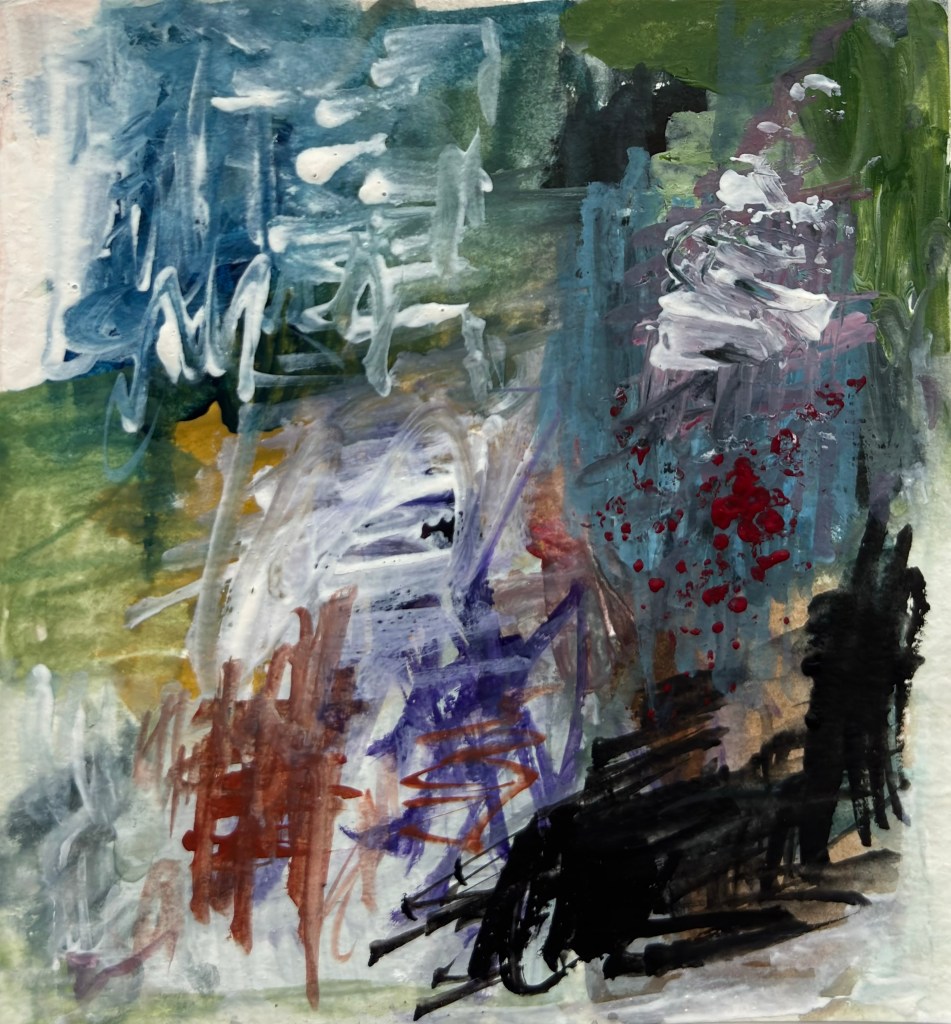
Mary Tina Shamli Pillay is an abstract painter and writer based in India. Her art, poems, and fiction have featured on BBC Radio, Kitaab, The Mean Journal, Blink-Ink, Borderless Journal, The Chakkar, Madras Courier, The Pine Cone Review, The Literary Times Magazine, The Punch Magazine, Shooter Magazine, Ink In Thirds, Artist Talk magazine, The Hemlock Journal, The Penn Review, Chestnut Review, Inscape Journal, and Another Chicago Magazine among others. Her art has been showcased at exhibitions and collected internationally. She is passionate about painting, writing, cats, and food. Insta: @MaryTinaShamliPillay
✶
Whenever possible, we link book titles to Bookshop.org, an independent bookselling site. As a Bookshop affiliate, Another Chicago Magazine earns a small percentage from qualifying purchases.

