
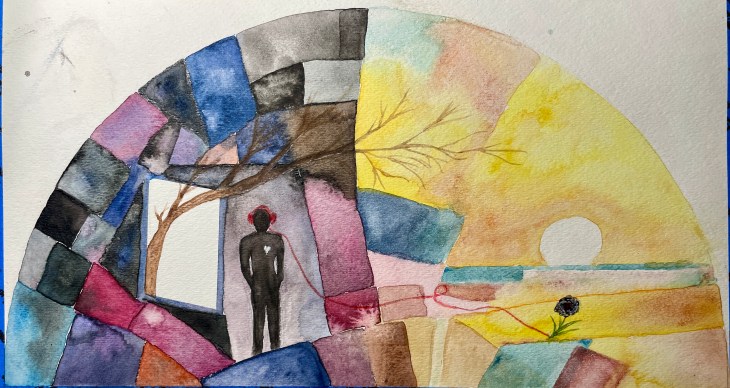
I am attached to a headset by a red wire. Like a dog to a tree, I can reach only as far as the cord allows. When a call comes, I answer: 988 lifeline this is … and speak aloud my alias. And it’s true; I’m someone with an alias. By company policy, I have a different name. I go undercover. I’m not quite me. It is a persona cultivated through watching corporate compliance training videos and role-playing in a conference room, the pretend distress from a supervisor saying, aloud, I wanna kill myself. It’s an alias reliant on the words it sounds like, I can hear, and I get the sense that—phrasing that avoids asserting itself—followed by feeling words extracted from a color-coded circle chart, coined The Feelings Wheel.
In ways, I am an amalgamation of various computerized tests that tried to stump me with overstimulating diagrams and many-stepped directions on dealing with different populations enduring different crisis situations—as well as decompression tutorials to help deal with the emotional onslaught crisis work has on an individual. Deep breathing to digitized wind chimes, purple lava oozing on a conference room television, a disembodied voice repeating Pema Chödrön: Loving kindness is in you.
When I need to pee, I bring the headset with me and make it snappy. I keep the ringer at full blast, so I know when to cut the stream. When you call, it may be the worst day of your life, so I’m in a hurry to meet you there. Always within reach is my son’s red rubber frog Ravioli. Its eyes pop out of its head when I squeeze it. One eye pops farther than the other, satisfyingly so. Between calls I read the ending of Colson Whitehead’s memoir The Noble Hustle, which more or less says, “do not hope to change.” I watch unsatisfying clips the algorithm provides; men with microphones speaking about sports with quippy one-liners and the façade that all is right in the world. I engage with restorative practices like downward dog and child’s pose. I become a tree. I lie flat on my back and try to identify the spots where my body meets the ground. I count the minutes when closing time nears. When I can walk away from the headset.
When you call, I can hear noises in the background. A clattering of dishes. Voices from a television. The whirring rumble of close-by machinery. The breeze swooping through a grassy knoll by a reservoir. There are crickets, bird chirps, the sudden sound of a microwave dinging. I can hear the automated voice announcing the next stop to public transit passengers.
When I answer, you may be in the throes of a conflict, of a psychotic break, a flashback, a panic attack, it can be hard to breathe, hard to talk, hard to know how to begin. I might say, Would you want to try to take a few deep breaths? Then you might tell me about unkind words spoken about you. A recurring image in your head. You may have lost multiple paychecks from the most recent government shutdown, unable to meet the requirements for unemployment, and are in a spiral, crashing out, breaking down, counting the days until eviction. It may have been a while since you slept. There may be nowhere for you to sleep, or you do not feel safe with those you sleep around or beside. You may be getting bullied at school or by a family member, or gaslit by a significant other, or ghosted. It could be that it’s not about you, but your concern for a friend’s safety, or a family member, or the screaming from someone in the background who you scream back at, where the screaming escalates into one static screaming noise, requiring the volume be turned down on my computer.
Outside the window, I find neighbors who park cars, haul in their bags of groceries, and walk a child back from the bus stop. I find squirrels chasing squirrels, leaves falling on leaves, the moon replacing the sun, winter followed by summer, all of our days passing by.
You call with thoughts about killing your mom, or dad, or someone who wronged you, or hurt you. I ask, Have you thought of a plan, hoping for a tone that eliminates any semblance of encouragement. Sometimes you call and are despondent, resigned, having cut into your body with something sharp. And you are bleeding, or in the process of cleaning blood, wrapping a rag around a cut, or a burn, or an opening you created with a fingernail.
You might call simply wanting the sound of another voice. So, I become that sound. By speaking, I turn into an opening—an attempt at release.
You call, and it could be nothing. A pocket dial, a whoops-wrong-number. Or the fax machine again, with its dial-up tone and beeps, perhaps trying to express its despairing obsoleteness in the face of technological advancement. Something might tell you that this is not a good time or this isn’t working, that talking to someone is not what you wanted or expected. It could be silence, your reluctance, a desire to speak when you’re not quite ready to.
When a call ends, so does my alias. I whisper unintelligible things during my post-interaction write-up. Fuck shits, groans, a Geez Louise, an exuberant exhale in an attempt to evacuate stress—words and sounds absent of meaning or purpose other than to unleash what the alias won’t allow. Nearby is a ceramic bowl of crackers, pretzel nuggets, or chips I can chow from. I make a beat with my fingers against the desk or get a hold of a beard tuft and tug for a low-level burst of pain. Actions that get from one moment to the next.
When you want to kill yourself, you may not know where to begin, having never spoken your thoughts aloud. That’s okay, I say, take your time. You may use words like end, over, breaking point, sleep forever, not wake up in the morning, or ask questions like What is this all for?, What is the point?, or ask Why, or How come, or say I am sorry, or speak about heights, about jumping, shooting, cutting, taking, swallowing, asking: Can’t I just get on with it?
I say, OK, I hear you. I ask open-ended questions about your thoughts and feelings, about plans, timelines, the means you would use, history of attempts, or if there is any personal and professional support that may or may not be present. Above my monitor, on the wall, is a watercolor my dad painted that says, By All Means, reminding me to keep an ear out for pills and guns, moving vehicles and bridges, ropes and sharp objects, anything you mentioned that could be used to kill yourself.
Sometimes you want to hang up, so I ask if you’d be open to talking just a little longer, trying to stretch the cord a little farther.
A crisis might mean I can feel my heart in my chest, that time passes without my knowledge. I might feel the wall with my hand for something solid or reach for Ravioli. Outside, the wind swings the branches of a zelkova tree, fills the spaces between leaves. Each interaction dissolves into the next one. I become versed in leaving them behind.
Some days are quieter than others, and I manage to get through a whole crossword or finish the last part of a book. Other times it’s one call after the other. When you call, it is never good news. You may be in a bureaucratic nightmare, unable to find treatment for chronic pain doctors can’t diagnose, hopeless about solutions or remedy or support, convinced the world wouldn’t care if you were gone. You might need mental health support from a person with more expertise than me, having grown tired of cold showers, 5-4-3-2-1s, deep breathing, such coping mechanisms that get you to the next moment. You might have been given treatment options that do not suit your needs, sensibilities, or desires, but are supposed to be grateful to have any treatment at all. I never say I am sorry. Nor do I voice any reaction—no disdain, or anger, or surprise. Any reaction is reduced to the softest form of hm. I am skilled in the art of saying nothing.
Still, I may ask some questions that begin with Can you tell me, understanding there may be a limitation to what you can say, that words are not always possible. I tell you my name that isn’t my name and rub up against the indifference a system has to human suffering. I am not an antidote in this system. If you hear my voice, it’s probably because many other voices have failed. I never sell you on the idea of healing, or the elusive nature of hope. The lifeline is a floatation device thrown in a storm when drowning feels certain. Yet it doesn’t pull you to shore, only means to wait long enough for the waves to subside.
I rely on the weight of certain words. Devastating tries its best to mirror pain but can become an empty shell if used too often. Sometimes I go for despair, but it doesn’t hold up when describing the actual circumstances, as in That’s incredibly despairing. Alienation helps once loneliness loses its punch. Painful is a given, as is suffering, and feels accurate but not specific. Sometimes unfathomable is my only out, becoming the most accurate description of my understanding of what is happening to you.
The more time that passes, the softer and quieter my voice becomes, like a rugged stone smoothed by a flowing river. Like it’s felt the syllables of devastated too many times. I learn it’s not so much the meaning of a word as it is about the inflection. How tone bypasses meaning or making sense, becoming a more effective vehicle for a feeling. I think about all that I pack into a word. In my gentle uttering of loneliness is the isolation of an Alaskan winter while folding hotel linens. In my cruel is my own childhood torture of ants as I flooded villages with hose water. Embedded in the devastation is my brother’s death four years ago, how my dad rushed up the stairs, the sound my mother made when she learned the news. My alias pulls in the me that I am meaning to hide. It does so without my knowledge, blurring the crisis counselor in control and the damaged human trying to survive.
When the sun sets, the reflection of the cord might appear outside the window, as if coming from somewhere beyond the office. At a certain angle, it looks to be its own branch growing from the zelkova, marking a confluence between what is happening here and what is happening out here. I might ask you, Is there anything that makes you want to stay alive? while staring out onto my street while it rains. I might be seeing my wife backing the car into the driveway while listening to the sound of you whimpering.
Some days it feels like you run over my mind with a semi-truck. Like my compassion is a piñata being whapped with a stick, long after spilling its contents onto the floor. As I’m listening, dysregulation prickles the skin on my forearms and on the back of my neck. I feel hot, a sudden urge to punch the wall. There are days when I’d rather watch your call end up on another counselor’s dashboard, so that I can survive until the end of my shift. Off the clock, I might encounter a phantom ringer. One that perks my head up and spikes blood pressure, causing me to dig into my ear to try to reach the sound. Even though it’s not real, I imagine it’s the lifeline beckoning me back, that after a while I may not require a headset; all the calls will come directly to my brain.
At times, I have trouble sleeping, existing in a state of restlessness that no cold shower or Pema Chödrön lecture can remedy. I move about the house in the dark, from my bed to my couch, to the light of the fridge, wandering halls and growing older.
For the most part, your calls move right through me like a fish tank filtration system. I’ve gotten quite good at processing, well-trained in moving on. But, like anyone, I am susceptible to being shook, alarmed, dysregulated, and therefore rendered less effective. When you call, I am not always at my best, and I’m sorry. Past calls may be with us too.
Sometimes you call, and it all comes out at once. A waterfall of words that ends in a plunge pool of tears. You may be feeling out of place in your environment, or ostracized by friend groups, or insecure, or unnoticed, unheard, under the belief you are a freak of nature, convinced you are destined for an eternity of loneliness and misery and pain. I never say: same, or me too. It can feel like you run into a truth about yourself you cannot get around or cannot begin to articulate. That’s okay, I say, we have time. You call from the prison of being held inside a body you didn’t choose, in a world you didn’t make, with thoughts you can’t control, but with a choice that presents itself. Perhaps the truth is a new understanding of forever. What do I do? is a question without an answer. How do I escape me? is the search for a key that’s gone missing. I become a visitor to the walls that keep you, crouching and putting my ear to the space you speak from. I might ask again if you’d be open to breathing, for words don’t come from our brain, but from the lungs, and breathing is a reminder that you are still alive. And I’ll breathe while you breathe, and the wind outside will breathe, and we become two people breathing together.
When a call ends, I might wonder what becomes of you. Sometimes you say you feel a little better after talking. Sometimes nothing’s changed. Sometimes the disconnection is abrupt, and I am left alone, speaking, Are you there? to someone who isn’t. I am a practitioner in not knowing, of asking, yet never answering: What becomes of you?
I can ask the same of myself: What might become of me? Knowing none of us are safe in a world where there is still a future. The horizon might hold my own financial ruin, or a familial death that eliminates my ability to cope, or a chronic illness that renders me immobile and subjects me to perpetual, inescapable agony. I, too, may lose my ability to regulate emotions during times of chaos and stress and heartbreak—or develop a mental illness that doctors and pharmaceuticals fail to keep at bay, or become so entrenched in a system of bureaucracy where treatment options do not account for my circumstances, my sensibilities, my desires, and I, too, will desire escape from the suffering that a mind and body endure in a world of other minds and bodies, that will quickly, without missing a beat, carry on without me. Yes, who really knows anything at all? I, too, may become trapped in an unending thought loop, believing in the possibility of forever. Or perhaps grow old enough to cross some finish line I didn’t know existed, say farewell to this world and all that I love about it, and exit of my own accord.
Not everybody wants to die, but everybody knows they will. By calling, part of you wants to live—even if it’s just the smallest, least detectable part possible—it is still there: in your words, in the silences we create and feel obligated to fill. It is not so much a matter of hope as it is a matter of being alive, the part that tells us we all should live, as it is the only thing we’ve ever known.
Still, you call and maybe nothing will keep you from suicide. I run into the limitation of language using up my devastation’s and unfathomable’s, trying to reflect suffering with the same words that helped create it. I think to sever the line that connects us, escape out the window for an elsewhere. Instead, I grab Ravioli and try to squeeze us into the next moment. I pull the hairs off my beard and rub them between my fingers. The sign above me says, By All Means. Whatever is necessary. So, I make words appear where they otherwise shouldn’t. I speak not knowing where I may end and sink into a puddle of fillers—of um’s and uh’s—starting sentences I can’t finish. It is here, clumsy and uncertain, that I am stripped of my alias.
✶✶✶✶

Jacob Hibbard is a writer and crisis counselor from Maryland. Find his essays in The Adroit Journal, Seneca Review, Quarterly West, and other places.

Paul Hibbard is the writer’s dad. You can find him in the backyard.
✶
Whenever possible, we link book titles to Bookshop.org, an independent bookselling site. As a Bookshop affiliate, Another Chicago Magazine earns a small percentage from qualifying purchases.

