
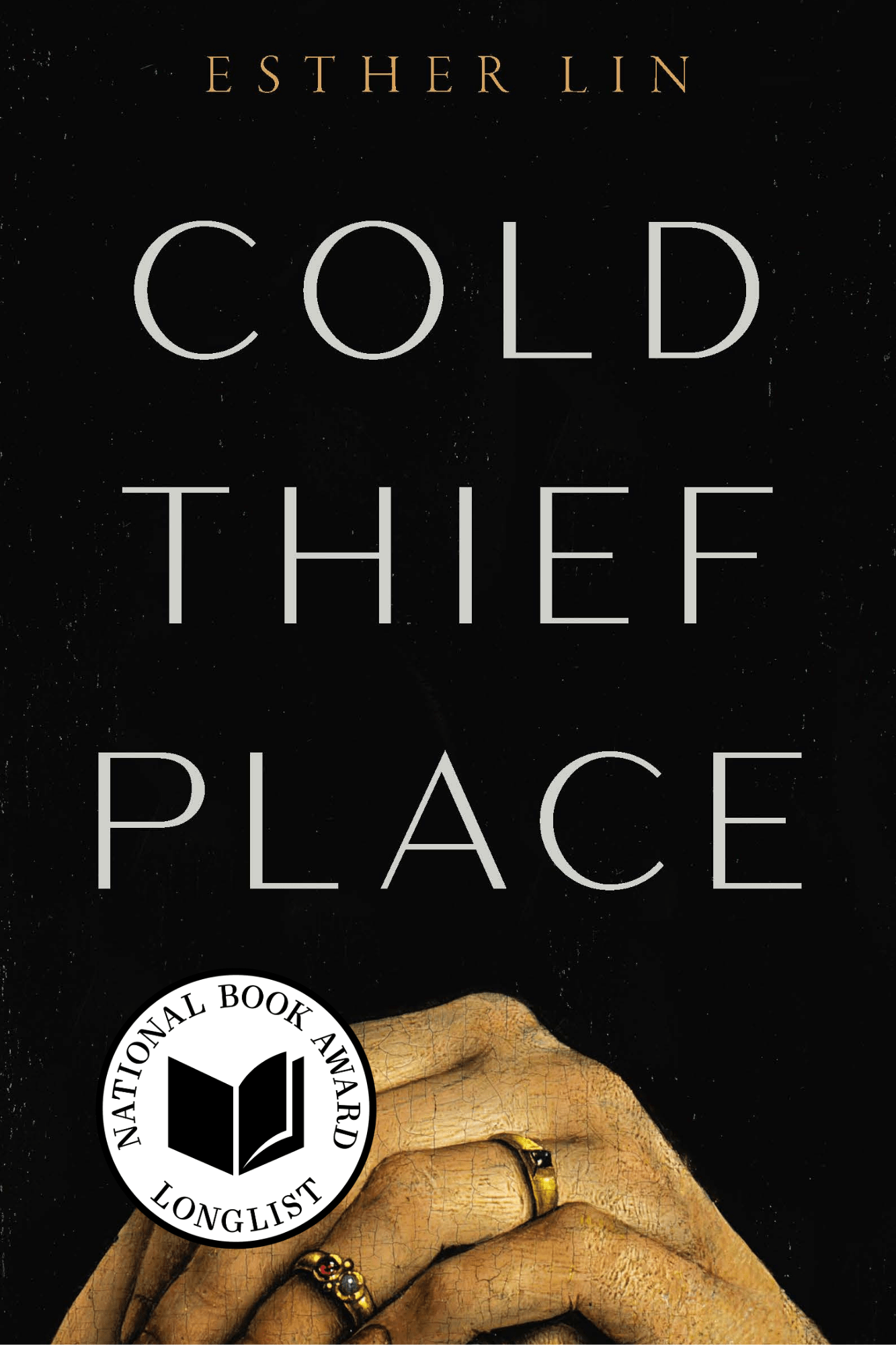
“Cold Thief Place” Alice James Books, 2025, 100 pp.
Her publisher tells us that Esther Lin, author of the sensational Cold Thief Place, longlisted for the 2026 PEN Open Book Award, “was born in Rio de Janeiro, Brazil, and lived in the United States as an undocumented immigrant for 21 years.” It’s not surprising then that a keen sense of displacement haunts the people who inhabit these poems.
This is not a new story. Aeneas escapes his war-torn homeland and lands in a hostile country. Steinbeck’s Okies and Arkies are driven from the Dust Bowl only to arrive in an inhospitable Eden. Lin takes this familiar plot and transforms it into a compelling document of human resilience.
“Ghost Wife,” for instance, begins with a horrific anecdote of intrafamilial cruelty. What happens when a woman’s looks are “damaged,” disfigured in a domestic accident? How do her relatives respond? As Lin tells it, they “lay her in a coffin / upstairs / and close the lid.”
More than a ghost story, the poem is a paradigm of exclusion and victimization. We’d be right, I think, to hear echoes of Jane Eyre and Poe, and to notice the matter-of-fact cruelty meted out to women who fail to live up to their family’s expectations. In fact, poems throughout the book stand as an indictment not just of Chinese culture, but also of the patriarchal skew of many cultures.
Clearly this “ghosting” symbolizes the roles that deprive women of agency and importance. Lin tells us in “Ghost Wife” that single women fall into three groups: “the sickly, the ugly, / or kept back / to tend aging parents”; the speaker’s mother had expected her to fulfill that last role, but then died unexpectedly, leaving her daughter free to marry:
You are not nothing
before you marry.
Rather, you are simply
one without a story.
Become a wife.
That is a metamorphosis
worthy of legend.
That seems the ultimate goal for a Chinese woman—to become a wife—but as Lin demonstrates in “Ghost Wife,” there is deadness in the life of even a wife. On the day of her mother’s death, we see the speaker’s sister watching TV (The Walking Dead!) and hearing this:
A man can’t bring himself
to shoot his wife
as she wanders the streets.
Dead, she remains
lovely. Dress damp,
feet bare as if
returned from a party
Lovely is a stretch, and damp dress and bare feet the result, no doubt, of a bucolic tryst with easeful death—all deliberately unsettling.
In addition to its insight into the family romance, what distinguishes Cold Thief Place is the way the individual and the family interact with political systems. Family trauma is conditioned by its communal, historical setting.
Lin reminds us how the Gang of Four set out to dismantle Chinese culture as they had received it, and how, in the process of re-educating the masses, they managed to destroy the lives and spirits of many ordinary Chinese citizens. Lin is unsparing about the impact of the Cultural Revolution on her parents. “Up the Mountains Down the Fields,” a long poem whose title is drawn from a slogan of the Cultural Revolution, portrays the mother as both heroic and despicable, desperate and uncompromising, reserving her ultimate cruelties for her family, especially her daughter:
you were like
the revolution
itself
always spoiling
for the next account
next man
next fight
And when the daughter asks her mother when she was happiest:
you said
the revolution
nobody
says that
“[N]obody / says that,” nobody except a true believer—someone who accepts abuse as their due, the normal state of things, another victim of Stockholm syndrome.
For this particular family, the end result is that they all become homeless, stateless, permanent migrants. Traumatized. And cruel.
The speaker’s estrangement from her parents and her ancestral culture carries over to relationships with lovers and friends. The book contains moments of broad and icy humor, which reflect uneasily on her difficulty in forming intimate relationships. We notice this particularly in a pair of poems that dramatize interviews conducted by the United States Immigration and Customs Enforcement agency, first with the speaker and then her fiancé. In “Mr. F— Describe Your Beneficiary,” her petitioner, the man whom she tells ICE she is going to marry, is asked to describe their sex life:
On my back,
blood in my mouth, her hands around
my neck, how hard she concentrates!
You get the picture. It’s not pretty, but it might sell thousands of downloads. At the same time, the reader is invited to feel outrage at the violation inflicted by ICE on the private lives of these young people.
As this anecdote suggests, for Chinese women like Lin, America is not a place of freedom, but a place that is always trying to limit or destroy her freedom, an impression reinforced in “Winter”—the father’s regret mirroring the family’s many disappointments:
Before he died
my father said
what no one wished to hear.
We should have stayed.
Despite the overall confidence and competence of the writing, once in a while, narrative mysteries cloud the story. It’s not clear, for instance, how the “Ghost Wife” became disfigured; was it a kitchen accident or sunburn? Nevertheless, Cold Thief Place is a book worth reading and re-reading. In our time, America’s long-standing ambivalence to the “poor and huddled masses” has become a war on immigrants, a never-ending emergency. Should we take sides? Of course we should. Not only does Lin’s book reveal the suffering and humanity of those who seek its promise today, she reminds us of the many generations who, hopeful, approached American shores. Once upon a time, weren’t most of us who call ourselves citizens strangers arriving in a strange land?
✶✶✶✶

Lee Rossi is the author of five books of poetry, most recently Say Anything from Plain View Press, and has appeared in numerous anthologies, including Don’t Leave Hungry: 50 Years of Southern Poetry Review and Grand Passion: The Poetry of Los Angeles and Beyond. His poems have appeared in many journals, including The Southern Review, The Harvard Review, Poetry Northwest, Beloit Poetry Journal, and Poet Lore. He has published reviews in, among others, Poetry Flash, The Los Angeles Review, Rain Taxi, and Pedestal. He is a winner of The Jack Grapes Poetry Prize, as well as the Steve Kowit Prize. He is a member of the National Book Critics Circle and a Contributing Editor at Poetry Flash. He is currently Poetry Moderator at Portside.org, “Materials of Interest to People on the Left.”
✶
Whenever possible, we link book titles to Bookshop, an independent bookselling site. As a Bookshop affiliate, Another Chicago Magazine earns a small percentage from qualifying purchases.
 Another Chicago Magazine