
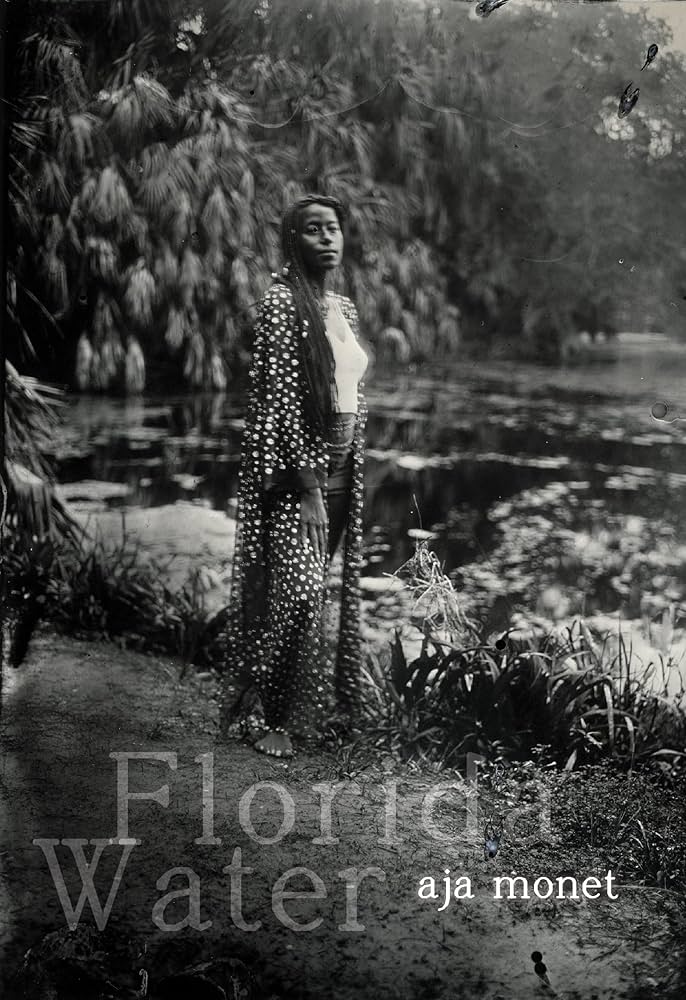
“Florida Water” Haymarket Books, 2025, 144 pp.
It feels like a devastatingly urgent time to read aja monet’s Florida Water. In the past couple months, United States Immigration and Customs Enforcement agents in Minneapolis shot and killed two US citizens, Renée Nicole Good and Alex Jeffrey Pretti, in broad daylight (to say nothing of their continued raids). In the wake of anti-regime protests that killed countless people and the assassination of Iran’s Supreme Leader Ali Khamenei, people living in Iran are facing deadly airstrikes and internet blackouts. Despite a ceasefire agreement, Israel continues its genocide of Palestinians.
It may seem like an easy moment to dismiss poetry—even explicitly activist poetry like monet’s—as toothless or unnecessary. What can a poem do against the imperial, heavily militarized nation-state? Florida Water urges its readers to think of this question not in futile despondency but as a call to action, a way to bring people together in their belief that the world we’ve been given doesn’t have to be received without dissent—that it doesn’t have to be received at all.
Florida Water models radical togetherness, a mode of connection built on resilience, love, and care. In the prose prologue to the book, “initiation,” monet writes that “poetry creates a cosmos for connection”—and the rest of Florida Water certainly seems to demonstrate that statement. First-person plural pronouns are the most frequently used, filling the pages with splatterings of “we,” “us,” and “ours.” Several poems detail intimate connection, from having sex with a lover to community organizing efforts. In the second half of the book alone, there are eight poems dedicated to various friends, revolutionaries, and poets monet has organized and written and loved with.
I see this connection throughout Florida Water as tied to the “poetry of being alive,” to which monet devotes herself in the book’s opening line, a poetry that requires struggle, vulnerability, curiosity, and fear. Take “a state of emergency,” which repeats the refrain “we water” to guide a collective resilience to the history and legacy of Florida’s racial violence. Or “maroon poetry festival,” which details a sweaty summer night’s gathering of poets resisting the police as “[sitting] mischievous as midnight / giddy with raucous poems.” monet mourns, laughs, dances, cooks, remembers, and fights in these poems—all of which are done through or for her connection with others.
The care and connection in Florida Water seem inherently tied to political and poetic organizing. The long-form poem “the water is rising,” for example, is one of resistance and resilience, ushered in through cleansing baths, babbling brooks, ocean waves, and sweeping floods. About two-thirds of the way through the poem, monet writes:
if we don’t talk about the moments we fought back the efforts to resist, we will forever go
down in history as being complacent with our oppression, and therein complicit in the
oppression of others, we must always tell the stories of those who fought back and why
what compels a person to anger or to radical love, they’ll tell you militance is the story of
soldiers intended to kill, and not lover intent on living, i feel for the grass that uproots
pavement; nature is militant towards survival.
Unique among all stanzas in the eighteen-page poem, this sentence is formatted like prose on the page, sticking out literally and figuratively among the margins of its siblings. It calls for and honors grassroots community organizing that works towards collective liberation, a militant rallying cry for lovers, poets, and freedom fighters.
The government, monet notes, will try to spin a different narrative—that of the domestic terrorist, the outside agitator, the paid protestor. That’s why it’s important to write and share, to maintain the presence and livelihood of resistance. Poetry, for monet, resists the narrative of complicity and complacency, instead documenting the “radical love” and “efforts to resist” of those “intent on living” in an ever increasingly difficult place to live.
While monet notes the importance of poetry in sustaining and empowering resistance and liberation efforts, she also holds no jejune beliefs about the type of poetry’s power. Poetry can be connective and invigorating but, on its own, has no physical force. “[A] poem is not a knife or gun / or food,” writes monet in “in justice,” an homage to “power” by Audre Lorde, “… a pen is only a sword / of feelings / not a home / not louder than a bomb.” Responding to the popular phrase by English author Edward Bulwer-Lytton, monet knows that poetry is not necessarily “mightier than the sword,” especially when that sword is held by an imperial regime intent on silencing dissent in any form.
What then, can a poem do against such a regime? Against a knife or a gun or hunger? I see monet’s most direct answer to this question towards the end of the book in “what a poem is,” the antepenultimate poem.
“I know what a poem is,” writes monet. “[T]his is not another would-be poem to tell you what you already want to hear … this isn’t a poem unless / you rise in the riots of words and do something / different today than yesterday.” A swell from “the water is rising”—which notes how poetry can document the lives and stories of those whose lives and stories don’t align with those in power—“what a poem is” articulates poetry’s insightful, and inciteful, possibility.
For monet, poems are not passive or neutral or benign. They certainly are not a luxury. Rather, poems have grit and tenacity and force. They inspire action and usher in change. They aren’t here to coddle or comfort or hold.
Or maybe they are here to hold. A poem can take your hand and lead you to advocacy, organizing, action. A poem can help build and uplift communities that hold each other closely in joy and solidarity during uncertain times. A poem can rattle in the throats of resistors. Poems are active and alive and revolutionary. Anything else, for monet, is not a poem. And we urgently, immediately, and intimately need these poems right now. We’ve never not needed them.
✶✶✶✶

Maggie McLaughlin (they/them) is a PhD candidate in the department of Comparative Literature at Indiana University Bloomington, as well as the Instruction and Outreach Art Librarian at the University of Wisconsin-Madison’s Kohler Art Library. They study American literary and visual culture of the twentieth and twenty-first centuries, with a focus on queer and racialized art, performance art, and protest art.
✶
 Another Chicago Magazine