
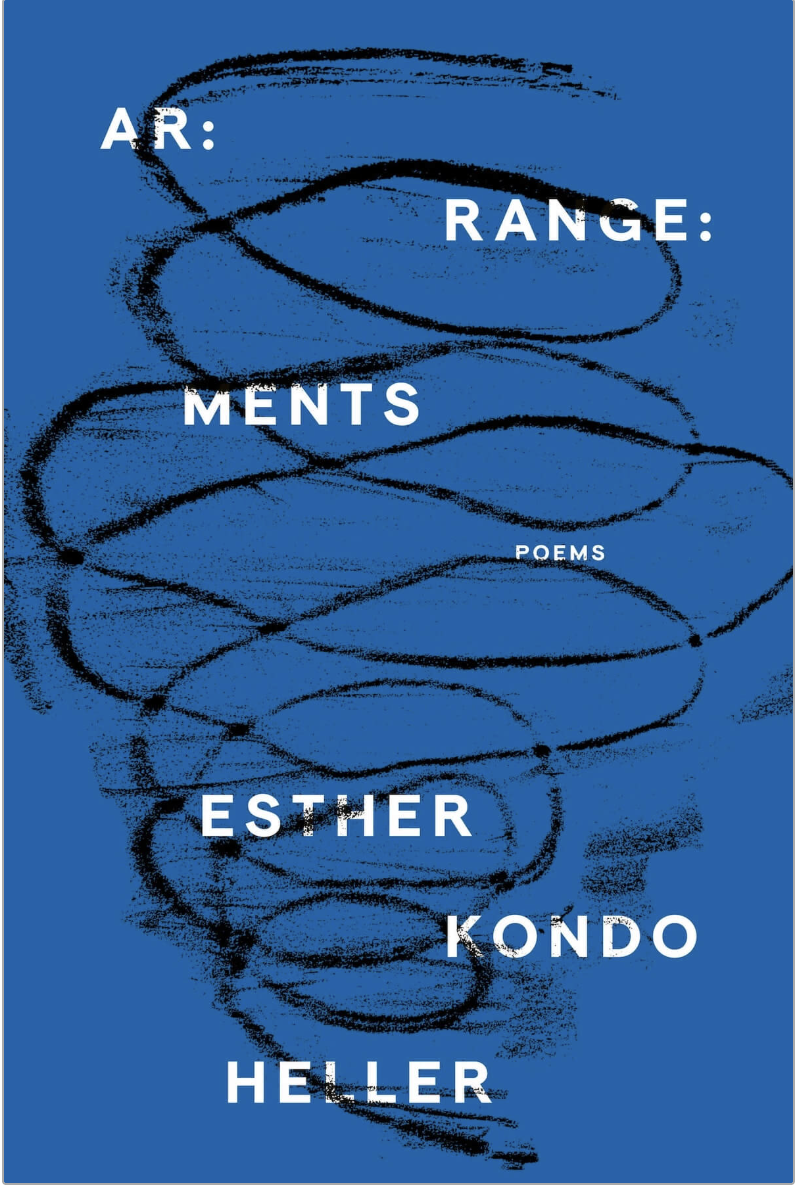
“Ar:range:ments” Fonograf Editions, 2025, 74 pp.
It was easy for oh-so-cynical me to see the title of Esther Kondo Heller’s debut collection of poems, with its quirky use of colons, and think this book might not have been the serious work of art I wanted it to be. Yet my would-be skepticism was eliminated with a well-placed bell hooks quote clarifying the book’s title: “The word of remember (re-member) evokes the coming together of severed parts, fragments becoming a whole.” By the time I read the first page, with poems, or poem-like writing, arranged according to the swooping lines on the page, I was a goner, fully hooked, ready to go where Heller’s words took me.
What even is Ar:range:ments? That’s the first question, though this review might not even be able to answer that question fully. The book defies genre in the best possible ways, mixing poetry—or poetic language—with images, lines, block quotations, repeated words and phrases, film stills, and cut-out words like you might see in a ransom letter. It’s poetry in the way Claudia Rankine’s Citizen is poetry, which is to say, yes, it’s poetry because the author says it is, but it’s modern, literary poetry (and I mean that as an absolute compliment), teasing the bounds of language and form to convey meaning while pushing readers outside their linguistic comfort zones.
To be clear, it’s all done with purpose. At one point, for instance, in “I: Remember,” the speaker says, “I want to be understood,” the line repeating across the page while centered is a still from a film with untranslated German subtitles at the bottom. If the German was translated, it would read: “For me, writing means conveying a message that is understood.”
The poem’s next two pages are again not in English, only to be followed by a powerful page in which the speaker talks about the language barrier between themself and their dying mother, where the only words they can speak are halting beginner phrases: “Hello, how are you?” “My name is…” “I love you.”
What do we make of a poem whose literal center says “I want to be understood” in language most readers will not understand? It demonstrates a basic reality for all readers—the desire to be understood, yes, but with the simultaneous reality that we never really are, just as we can never really know or understand others.
Ar:range:ments, according to the back of the book, is poetry. Fine—I don’t disagree. But if I’m feeling particularly pretentious and wordy, I might say it is a work of language-based art, using images and words, but also white spaces, empty brackets, tonal connections, and a wild variety of typesetting maneuvers to interrogate the consistent failure of language to fully convey what is most important in our lives—best demonstrated via the book’s speaker, who continues to mourn their deceased mother, words never being enough to explain the sense of despair all of us experience when we lose those to whom we feel closest. Here, for instance, is an excerpt from “1993 – 2001” conveying language’s limitations when it comes to mourning:
What is this seed of language? I am writing here in English, a language that M. NourbeSe Philip calls a foreign anguish. There is a cold-hard and swollen fruit I am pressing to my mouth to carry its pods with me in the pocket of my gums, in the gaps of my teeth, in that space where I am missing a tooth. My mama’s passing on my lips.
How does one write about the very things that defy language—things like loss, sorrow, not to mention potential words from the past that went unsaid? How does one convey language-defiant notions through language? For Heller, such linguistically impossible truths are conveyed with metaphor and story, but also with silences, approximations, and fragments. The “arrangements” one might make for the deceased, for instance, have to be portrayed as fragmented, much as the grief makes life itself feel fragmented and convoluted, where throughout the book “mother” and “mutter” are continually intermixed by a grieving speaker.
Midway through the book, in “Say Less,” the speaker says, “If erasure is a reconsideration of a text or an image, then who do I reconsider in the archive?” They go on to talk about people on buses and trains as archives, but soon there is a story of a woman frying an egg on the rail, the description of a tapping sound as she initially cracks the egg. Later, the book depicts the burning of books, and I find myself pulling these images together—the seeds in the speaker’s mouth, the breaking of the egg, the burning of the books; all are about both potentialities destroyed, but also the small bit of hope left over, even if it is only a trace. Archivists attempt to save documents, history, but they can only do so much.
Perhaps the most apt passage comes near the book’s end in “Word of Foam,” two lines on a page of white: “my mama cleaned the windows with newspaper til / there was not a single print left on the glass.” The newspaper, literally print media, erases memory, removes traces of humanity from the glass. The language of newsprint, meant to memorialize what was, does the opposite, as language is not presence—the words only able to do so much when it comes to evoking the past, in bringing back what is gone.
The finality of loss is difficult to convey, but Heller does so quite majestically. Their efforts are enhanced by the book-as-object Fonograf Editions has created—not only is the cover of Ar:range:ments gorgeous to look at, but they have spared no expense when it comes to the quality of this book’s parts. This is the sort of book that reminds you of why a physical copy is best, just as its contents remind us why we read in the first place—to be moved, transported, and see ourselves and our world anew, fragmented, yet maybe, with some effort and luck, able to heal. Heller does not shy away from challenge—aesthetic, political, or personal—and these bold efforts come together to make a profound and challenging collection I highly recommend.
✶✶✶✶

Matt Martinson teaches honors courses at Central Washington University and regularly reviews books for Heavy Feather Review. His recent fiction and nonfiction appear in Lake Effect, One Hand Clapping, and Coffin Bell. His piece “Trout and Trout Remain” was listed as a Notable Essay in Best American Essays 2024.
✶
 Another Chicago Magazine