
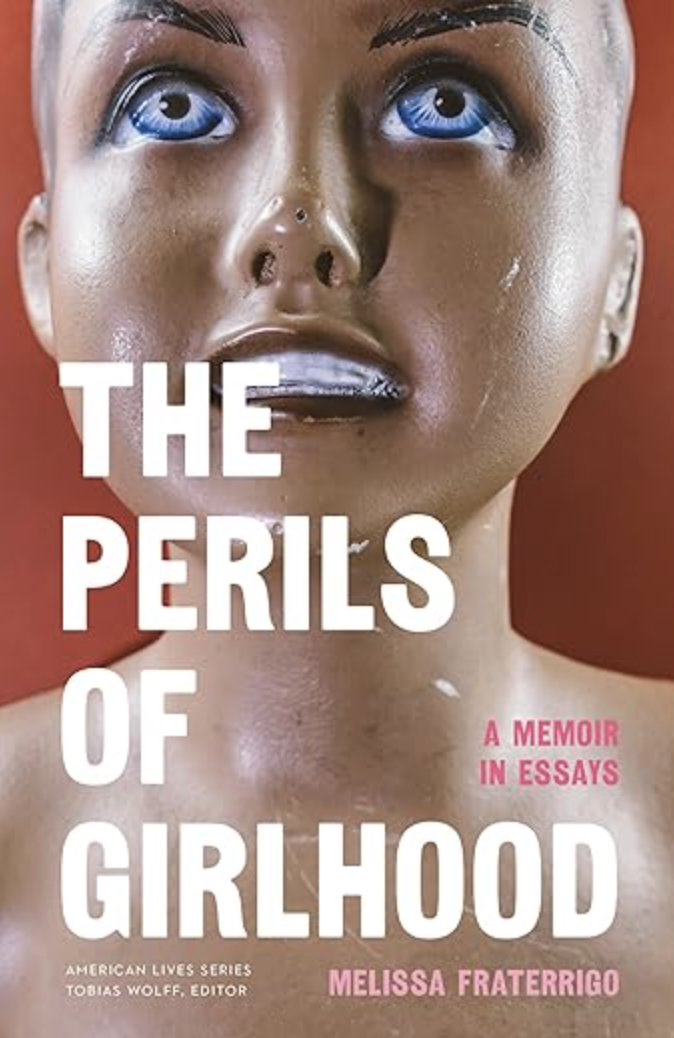
“The Perils of Girlhood,” University of Nebraska Press, 2025, 206 pp.
If the well-worn piece of advice “Don’t judge a book by its cover” is taken as a rule, then Melissa Fraterrigo’s third book, The Perils of Girlhood: A Memoir in Essays, is a compelling exception. The cover image features the strained face of a doll who looks hungrily upwards, her mouth twisted into an uncomfortable grimace instead of the smile she seems so desperate to find. If we look more closely, we see the doll’s skin marked by chips in the paint—traces of violence that our girl has survived—her searing blue eyes defiantly looking toward the sky, or at least something higher than where she is now.
This doll provides a near-perfect representation of the girlhood Fraterrigo depicts in her aptly named memoir in essays: a self indelibly marked, but bravely persevering through violence inflicted upon her. Throughout the twenty loosely chronological essays spanning her childhood, adolescence, early adulthood, and motherhood, Fraterrigo recounts memories centered around living as a woman under the constant threat of male violence.
This is Fraterrigo’s first book-length work of nonfiction, and yet the collection rings with the assuredness of the Pushcart-nominated writer’s numerous successes. These include the critically praised novel Glory Days (University of Nebraska Press), her roles as director of the Lafayette Writers Studio and teacher at Purdue and Butler Universities, and individually published pieces of nonfiction (including the titular essay of this memoir, which first appeared in The Offing in April 2024).
In the book’s first essays, she poignantly recreates the burgeoning desires of adolescent girlhood. Though the essays are peppered with details of the 1980s Chicago suburbs—Judy Blume, Duran Duran, Rob Lowe—the focus remains her psychological and sexual development. Her direct and grounded, yet descriptive prose vividly recreates the psyche of an adolescent: “With each bike ride, I began to sense something new about myself, like a birthday gift that had been pushed to the back of my closet and only recently opened: men might find me attractive.”
Like many girls, however, Fraterrigo is not left to enjoy her burgeoning sexuality. She is instead victim to multiple acts of male violence, including an older swim coach touching her inappropriately and a date ripping her beloved dress. Even home is not a safe haven, and in “More Like Dad,” she describes living with her father’s uncontrollable rage. Eventually, she internalizes the patriarchal violence and uses it against herself, developing an eating disorder and competing with her high-achieving sister, which she expresses with the sureness and warped logic of a hurt teenager: “I will be the beautiful one.”
Fraterrigo also details her experience with that all-too-common manifestation of violence, the lone male gunman, in the strongest essay in the collection “November 1, 1991.” Here, she recounts being a freshman on campus during the 1991 University of Iowa shooting. She deploys her grounded lyricism to create a moving portrait of living through traumatic events, never veering into melodrama: “I sit on the floor and hold my knees, maybe rock them, some tiny bit of motion as information trickles in. The shooting started in Van Allen Hall, the very building where I’d attended Spanish that morning and ended not far from our dorm in Jessup Hall.” Her splitting of the essay into two dates—November 1, the day of the shooting, and November 2—offers a welcome structural difference that allows some breathing room for the drama of the event to land in the reader’s psyche.
This is not only a world of threats, however, and the book’s biggest strength lies in how Fraterrigo establishes that women are not facing these harrowing dangers alone. This is particularly evident in her descriptions of her miscarriages. In “The Facts of Life,” she describes a web of supportive women that emerged around her in the aftermath of one of her miscarriages. In “Vinegar,” she unflinchingly describes one of her miscarriages: “Heavy clumps slid from me and I caught a piece of warm matter in my palm, a human tadpole—faceless and unnamed.” In writing so vividly, she destigmatizes a harrowing experience, allowing her readers—even those who may not have experienced a miscarriage themselves—to know they are not alone in painful experiences.
And so, when Fratterigo “becomes a crucible of fear” as she raises her twin daughters in a world of dangers she knows all too well, we feel we are reading not just a mother’s concern for her children, but every woman’s plea for girls’ safety. The terrors, however, do not win; hope and belief in her daughters’ strength triumphs, whether it is obeying her exuberant daughter’s wish to be pushed higher and higher on swings, or a nighttime ritual: “I whisper that I love them. Hope the words take root, offer steadiness for whatever lies ahead” (“Vinegar”). Occasionally, Fraterrigo’s straightforward prose veers into didacticism (i.e., the essay title, “To My Teen Daughters: You Don’t Owe the ‘Creepy Guy’ Anything”), but in these rare instances, Fraterrigo quickly returns to her courageous and insightful storytelling.
“This book is a testament to my memories,” Fraterrigo writes in her acknowledgements section. Her singularly powerful testament leaves readers grateful for Fraterrigo’s poignant and generous insight into her own experiences; and it also inspires us to thoughtful action in our own lives. With her searing honesty and emotional candor, Fraterrigo offers a resounding rallying cry that stays with readers long after we have finished the book: to protect girls and honor women. Like the doll on the cover, all of us who heed that call look upwards through adversity with a hope and strength that refuses to be dashed.
✶✶✶✶
Anne is currently pursuing her MFA in Creative Nonfiction at Columbia University. Originally from Chicago, she earned her AB in Art History and Arabic Language from Harvard (2012), a Master’s in Art History from Oxford (2013), and an MFA in Producing from the American Film Institute (2015). She worked in TV development and representation for eight years before transitioning to writing. She is also a devoted cat mother to Walter and Temmy.
✶
Whenever possible, we link book titles to Bookshop, an independent bookselling site. As a Bookshop affiliate, Another Chicago Magazine earns a small percentage from qualifying purchases.
 Another Chicago Magazine