
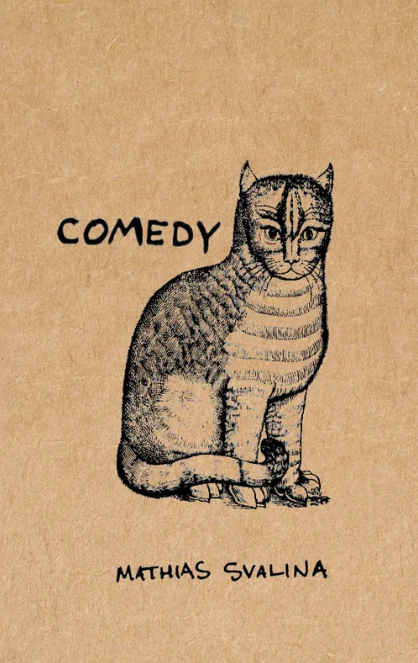
“Comedy,” Trident Press, 2025, 134 pp.
Going through The Best American Short Stories 2025 or Pushcart Prize XLIX: Best of the Small Presses, what leaps off the page, with rare exception, is one representational narrative after another. Character A does (or says) something that Character B responds to, plus or minus descriptions of varying valence of atmosphere, setting, context. Eventually this yields a coherent, all-too-linear plot, no matter how graphic or lurid the accompanying details get. What we have all too often is your basic John Cheever begonias-in-the-window box tale, the kind of tale that floated the fiction department of The New Yorker for several decades running.
Mathias Svalina does not subscribe to that model. In Comedy and his nine other books of edgy, quirky fiction and poetry, he storms the beachhead of the prosaic with sallies of gorgeous, metered prose that rocks readers’ sensibilities to a good place, to an aerie, high as a kite, where they always wanted to be. This is the demesne of Leonora Carrington, Harry Mathews, Donald Barthelme.
It boils down to this: trapped in a one-artist museum, would you rather spend eternity gazing at Norman Rockwell or Hieronymus Bosch?
For those of us who choose Bosch, Svalina’s Grand Guignol-esque tales are a gift from heaven, or hell, or somewhere deliciously in between. These are not your competition-winning stories of family conflict, of thwarted ambition, of romance gone sour. Instead, Comedy is rife with blood (lots of it), detached body parts, tongue-in-cheek deadpan reportage of the most ineffable of experiences, namely, when an umbrella meets a sewing machine on an operating table.
In “Lake,” a man cuts his hand off but cannot make it to the emergency room because a disappearing mom freights him with her mewling baby. In “School,” kids come home from school missing chunks of flesh from their limbs but it’s no big deal—just business as usual. One story riffs on every possible avatar of the word “train,” which blows up the reader’s imagination to Season in Hell proportions. In another story, “The Man Who Married a House,” you guessed it: a man marries a house.
Svalina achieves these displacements and incongruities with seemingly effortless ease. The transitions from the ordinary to the grotesque occur in a heartbeat, often because the prosody is direct and insistent, like the bass drum in a rock anthem, a tom-tom in a tribal chant. Further in the collection in “My Arm and Me,” the spotlight is shared by four characters: Ellen, ‘Lil Ellen, the narrator, and his detached arm. (The ordinary, just like the character’s arm, is stretched beyond the point of rupture. Cinema fans will think of Blue Velvet’s ear on the pristine American lawn, the films of Quentin Dupieux—who really should read this book. I’m sending him a copy—of Luis Bunuel.)
What he does masterfully in these stories is rant, rant like a bard on fire, framing the banal with the rococo and the grotesque until it oozes and leaks—to our unending delight.
The Mathia Svalina bio informs the writing, and vice versa. Svalina was a founding editor of the small press Octopus Books, and since 2014, he’s run a Dream Delivery Service, traveling around the country to write and deliver dreams (in little pink envelopes, no less) to subscribers. With the Dream Delivery Service, he’s worked with the Denver Museum of Contemporary Art, the Poetry Foundation, and the Museum of Contemporary Art in Tucson.
The matter-of-factness of the simple declarative sentences, one after the other, do the job: “…death just felt like one of those things you have to do. Like going to Target.” Or this banal exchange between two doctors examining a patient who has a cup of nails where a heart should be: “‘Right, right,’ my doctor said. ‘Well we need to get him in there quick, there’s nothing beating here at all.’ ‘Interesting,’ the other doctor said. ‘I know, right?’ my doctor said.”
The often pitch-perfect language captures the absurdity of the way we live now and renders it hilarious: “I fought a monster and defeated it. I did that. But what do you do with that? It’s not something I can post about on Facebook. I mean, my mom would see that.”
Svalina visits that innermost ring of hell, otherwise known as the commodification of everything, especially literature. (One of my favorite stories in the book is a smarmy celebration of airport bestsellers. The story is called “The Andromeda Strain by Michael Crichton.” How’s that for irreverent?) In this writer’s universe, just as in ours, and in the larger world, long unrecognized artists finally get their due: a big yellow egg.
✶✶✶✶

David Brizer is a Bronx-based author and book critic. His most recent novel, The Secret Doctrine of V.H. Rand, was published by Fomite in 2023. His work has appeared in AGNI, Word Riot, TYPO, failbetter, The Kit-Cat Review, Compulsive Reader, Vol. 1 Brooklyn, Rain Taxi, and others.
✶
Whenever possible, we link book titles to Bookshop, an independent bookselling site. As a Bookshop affiliate, Another Chicago Magazine earns a small percentage from qualifying purchases.
 Another Chicago Magazine