
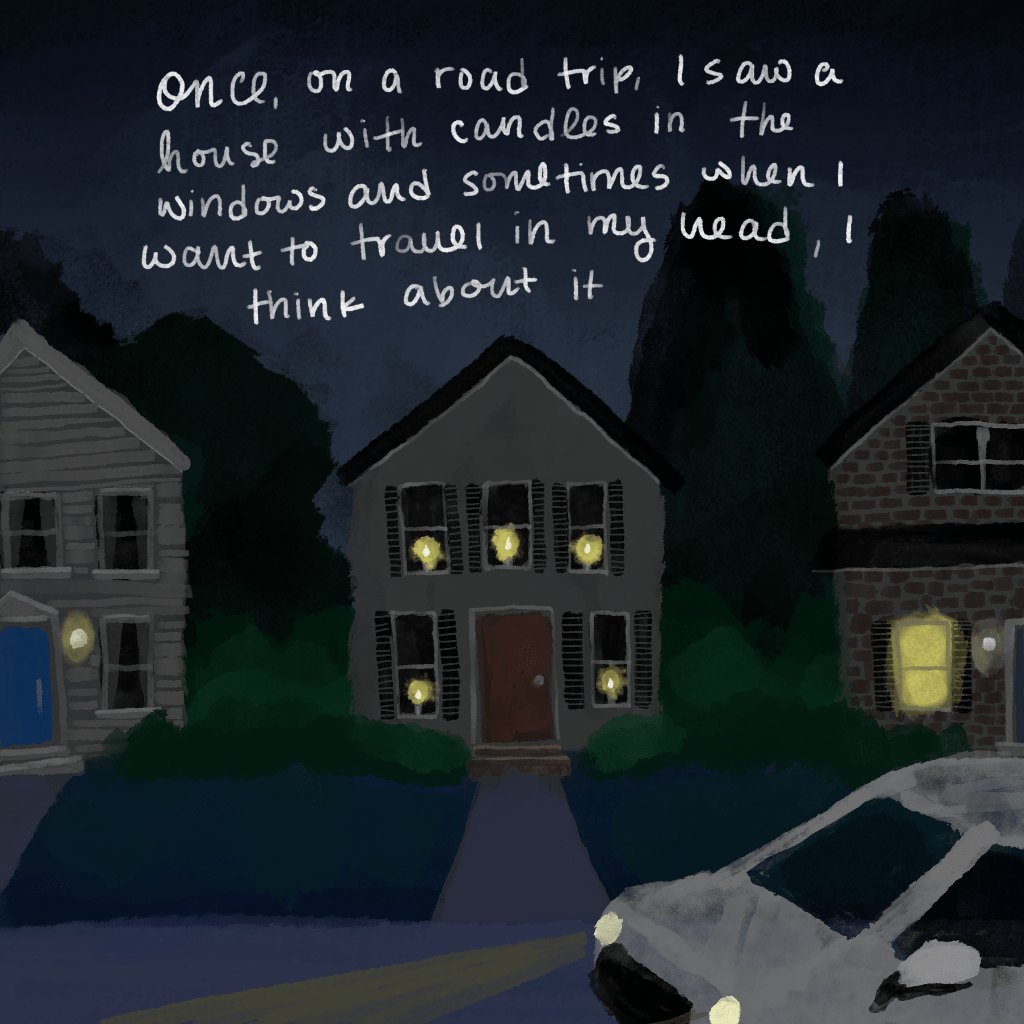
This week, ACM is posting poetry every weekday.
Queen Shit
Friend of seventeen years, I can’t recall the bands
I listened to when I met you. Months ago
I quit folk songs, jangly banjo
now dull to me as a microwave’s hum, and when
I admitted this to you—under a dogwood in Atlanta
at a recent music festival—you squinted hard.
Was the sun in your eyes? I can’t recall, before
we had kids, if we smirked imagining their mouthiness.
We smoked a lot of Marlboros back then
never to share your dad was mean, my mom lenient,
never to consider our future parenting styles could differ.
At the festival, two beers in, I vented
my toddler plugs her nose in a parking lot-baked car,
cries that it stinks; you said sensory processing disorder
but I haven’t called my pediatrician. A worn guitar string—
is that our friendship? Still playing but faintly.
All I know is, the last night of the festival, I got stoned
and the midnight Uber ride to our hotel
lasted a lifetime. From the dark backseat I stared
at you in the passenger seat:
head cocked out the open window,
sunglasses big as cake pans
sliding down your nose,
arm stretched and index finger lifted
lazily pointing at a blur of cars, yelling I need pizza!
I remembered that same easy confidence
the day we met, the thunder
of your stilettos on the tiled hallway before you
entered that conference room, shoulders thrown back.
You’re a power ballad I’ll never tire of hearing.
Open Heart
We met in junior high on a track, looping the burnt-orange circle
not bothering to look up. No one counted steps or laps—
just walked until P.E. period ended.
Did I know we’d be lifelong friends? You chirped Hi louder than wrens
in pine trees edging the track. You listened, nodded,
as if I weren’t as average as a fallen pinecone,
as if time weren’t a race but barely budging, like hovering clouds.
In your 42nd year, we began a countdown to your surgery—
thirteen days until a doctor cracked your sternum.
Make that eighteen when the doctor came down with COVID.
Time was math: four glasses of Merlot to calm your hands
the day before you went under, three hours
the next morning until I received a text: you were awake, valves replaced.
I wanted to feed you cheese crisps from a crinkly bag
like we shared as college roommates,
to swirl ointment onto your scab—dark as dried figs, long as a baton—
but by the weekend I flew into your city and hugged you
gently, you said you’d fully recovered.
It will eventually be silver, you sighed wistfully, fingering
your pink scar peeking from your paisley blouse,
then we tramped
in staccato rain to a soggy farmers’ market and a man selling corn
told me Come back when it’s sunny, it’s even nicer
and time was a distant promise—
wait, things improve, around every corner is a prize.
Let’s go back to that track and crush pine needles
with our heels. Crush our watches too.
My Eight-year-old Can’t Find His Baby Blanket
I heard a poet say tattered is overused,
just as poems about motherhood are called trite, age-old, tattered.
Nevertheless, my son shakes me awake, my dream in tatters,
sobbing My blankie’s missing.
Muslin, washed-out red, and tattered from stretches,
nibbles, and that day as a toddler he tattered a corner with scissors,
his time-tattered blanket is in a box. I put it there.
No, I soothe, slide on tattered slippers, and guide him by his wide shoulders
back to his room.
Gauze-thin tatters dangle
from a keepsake box in his closet. I tug on the tatters
and the blanket tumbles onto his sleep-tattered hair. He crumples it,
curls himself around it, and cries. His window blinds tatter the sunrise.
I never want to lose it, he croaks, voice tattered.
I say it’s barely holding together,
almost rags, too tattered for nightly use. I don’t say
his childhood is fading, tattering, too. Lately his face looks like
nearly-baked bread, puffy and pale, the opposite of tattered;
as a teenager, will he want this tattered wad?
Tattered comic books on his nightstand give me an idea.
In the nightstand drawer we tuck his blanket, draping a tattered corner
over his favorite book. The blanket is safe from further tattering
yet easy to reach for
occasionally, in the dark, no one judging if he overuses tatters.
How to Play Basketball with Your Son
A golden shovel after Naomi Shihab Nye’s “Little Boys Running on the Dock”
Leap and release the ball, elbow slightly bent like a seagull’s
wing. If the ball skims the rim and slides in, don’t startle:
shrug as if your talent came easily. High-dribble and soar
up the court he’s chalked onto your driveway ten, fifty, a
hundred times. When you gave him this hoop, he curled onto its massive
plastic base and pretended to nap; now he’s taller, flapping
baguette-length arms in your eyes. Clutch the ball and
remember your first hoop: blended into backyard, mounted over-the-
rail of your parents’ two-story deck, draped with a hose. No boys
your son’s age spied it, no courage could compel you to call
their names. Pause beneath the net, mind wandering out-
of-bounds: how do you thank your child for friendship? Say Sorry—
I lost focus for a sec. Wave over the kids observing like hungry pigeons.
Figment
I swear my grandmother
used to cut a cold slab
of sharp cheddar cheese,
plop it onto a dessert plate
and microwave it
for ten seconds, just until
its waxy surface turned shiny,
its hard right angles rounded
and it plumped, wanting to melt.
She lifted it, nibbled.
When I share this memory, my knees
knock her walker,
a metal intruder as we sit
holding hands on her loveseat.
She can’t remember preparing
such a snack, although
it sounds tasty,
she says. I have no proof
so the memory
washes away like the greasy
orange imprint
left from the cheese, rinsed
off the plate.
At ninety-two
she is slowing down of course
but I can’t tell how much.
Hairdressers dye her feathered bob
the same copper shade
she had when I was a girl,
her hair color at birth,
like a flame never burning out.
Similarly eternal
is her love of chocolate; behind
my back are truffles I bought
on my drive here.
She plucks a dark raspberry
from the box
and dives in, moans,
closes her eyes. Her hand
squeezes the loveseat’s armrest
and momentarily trembles.
It’s the same response
she had to that cheese. I’m sure of it—she taught me,
a child, pleasure.
Just as her
forgetfulness teaches goodbye.
.
✶✶✶✶

Marianne Kunkel is the author of Hillary, Made Up (Stephen F. Austin State University Press) and The Laughing Game (Finishing Line Press), two anthologies, and poems that have appeared in Best American Poetry, The Threepenny Review, Hayden’s Ferry Review, Puerto del Sol, and elsewhere. She is an associate professor of English at Johnson County Community College. She holds an MFA in poetry from the University of Florida and a Ph.D. in English from the University of Nebraska-Lincoln, where she was managing editor of Prairie Schooner and the African Poetry Book Fund. She is the co-editor-in-chief of Kansas City Review and winner of Frontier Poetry’s 2024 OPEN Prize. She loves writing poems and baking pies, and she posts images of both on Instagram at @asliceofpoetry.
✶
Cara Bloomfield runs a pictorial diary on Instagram called The Be Nice Comic. It’s a catalog of the universal and oddly specific ways she is human, a (semi-recent) journal of a new mother, and an attempt at capturing saliency in single panels.
✶
 Another Chicago Magazine