
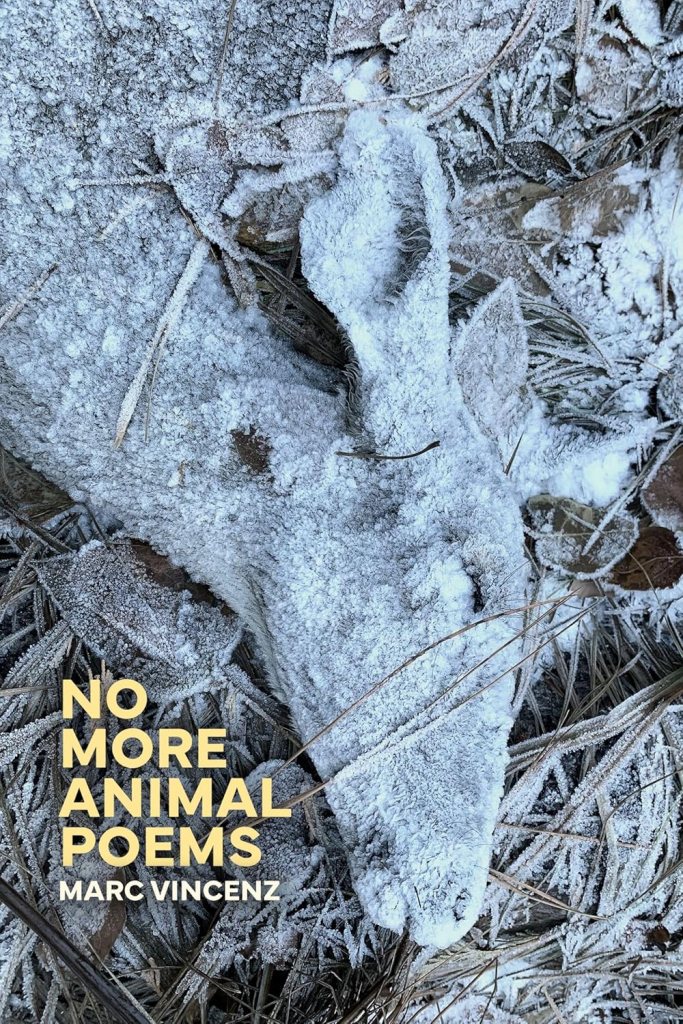
White Pine Press, 2026, 160 pp.
Review by Raymond Barfield
Over the years, I have learned to stay alert when I open one of Marc Vincenz’s books for the first time, because I don’t want to miss the surprises and clues he embeds before the first proper poems appear on the page.
His new book, No More Animal Poems, rewards this practice, beginning with a picture of a monkey wearing a NASA hat—Ham, the first great ape in space, to whom the book is dedicated. From there, the book proceeds with the calculus of a flower blooming, or a possum giving birth, depending on where you are in your journey through it.
Here’s a helpful hint for those who might be new to Vincenz’s inventive genius: Don’t skip the table of contents, because it is a table indeed, crafted as a preamble, or more precisely, a lavish and eccentric menu promising improbable dishes served by a chef whose expression says, “Trust me, I know what I am doing.” And on this menu, the prices are not listed.
This is a structural feature; the book withholds the language of “cost” in its initial presentation, only to introduce the costs slowly, poem by poem. But if you are someone who wants to know the costs before moving ahead, turn to the final pages where you will encounter “The Animal Extinction List,” which is a catalog of species that have disappeared from the face of the earth. The list’s shift in tone is immediate and severe. The opening menu’s playful excess gives way to a stark enumeration of the departed: Bubal hartebeest, Mascarene teal, Chiriquí harlequin frog, Carpathian wisent, Cebu bar-bellied cuckooshrike. Names, followed by dates, each entry marking a termination.
The list accumulates with the effect of a litany rather than a dataset. The response it evokes is not analysis but a kind of arrested attention, as the list uncomfortably reveals extinctions that happened only a few years ago while the rest of life clipped along, business as usual. What seemed historical becomes immediate.
Embedded in the brief introduction to this list is a passing reference to what biologists call the “Linnaean shortfall,” the gap between the number of species that have been formally described and the far greater number that existed without ever being classified. Many organisms, particularly among invertebrates, disappear without having been named. They pass out of the world without ever passing through language. This detail, easily overlooked, is central to what Vincenz is doing. His poems are saturated with names—some precise, some hovering between the familiar and apparent nonsense. This poetic act of naming renders in its abundance what the extinction list renders in deficit; if the scientific record is marked by absence—by the failure to name before disappearance—the poems compensate by naming extravagantly and boisterously in an act of preservation and an acknowledgment of the insufficiency of language to capture what has been lost, and what is being lost right now, even as I write these words.
Between these two poles—the exuberance of the opening menu and the austerity of the closing list—Vincenz’s poetry is marked by stylistic exuberance that is clearly deliberate and crafted for the awakening effect it will have on the reader. Much contemporary writing about environmental crises (climate change, mass extinction) addresses questions of such vast scale that they resist narrative compression. As valuable as it is, the result is often either abstraction (graphs, projections, summaries) or moral exhortation. Vincenz’s approach is neither to simplify nor to instruct, but to intensify—to produce, at the level of language, an analogue to the complexity he aims to register in his poems.
The poems sometimes grimace, sometimes play, and sometimes bow down. They move quickly between the languages of scientific terminology, culinary description, surreal invention, and cultural reference. At times the language proliferates centrifugally with linguistic invention that echoes Finnegans Wake. Other times, Vincenz clicks his tongue, and the voice of the poem turns colloquial, like he is chatting with us from his front porch, chewing on a toothpick. The felicitous counterpoint he achieves with this strategy means that the book is often very funny.
This, too, is part of the book’s method. Humor doesn’t show up to provide relief from the subject matter, but instead becomes a way of inhabiting, or perhaps better, enduring it. If some of the ways it approaches various poetic situations seem absurd, this is because absurdity is an appropriate mode of response to the cascading actions of human beings that deplete biological diversity under conditions we understand and perpetuate. The poems allow for a kind of laughter that does not cancel seriousness but rather intensifies the honesty of our bewilderment as the scale of consequences dawns on us.
This becomes most intimately apparent to me through the book’s sustained use of food as an ordering set of metaphors. The menu with which it begins is not an isolated conceit. Culinary language recurs, often in exaggerated or grotesque forms. Dishes are described in elaborate detail, and their ingredients are exotic and unlikely to show up in your corner grocery store. The effect is at once comic and disquieting. But his choice to frame things in this way reminds us of something that is frequently hidden in a world where cows are comically enlisted on billboards to promote chicken sandwiches, a peanut in a top hat advertises roasted peanuts, and a cheerful tuna lures us toward neatly canned fish in a way that feels faintly cannibalistic. To eat is always to consume creatures who were once alive. In industrialized contexts, food is frequently encountered as product rather than organism. Its origins are hidden, its transformations sanitized. Vincenz reverses this process. He renders consumption visible, forcing the reader to confront what is ordinarily displaced.
This might make us begin to feel uncomfortable. One becomes aware, perhaps more acutely than usual, that nothing one eats is ever neutral. Even the most ordinary meal participates in a chain of transformations that ends, inevitably, in death. The poems do not moralize this fact, but by exaggerating and refracting it, they make it strange again, which is crucial if we are ever to wake up to responsible stewardship of the natural world on which we depend and of which we are only one part.
This estrangement extends beyond food. In “Daddy’s Shrunken Heads,” the boundary between human and object is disturbed, disturbingly, urging us to pay attention to the need for balanced wisdom. The poem draws on an anecdote—explained later in the notes—about preserved human heads received as gifts. In the poem, these heads occupy a space that is neither entirely inert nor fully animate. They are at once artifacts and presences. The heads are about the size of tomatoes, he tells us, giving us an image that disrupts the easy distinction we are prone to make between the human and the nonhuman. His image was especially poignant to me, as I, too, experienced the haunting stares of two shrunken heads that occupied my Aunt Betty’s shelf of curiosities when I was a child.
It would be possible to situate all of this within a familiar set of intellectual coordinates: the so-called Anthropocene emphasizing our impact at a planetary scale, the post-humanist decentering of ourselves as the primary measure of value, and the recent work in ecology stressing interdependence and entanglement. Vincenz’s book clearly participates in this conversation, but it goes beyond naming its alignments by using dynamic drama and dialogue to enact them.
The structure of the book reinforces this approach. It does not move in a straight line from premise to conclusion. Instead, it invites a kind of recursive reading, moving from menu to poem to list to note, and then back again. Each pass alters the others. The playful dishes acquire a different resonance once one has encountered the extinction list. The list, in turn, is inflected by the poems’ playful vibrance and strangeness. The various sections, with their wildly varying languages, are themselves entangled and interdependent, creating a poetic ecology that holds together within the whole of the book, with meaning emerging not from any single element but from their interactions.
The initial lightness of the book becomes complicated. The humor remains, but the shadows become more prominent. The imaginative abundance of the poems, set against a background of actual loss, does not leave us with despair, exactly, but with a sharpened awareness of what is at stake.
When I finished reading the book, I thought about William Carlos Williams’s well-known lines: “so much depends / upon / a red wheelbarrow.” Williams reminds us to pay attention to the significance of the ordinary, properly seen. Vincenz’s book extends this intuition into a more expansive, and more troubled, field. It is not simply that so much depends on a single object, but that everything depends on everything, when all creatures are interdependent within an ecology whose fragile continuities are easily disrupted and not easily restored.
To register this fully would be to live differently. No book, simply by being read, can affect such a transformation. Vincenz’s book does, however, make it imaginable.
We must continue, of course, to eat, to read, to speak, and to act. But the ways in which we do so can be more deliberate, more attentive. As the book helps us to insert even a slight hesitation into acts that are otherwise automatic—a pause, perhaps, before consumption, or a moment of recognition and gratitude—we can close the book knowing we have been given a great gift which, like love, is not diminished by being given away, but multiplied. And that is the calculus of fecundity we must learn again if the earth and its creatures, including us, are to bloom and flourish. The alternative is a row of shrunken heads staring out, as in “Quantum Entanglement,” with spookiness as the last vestige of animation:
The space between you and them doesn’t exist.
They may be the mirror of each other, or they may be
not what we think; perhaps they are made of a spooky action
at a distance; or maybe, cause and effect occur at the same time.
✶✶✶✶
Raymond Barfield is a writer and palliative care physician in Asheville, North Carolina. He has published several volumes of poetry, a few books of philosophy, and three novels—most recently, Dreams of a Spirit Seer.
✶
Whenever possible, we link book titles to Bookshop, an independent bookselling site. As a Bookshop affiliate, Another Chicago Magazine earns a small percentage from qualifying purchases.

