
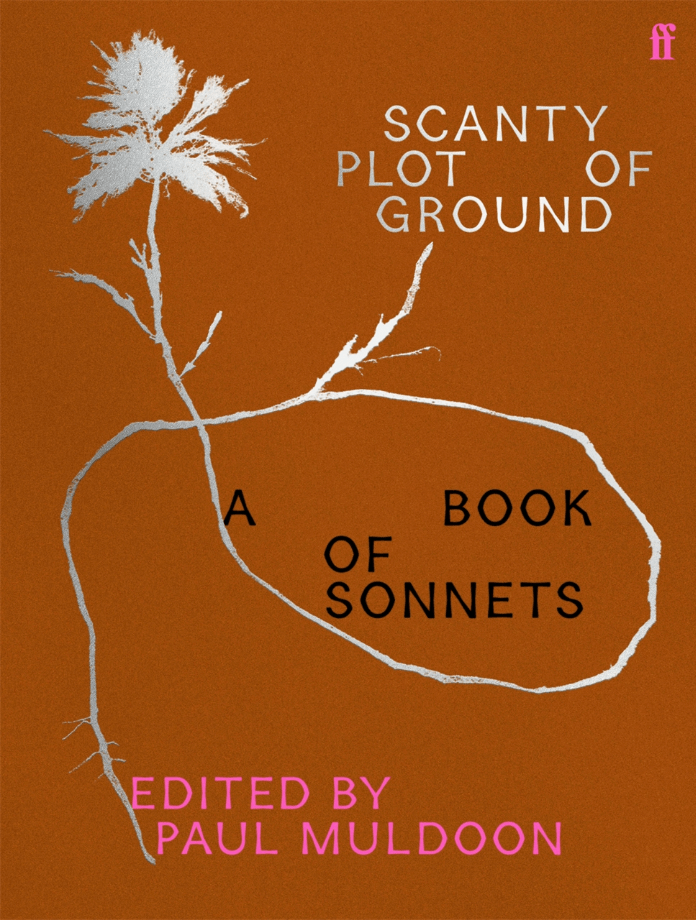
Paul Muldoon’s Scanty Plot of Ground gathers six centuries of the sonnet in English, alphabetized by the authors’ surnames. The editor’s contributions are the introduction and a handful of translations—Baudelaire’s “Correspondences,” Vallejo’s “Testimony,” Rilke’s “The Unicorn,” the scurrilous Verlaine-Rimbaud collaboration whose title is “Arsehole.” Otherwise, Muldoon stays out of the room he has built. That decision is itself the anthology’s first interesting move.
The introduction’s most important borrowed sentence comes early. Quoting Paul Oppenheimer’s The Birth of the Modern Mind, Muldoon agrees that the sonnet was “the first lyric form since the fall of the Roman Empire intended not for music or performance but for silent reading.” Oppenheimer’s larger claim, which Muldoon also quotes, is that the sonnet is “the first lyric of self-consciousness, or of the self in conflict”—a new architecture for thinking about the person, one in which “emotional problems, especially problems in love” might be “actually resolved, or provisionally resolved, through the logic of a form that turned expression inward.”
That is the deepest available claim about why the sonnet has persisted, and Muldoon names it cleanly. What he does not do is push it. The introduction sets the Oppenheimer paragraph down and then walks toward safer formulations—the form’s “chaos and control,” its “grave restraint and giddy release,” the room with its “few basic house rules.” These are useful, but they are not what Oppenheimer is offering.
If the sonnet really is the first lyric architecture built for the silent reader’s own mind, then an anthology gathering six centuries of its practice is not a museum of formal pleasure. It is a history of consciousness under compression. Helen Vendler’s argument across her work on Shakespeare and Keats—that the sonnet performs the mind moving through a problem in real time, making and unmaking and remaking its position before the volta arrives—is the critical tradition the anthology gathers without quite entering.
The walk-back is gentle. It is also editorial. “Chaos and control” is anthology rhetoric; the “first lyric of self-consciousness” is a claim with consequences. Muldoon prefers the first, and the anthology that results is intellectually more cautious than its own sources permit.
The borrowed title does similar work. Muldoon takes “scanty plot of ground” from William Wordsworth’s “Nuns fret not at their convent’s narrow room,” where the phrase is Wordsworth’s own figure for the sonnet: it was, he writes, “pastime to be bound / Within the Sonnet’s scanty plot of ground”—the self-imposed prison that, in the poem’s own paradox, “no prison is.” The introduction notes that the sonnet’s “fret” carries etymological weight—interlaced pattern and shackle both. The note is precise as far as it goes, but it does not mention that Wordsworth’s actual subject in the source poem is religious enclosure. The nuns who do not fret at their convent’s narrow room are figures, in the poem’s logic, for souls that have chosen their constraints; the sonnet’s “brief solace,” in Wordsworth’s phrasing, is offered to readers who “have felt the weight of too much liberty.” The poem is anti-revolutionary, theological, and turned against the imagination of unbounded selfhood.
Muldoon takes this title and uses it as a formal metaphor. The editorial sleight is fair; titles travel. It is also of a piece with the Oppenheimer walk-back. The introduction is comfortable with the sonnet as constraint-as-pleasure and warier of the sonnet as enclosure-as-spiritual-discipline. Both readings are available in the room Muldoon is curating. The introduction prefers the first.
✶
Muldoon’s editorial theory of the individual poem is more permissive than his editorial theory of the larger structure. Tennyson’s “The Kraken,” fifteen lines, is included—a poem whose status as a sonnet has been argued and not always conceded, but which Muldoon, following Carl Phillips’s account of the form’s “tolerance for innovation,” is willing to admit. Terrance Hayes’s “American Sonnet for My Past and Future Assassin” is in too, presented as a single poem rather than as one of the seventy in Hayes’s 2018 sequence.
The elasticity at the level of the line is real. What is less evidenced is interest in the architectures a poet builds across many sonnets. Hayes’s sequence is a sustained argument; Muldoon shows us one of its sentences. The alphabetical-by-surname structure of the anthology reinforces the preference: it sets each poet beside the next without the contexts of sequence, country, or moment.
Form is admitted in many configurations. The architectures larger than the single fourteen-line room are quietly set aside. What an editor leaves out can reveal more than what he admits—not the choices he makes, but the ones his frame makes for him. The sharpest omission here is of exactly that kind.
Edward Thomas is in the anthology. Dylan Thomas is in. Welsh-born George Herbert is in. The Welsh tradition in its romantic, modernist, and metaphysical-by-birth modes is acknowledged. What is missing is the twentieth-century Welsh tradition in its specifically religious-formal mode—the figure who would have given Oppenheimer’s claim its sharpest contemporary test.
R. S. Thomas is not in the room. Neither is Henry Vaughan, the seventeenth-century Welsh metaphysical who followed Herbert and would have made an obvious neighbor.
These omissions are more legible against the rest of the table of contents. Muldoon’s Irish list runs to seven poets across the modern century—Yeats, MacNeice, Kavanagh, Heaney, Eiléan Ní Chuilleanáin, Michael Longley, Ciaran Carson. The African American list runs to seventeen—including Hayes, Wanda Coleman, Tyehimba Jess, Marilyn Nelson, Reginald Dwayne Betts, Rita Dove, Robert Hayden, Claude McKay, Gwendolyn Brooks, Patricia Smith. Both inclusions are sustained by deep engagement: the Irish from the editor’s own life, the African American from years of deliberate reading, marked in the introduction by direct quotation from Coleman and Hayes and by the citation of Timo Müller’s literary history. The Welsh tradition in English, by contrast, is reduced to two or three well-known anglophone exports.
R. S. Thomas’s absence does not read like a mere oversight. He is, by most accounts, the most important practitioner of the religious sonnet in English in the second half of the twentieth century. The sonnets in Thomas’s Counterpoint (1990) and Mass for Hard Times (1992) engage the form with a discipline and a Welsh-located religious seriousness that nothing else in Muldoon’s selection approaches. They are sonnets of an interior life under pressure—rural, severe, metaphysically compressed, made of voluntary enclosure rather than performative compression. They are, in short, what Oppenheimer’s claim would lead a fully committed anthology to gather. They are not here.
The Welsh omission is consonant with the introduction’s hesitation. A curator who is comfortable with the sonnet as a room of “chaos and control” but wary of the sonnet as the discipline of the soul will tend not to recognize R. S. Thomas as central.
✶
To say this is not to slight what the book contains. The religious sonnet is present in its older and more cosmopolitan forms. Donne’s “Death be not proud” is in. Herbert’s “Redemption” is in. Hopkins’s “The Windhover” is in. Milton’s “When I Consider How My Light Is Spent” is in. These are decisions made by a serious reader of the form.
Herbert’s “Redemption” earns its place by doing exactly the work the Oppenheimer claim makes available. The poem is fourteen lines of an extended conceit: the speaker, “having been tenant long to a rich Lord,” resolves to seek a new lease, goes to heaven, finds the Lord has come to earth, hunts him through the world’s “cities, theatres, gardens, parks, and courts,” and at last locates him among “a ragged noise and mirth of theeves and murderers.” The volta is the last line: “Who straight, Your suit is granted, said, & died.” The form does the work no other lyric structure could do at this length. The proposition is set down. The hunt unfolds across the octave and the first half of the sestet. The pivot arrives in the final couplet and reframes everything that came before. The poem performs, in real time, the cognitive structure of a man arriving at the Crucifixion as the answer to a question he did not know he was asking. Vendler’s argument about the sonnet as the architecture of reflective thought finds, in “Redemption,” its plainest demonstration.
Claude McKay’s “If We Must Die” does the work in a different key. The poem is sometimes read as militant exhortation, and it is that. It is also a structurally precise demonstration of what the form’s enclosure makes possible politically. McKay’s figures of being “penned,” “constrained,” and “pressed to the wall” are inside a sonnet because the form’s pressure mirrors the pressure he is naming. The sonnet does not merely contain the resistance; the sonnet is the resistance, articulated through the constraint that would otherwise have silenced it. Muldoon notes the “penned” pun on the Federal Penitentiary, which is good, but the deeper point lies a half step further: McKay needed the sonnet because the sonnet had the architecture of an interior life under siege, and his political subject was an interior life under siege.
These two poems are the anthology’s best evidence for the case the introduction declines to make. They are not the only such evidence, they are the clearest.
✶
The sonnet, on Oppenheimer’s account, survived for reasons that have little to do with the marketing categories the contemporary anthology business sometimes uses to defend its persistence. The form survived because its shape is that of reflective thought under pressure—proposition, complication, turn, recognition, closure that does not pretend to be resolution. Vendler is the critical tradition that has worked this ground most fully. Christina Pugh, whom Muldoon himself cites, has worked it. Carl Phillips, also among Muldoon’s cited sources, has worked it. The anthology gathers the evidence for the thesis without quite making it.
The book is generous, the selections substantial, the introduction intelligent and tactful. It is also a missed opportunity. The question Muldoon almost asks—what bounded form does for consciousness under pressure—is among the questions this moment is most failing to ask. The omissions are symptomatic, and not of Muldoon alone: the frame that prefers the sonnet’s “chaos and control” to its discipline of the soul is the frame of the moment, which is why the choice goes unremarked. R. S. Thomas is the absence the Welsh reader will notice first. The reader of any nationality with patience for what the form can do will notice the larger one: the deepest argument is gathered into the anthology and then not quite spoken.
✶✶✶✶

Jeffrey-Michael Kane lives in New Orleans, where he works as an environmental attorney. He is the author of the nonfiction book Quiet Brilliance: What Employers Miss About Neurodivergent Talent—and How to Finally See It (Collective Ink, 2026). His essay, “Nomenclature of a Life,” cataloguing his experience as an ASD-1, was awarded the 2025 Ellis Prize for Nonfiction by New Ohio Review. His writing has appeared in cultural, theological, and literary journals that appreciate compression—and his willingness to obey word counts.
✶
Whenever possible, we link book titles to Bookshop, an independent bookselling site. As a Bookshop affiliate, Another Chicago Magazine earns a small percentage from qualifying purchases.

