
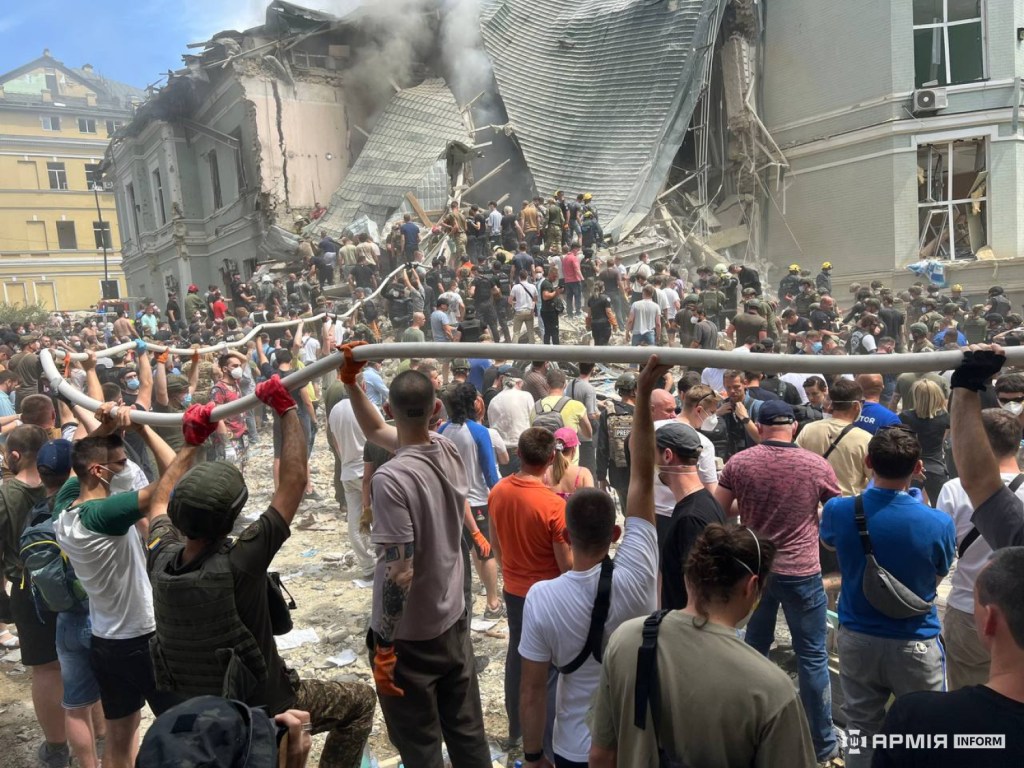
2023, Houston
Hidden Life
The old cashier at Kroger, once a teacher of English in Kyiv,
calls everyone “my dear.” She tells me in Ukrainian
about the newborn killed in a missile strike, and—
to the next in line—“I’ll clip the coupons for you, my dear.”
In Hebrew, the joy we feel for others despite
our own sorrow is embraced by one word—firgun.
I feel joy watching children as they cartwheel
and toss balls on Astroturf at Bellagreen.
I feel joy about Brahms’s “frei aber froh” movement,
so consonant with heartbeats in Jones Hall.
From the bridge over the ship channel I recognize the view
with refineries that feels like home to you, my friend:
the way I felt for years in Donetsk about terricones
of coal mines—my father’s hidden life underground.
The hidden life matters most in this vortex
of highways & wards—this convex mirror
reflecting those on whose shoulders we stand.
What are the odds that you from Pleasantville would’ve
met me thanks to photos by Gordon Parks and letters
of farmer Franz Jägerstätter, guillotined for refusing
the oath to Reich? Still, it’s cognitive dissonance:
at noon I Zoom blacked-out Kyiv; at the post-
concert dinner my mind unconsciously translates
the check to hryvnias—banknotes that could’ve bought
more QuickClot Combat Gauze. But…
My palm has grown the line of life where it was interrupted.
My eyes have grown attached to southern live oaks.
Astros hats, quinceañera dresses, hijabs, kofias, baby strollers—
I feel joy walking by picnics at Hermann Park; feeding
squirrels, with Nina Simone in my headphones. “Dragonfly
out in the sun, you know what I mean,” if you look closer:
the wandering glider, who might’ve flown thousands
of miles through tropical doldrums, and here she is, circling
Houston pine. Her filmy wings endured storms, now glow.
If it’s not a wonder, my dear, what is it?
August 2021, Kyiv (before the full-scale war)
1. At St. Andrew’s
Spare me from “Ukraine is awesome—churches, women, Chicken Kyiv.” Yes, it is, but when you order basic Valpolicella with a view to Saint Volodymyr’s Cathedral, toast older Ukrainians whose pension approximates the cost of that bottle. There are millions—arthritic, with failing hearts and silicotic coughs, who plant potatoes not for fun, and pass roadblocks in the war zone to collect a subsidy on the other side. Thousands have lost their sons in Donbas. The rest curse revolutions and vote for peace, as if it were possible with the wrists of borders bleeding.
But yes, Ukraine is beautiful: Carpathian songs spilling wildflowers, sandy spits in the Sea of Azov, hills with shiny domes embraced by autumnal forests that you can’t take your eyes from, while standing on a shaky bridge above the Dnieper, where the roar is obnoxious, but feels good.
The last time, when I (an émigrée calling an Uber for the airport) walked down the wet cobblestones of Kyiv’s Upper Town, a rainbow arched above the cyan baroque of St. Andrew’s church, Bulgakov’s house, and yellowish art shops. For half an hour, I stood without an umbrella in the sunshower and listened to the streams of my native language.
February 2022 (the first week of the Russian invasion)
2. WhatsApp
I call my father to ask how he lived through the day. Nights of explosions when he keeps lights off, I see his eyeglasses glimmer in the dark. Nights he gives me pep talks, as if he weren’t close to airstrikes, I ask him about leftovers of firewood and bread, about what he read, what he felt— everything that he wouldn’t speak of before the war.
March 2022, a village in Kyiv Oblast
3. Return
Where it started, there it ends—a Ukrainian village. After we left our homes and tombs in Donetsk, there’s black soil—plant a new Eden not far from explosions, repay counter-drones with rare earths.
As a child, my dad didn’t know what grain confiscation meant. But he felt it with his ulcer as he saw—on Kyrnasivka square—the swollen bellies of neighbors trying to trade a primus, old boots, war medals for a few grams of bread.
Decades later, looters headed for Kyiv. (A bullet or a month in a frozen cellar?) Afterwards, my father’s wife found her ex in Irpin—an old man who could no longer walk. He rationed one pack of ramen noodles for thirty soaks in his icy bucket.
They brought him home, spoon-fed him for weeks, until he mended. Unlike his even older neighbor, artist Lyubov. She shared the last tin with her dog and left a hospital ward in her sleep—sunken cheeks, a white shirt with embroidery.
April 2022
4. Wake Up in Ukraine
It’s nuts. At night I wake to the shuffle of rushing soles,
to shouting: “Ambulance—she’s still breathing!”
At night I soar above the crater left by a Russian bomb.
Then soil closes above me tossed with my people in plastic bags.
At night I hover in the abyss of charcoaled stairs at Obolon,
weeping to God or NATO: “Close the sky. Close the sky.”
September 2022, Kyiv
5. Ptashka—
little bird in Ukrainian—a 20-year-old paramedic who sang folk ballads to the soldiers in Mariupol’s dark, besieged “Azovstal.” Swapped for several Russians, she is finally back from a hospital after beatings by guards. Her smile is still blithe, the silt of pain buried deep in the lakes of blue eyes, when she says how she missed kava—Turkish coffee sipped alfresco in Old Kyiv—and squints at the October sun caressing her dear cobblestones and passersby.
October 8/9, 2023
6. Jubilee
My cousin in Netanya takes his son to the pool where a man brings a boy with cerebral palsy, and follows his swim with a camera—to show on WhatsApp to the boy’s father, who is usually in foxholes at Bakhmut or my hometown. To show not the boy’s progress, but rather being safely afloat, somewhat smiling.
I WhatsApp my cousin on his jubilee. He was born the day after the Yom Kippur War started, and here again: rockets, hostages, my aunt fainting. Can we celebrate anything without a backdrop of mourning, or—unlike the other day in Ukraine—even mourn, not adding at the memorial half a village to the slain?
O Heavenly Father in the sky full of rockets. My father in Kyiv… My nephew quits Tzahal. The boy swims towards his dad in a foxhole.
2023–25, Houston
7. No-Fly Zone
i. Bird Feeder
A cardinal snacks on sunflower seeds. Two feet from the feeder to my patio table—blue, with yellow chairs just painted by my father.
A year together. Three days he’s been back in Ukraine, in his safe village…
“He’s got family,” I lull my conscience—bitch.
The bird feeder (the forked leg of whose iron pole my dad straightened to pull the squirrel baffle on)—the heart of my yard. It’s full of flying beings. Wrens with chickadees. Finches, klutzy doves. And here is my favorite—the cardinal.
Buses. Buses to the no-fly zone. Pushing bags forward and hopes forth.
Kraków → border→Lviv → Uman → Kyiv.
Dad stopped by Kraków; I saw him in a dream, an aged traveling monk: coarse gray frock with a cowl and a rope belt.
The monk? Even in Mom’s hospice ward he never talked beyond things to bring, buy, or fix —anything but intangible, winged, of Spirit. But doesn’t Spirit mean love in verb form? Why can’t I, a birder, fix father’s burdens? As my neighbor says: “Bring ‘em all from Ukraine.”
ii. A Bird from Ukraine
My scarlet joy looks at me and continues pecking seeds of safflower. A blue-eyelidded dove swings the feeder, glancing through me—the hollow suburban queen of lawn—invisible, with no dream, except for one enormous, like our aircraft destroyed by Russians—“Mriya,” Ukrainian “Dream” to rebuild.
iii. Propping Up
I press myself to your shoulder blades, so you would see the eagle in the blue—lean on me and lift your eyes without losing balance. A long-COVID gift… Now, only the present is in our hands.
Is it? The eleventh year of war reaches my father’s wife with radiation. A cellar of apples she won’t juice. Dizzy, unknowing in her eighties. How can I brace her? Fly them both from Kyiv—heal in the land of your unaffordable American dream? A bird demoted to human condition. Migrated for love. Mute at the foreign grief Olympics. A hundred thousand words learned with no use—I can’t even finish this poem.
✶✶✶✶
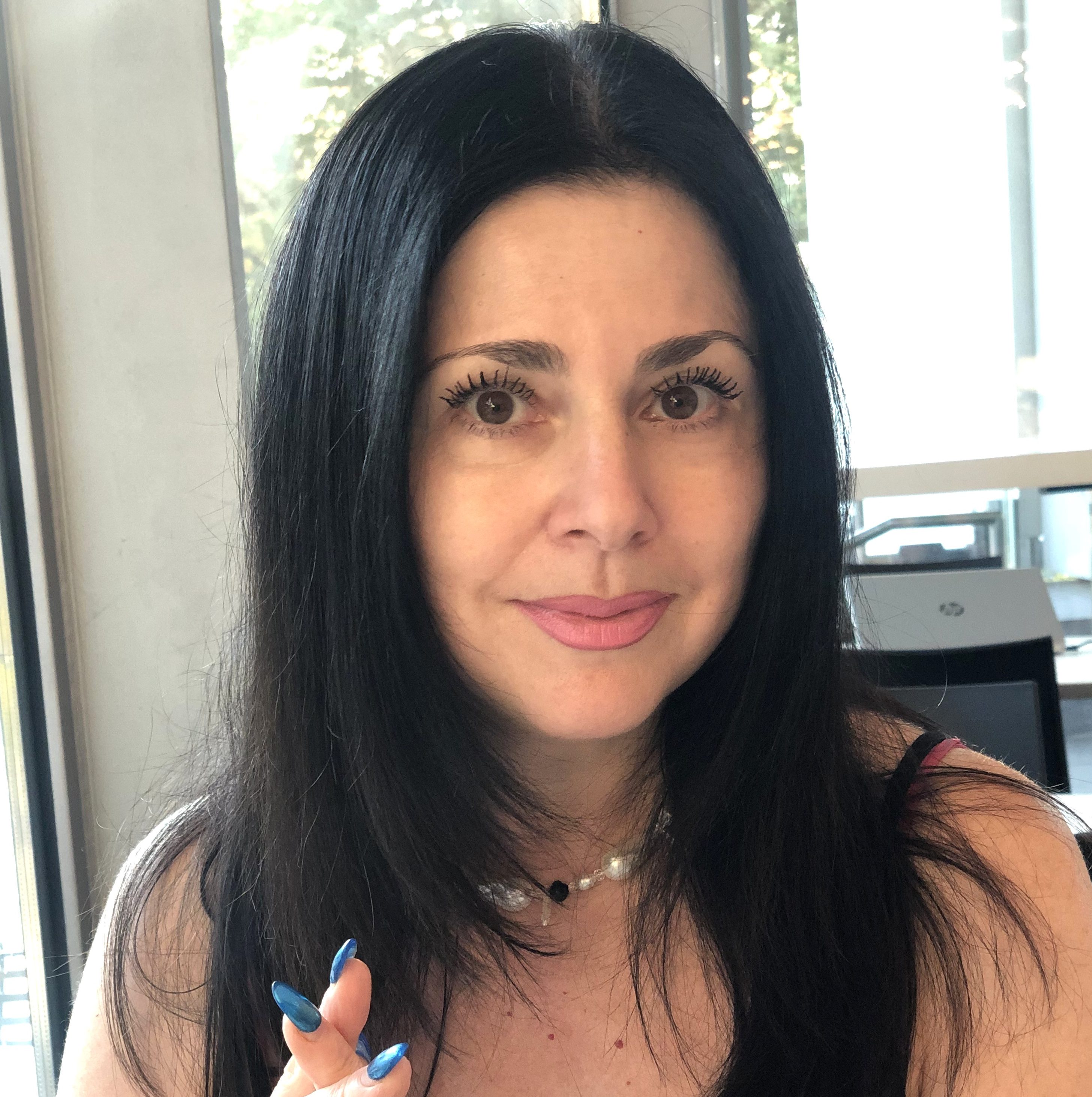
Until 2007 Elina Petrova lived in Ukraine, where she worked in heating engineering management. In 1998, in her hometown of Donetsk, she published her debut book in Russian and received the First Prize of the International Poetry Contest at the Text Festival. Shortly after immigrating to the United States and starting a new career as a paralegal, Elina began writing poetry in English, a language she taught herself. Her U.S. publications include Aching Miracle, 2015, and Desert Candles, 2019. Elina’s poems have appeared in Notre Dame Review, Texas Review, Chicago Quarterly Review, North Dakota Quarterly, Southwestern American Literature, Sequestrum, Porter House Review, Pedestal, California Quarterly, and a short film featuring her poem won the Best Cinematic Poetry award at the 2023 Miami Chroma Film Festival. “A Bird from Ukraine,” the winner of the Mutabilis Press contest, is her 2026 chapbook.
✶
Whenever possible, we link book titles to Bookshop, an independent bookselling site. As a Bookshop affiliate, Another Chicago Magazine earns a small percentage from qualifying purchases.
 Another Chicago Magazine