
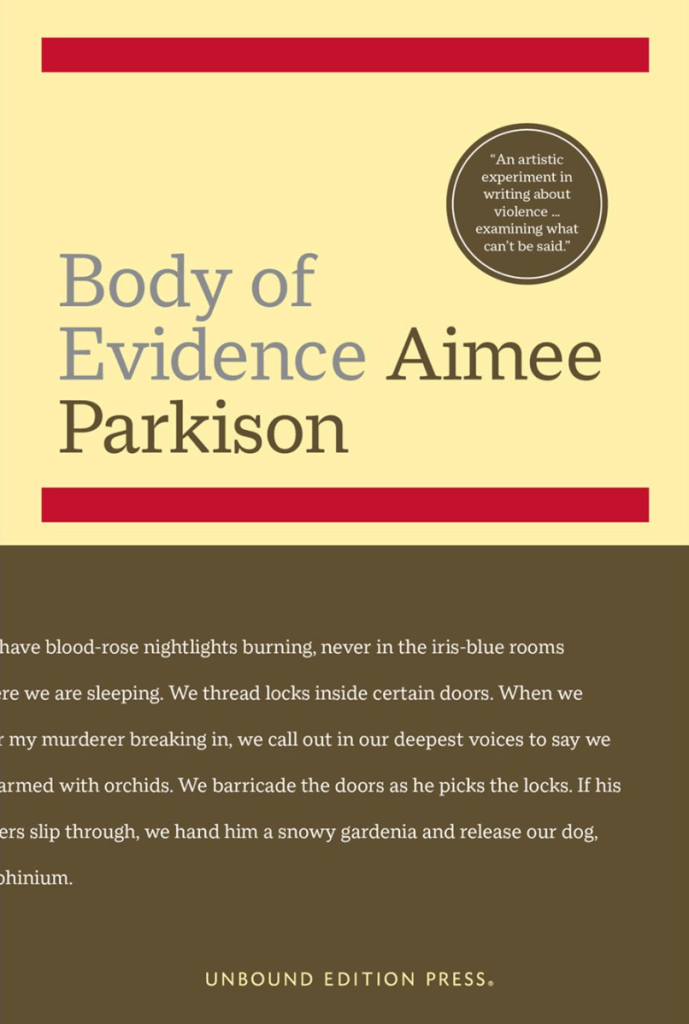
“Body of Evidence,” Unbounded Edition, October 2025,180pp.
Body of Evidence crosses boundaries between story and confession in a haunting speculative collection that confronts the aftermath of gendered violence by blurring the divide between fiction and nonfiction.
Speculative fragments and nonlinear prose explore what remains unspoken in trauma’s generational echoes. Avoiding graphic representations, Aimee Parkison examines how violence reverberates through communities and individual consciousness.
Structured as exhibits in a case file, this hybrid mosaic challenges traditional storytelling to make invisible wounds visible. Each piece functions as both artistic exploration and cultural investigation, questioning how silence operates in survival. Through the constraint of compression, Body of Evidence demonstrates how micro narratives can serve as witness and testimony.
✶
1.) That Word
You always feared that word whore. Like a nightmare someone else dreamed where waking brings you back, that word has power to change you until you wonder why people started to call you that. People say whores don’t have families. People say whores don’t have dreams. People say whores aren’t really people. After descending into the basement, you act as if you never went, as if you have no idea what the basement really is or what happened there. Even though you left the girl you once were in the basement, you spent the rest of your nights pretending it didn’t happen.
2.) Stolen Perfume
Don’t be afraid to mourn her by raiding dead women’s closets, your mother’s and sisters’ closets, your grandmother’s attics, your sisters’ panty drawers. Go to garage sales and buy used underwear in many sizes. Pretend it’s all for you. Make a girl out of cardboard tubes, old socks, nylons, used wigs, buttons, Styrofoam, paint, and cheap makeup. Dress her in used clothes, bras, lingerie, broken costume jewelry, and gloves from thrift shops. Use super glue, white glue, hot glue, rubber cement, string, clay, and wire with pipe cleaners to shape and bind her into the womanly form. Marbles can be used for lively eyes. Style her wig and apply the makeup delicately to her face to give color and appeal. Give her a name. Douse her with stolen perfume and tell her goodbye.
3.) The Not-You
A teenager, I explored old junkyards and found a graveyard of cars on my way to the river. I loved the sparkling waters but won’t say what happened there because I’ve spent the rest of my life not saying. The river flowed to the edge of town where the woods began. In that place between the town and the woods, where the woods became fields, the river threaded the fields all the way to the city. Men chased girls the way hunters tracked deer, wild turkey, and feral hogs. My grandmother once told me she was hunted where fields became darkness at night. The river trickled to sundown when men stumbled onto flesh dressed in blood, hardened like old bread, but by dawn, they found what they never wanted to see—girls with dignity who had learned things their fathers didn’t want them to know. “Grandmother,” I wanted to ask, “did you become not-you, the way I became not-me?” I never had the nerve to ask because I didn’t want her to wonder who I was. I didn’t want to risk becoming a stranger to my own grandmother. Once I stopped being me, washing blood off in sparkling water, I befriended a pregnant girl with a baby. I ran away to Grandma because the girl sent me to her. “Once a girl has a baby,” Grandma said, “men who hunted her pretend not to see their eyes in the baby’s eyes.” (I see you.) Grandma lost the girl she had been when she held the girl she called daughter. My mother. Grandma tells stories of those days when she was hunted along the river, and I see the girl my mother once was staring through her eyes, speaking to me in wordless ways. Run. What are you doing? What are you waiting for? Run! While you still can, run, girl! Run! I want to tell her what happened in the basement, the reason I ran to the river.
4.) Down There
Don’t go down to the basement. Don’t let men or boys take you there. Don’t even go with the boy you love, the boy you secretly want to love you. Even if he’s nice to you, even if he says he loves you, don’t follow him down. Down there, I’m sorry to say, there are others. Whichever boy you think you are descending with, it’s never only him. If you belong to one boy, you belong to all. If you agree to go down there with the boy you like, you agree to go down there with the boys you don’t. They are all waiting for you. If you walk down those stairs, the girl you are now will become the girl you were. Lost in the basement, she will leave you, disappearing.
5.) The Acrobat
I made the mistake of telling. It kept replaying in my brother’s mind because he wasn’t there. I suspected no one would ever catch him. I wanted to be that way. On the news online, his stolen motorcycle crashed at 80 miles per hour during a police chase. My brother disappeared. His body, with the motorcycle, vanished in smoke from the burning van. The camera panned to shop windows, empty sidewalks. Cops exited their vehicles before walking through smoke. I paused the video, searching asphalt. In midair, my brother summersaulted like an acrobat in rust-colored spray. His jeans tore free as blood clouds streamed. Liquified organs escaped his body to paint a burgundy stain on the sidewalk, a “meat crayon” scrawling over memories of a girl in the basement.
✶✶✶✶

Aimee Parkison is the author of eight books, including Refrigerated Music for a Gleaming Woman, winner of the FC2 Catherine Doctorow Innovative Fiction Prize. Her stories have appeared in over 100 literary journals. Parkison teaches in the creative writing program at Oklahoma State University and serves on the FC2 board of directors. Her recent books are Suburban Death Project (Unbound Edition, 2022) and Disappearing Debutantes (with Meg Pokrass, OutPost19, 2023). “Sister Replay” is from Body of Evidence (Unbounded Edition, 2025) which examines the aftermath of violence against women by avoiding actual depictions of violence. This project is supported by a Humanities, Arts, and Design Grant from OSU.
✶
Whenever possible, we link book titles to Bookshop, an independent bookselling site. As a Bookshop affiliate, Another Chicago Magazine earns a small percentage from qualifying purchases.
 Another Chicago Magazine