
This week, ACM is posting book reviews every weekday.
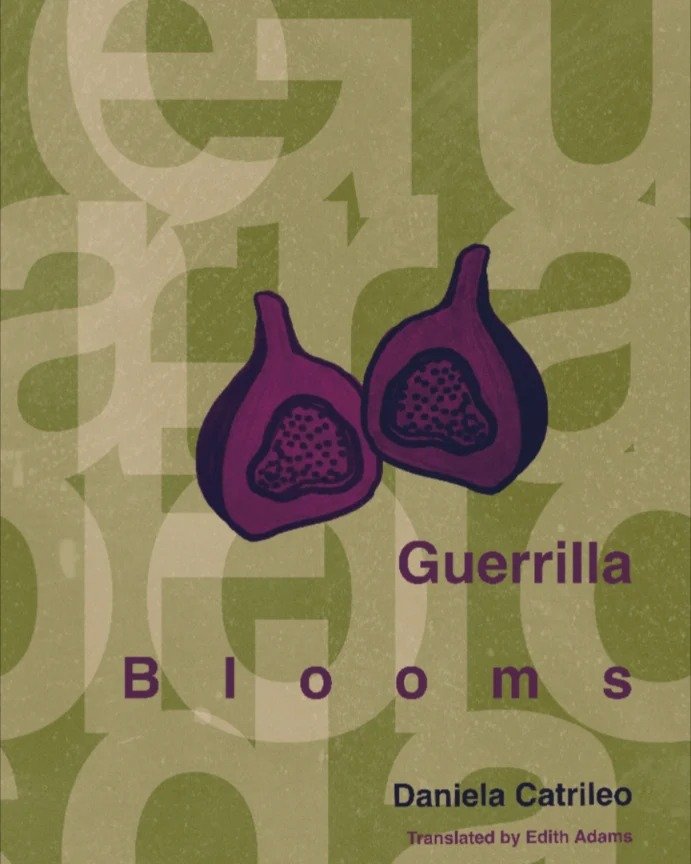
Guerrilla Blooms is the first book of poetry by Daniela Catrileo—a Mapuche feminist writer, artist, and activist from Chile—to be published in English. In this volume, Edith Adams’s translation is followed by Catrileo’s original Spanish text and Arturo Ahumada’s Mapudungun (the Mapuche language) translation, which appears in light font just below the Spanish.
The creator of audiovisual performance art pieces and the author of five books of poetry and prose, Catrileo co-founded the Colectivo Mapuche Rangiñtulewfü, a Mapuche diaspora collective whose members use art and literature to spark dialogue as well as resist erasure and oppression. She is also co-editor of the related literary magazines, Yene and Traytrayko, and was awarded the Santiago Municipal Literary Prize in 2019 for her short story collection Piñen and in 2024 for her novel Chilco. Adams is a literary translator and an alumna of the Bread Loaf Translators Conference and the Banff International Literary Translation Centre; she is a PhD candidate in comparative literature at the University of Southern California, where she is writing a dissertation on colonial naming practices in Latin America and the Caribbean.
The first texts that we encounter in Guerrilla Blooms are the epigraph—a quote by Gabriela Mistral in Spanish, accompanied by its Mapudungun translation—and a few short opening lines of poetry in Spanish, Mapudungun, and English. Thus, even from the book’s initial pages, Catrileo and Adams invite the reader to wade into the waters of champurria, a Mapuche word that, in contemporary times, refers to the mixing of Indigenous and European peoples, languages, cultures, and identities. It is a word that also appears throughout the verses of Guerrilla Blooms and illustrates the simultaneously subversive and preservationist intentions behind Catrileo’s writing.
The book is divided into four narrative-like chapters of continuous verse that correspond to stages of war, from invasion to aftermath. The verse is the song of a female Indigenous speaker, alternately individual and collective, who mourns her dead, confronts her aggressors, and dreams up an alternate reality. Catrileo’s florid, visceral writing traverses the centuries—from the so-called Conquista, Spanish term for the brutal colonization of the Americas, to the modern-day capital city. It is a lyrical and nonlinear chronicle that spans the arrival of invaders armed with “old maps” and “steel fire” to urban streets studded with bars and patrolled by police known for their brutality. Guerrilla Blooms is a poetic record of war, a mourner’s lament, and a vindication all in one; wild landscapes and harsh cityscapes are inhabited by souls worn down by centuries of violence, yet still determined to forge their own narratives.
The violent colonial history of the Americas and the subsequent genocides and forced dislocations of Indigenous peoples were not the only events on the poet’s mind. She began to write what would become Guerrilla Blooms beginning in 2011, during a period of intense student protests in Chile. She recalls hearing the clamor of the streets in the background as she wrote fragments of poetry, where dreams, images, and rhythms often came to her before words did.
The champurria pride that resonates throughout Guerrilla Blooms echoes the reclaiming and resignification of the pejorative terms cholo in Peru and pocho in the U.S.-Mexico borderlands. In fact, Catrileo sees a clear connection between the Mapuche experience and that of other Indigenous and Afro-descendant peoples throughout the Americas. For example, the author characterizes Guerrilla Blooms as having a purposeful “excess of images,” intended to counter a specific device of war utilized by European colonizers: the imposition of imaginaries and icons meant to overwrite Indigenous ones. “Nevertheless, there remain oral shards, languages, codes, weavings, signs that look like splinters, buried fragments that today are flourishing,” she comments in an introduction written for this edition.
Catrileo’s images are not only abundant—they are fragmented, mirrored, irreal yet rooted in reality; shifting, delirious, tangible but untouchable. The word “kaleidoscopic” came to mind, even before I arrived at the following passage in “Mantra of the offense,” the book’s second chapter:
Tonight we are
a kaleidoscope
at the center of the pacific
trying to return
to the light of its colors
where a sea of ashes
mourns
and our scattered
hair sways
in ancient braids
like cliffs from their rocks
For Catrileo, the efforts of ancestors to ensure the survival of their cultural and linguistic fragments through syncretism were both a gesture of love for future generations and a tool of resistance. In Guerrilla Blooms, Catrileo carries on this tradition, unearthing shards, joining them together, and encrusting Mapudungun, Nahua, Quechua, Taíno, and Yoruba words into her writing like inlaid jewels. Adams rightfully preserves these in her English translation:
She wants to dance this night
of skulls without flags
to smoke on buds in bloom
between seas
cactus and desert
between jungle and dew
To lay outstretched beneath heavenly bodies
of ancient gods
and reject her forefathers
I called her
Ngünchen & Quetzalcoatl
Negrita Ñaña Compa
Catrileo’s champurria lyricism applies two robust forces to language. The first refracts Spanish itself, in its twenty-first-century incarnation, revealing Indigenous and African frequencies as intrinsic facets of a global tongue often perceived as white and European in origin. Furthermore, the presence of Ahumada’s Mapudungun translation is a reminder of the other side of the story, the one that was preserved for posterity between the lines and outside the margins of historical documents written in Spanish.
The second force exerted by Catrileo’s writing springs inert syllables into motion, launching them off the page and back to their elemental roots of orality, musicality, and humanity—affirming by example that all poetry is born from embodied, spoken, or sung traditions. Given the primacy of rhythm in Catrileo’s writing, Adams shares in her translator’s note that she strives to achieve a “complementary vitality” in the English translation. Her efforts bear spirited fruits, such as in “Apocalypse song,” the book’s third chapter:
It’s hard to say:
is this a tapir
or
is it fear
I can’t decide
if the image existed
in this universe
of things
Because
tapir and fear
lay outstretched
in repose
before the eclipse
prior to their words
Just as I was also myself
before this poem
As the champurria kaleidoscope of words and images rotates, some through lines emerge: cycles of night and day; burning and extinguishing of fires; sleeping, dreaming, and waking; violence, blood, and death; conjuring of spirits, protective rituals, and celebrations; offerings and sacrifices; losing and finding.
Catrileo paints nature in opulent detail, but not as an idealized, peaceful landscape inhabited by the mythical noble savage. Catrileo’s Mother Earth is at times a passive, silent witness to ongoing violence; a refuge for warriors lying in wait; a living messenger signaling to the resistance; and a keeper of scars and memories. And even though humans have buried the Earth beneath the pavement of city streets, the animal species that have survived are witnesses too—symbols of immortal spirits living in unbroken time, where past, present, and future coexist.
I believe Guerrilla Blooms can be read as an individual and communal healing exercise, and its translation into English has rehabilitative properties. Catrileo attributes colonialism’s papering over of the “world that existed before” in the Americas to a certain “untranslatability” that fueled the colonizers’ zealous urge to dominate. Adams’s attentive efforts to bring the collection into English challenge the xenophobic impulses of colonialism and invite modern readers to resist such tendencies in our own times.
Leaning on her intimate knowledge of the languages and context of Catrileo’s writing, Adams has managed to attune herself to the underlying, non-semantic qualities of the text and has endeavored to create an embodied, multidimensional translation. In the United States in 2025, the sounds in the background may not be the same ones Castrileo heard when she began writing Guerrilla Blooms, but today’s backdrop makes her model for countering the dominant narrative—and drawing on our collectively kaleidoscopic ancestry to construct the future—all the more compelling.
✶✶✶✶

Emily Hunsberger is a writer and translator from Spanish. Her translation of Wonderland: Crónicas of Belonging in América, a collection of essays by Melanie Márquez Adams, was recently published by Mouthfeel Press. Her translations of shorter works have appeared in Latin American Literature Today, The Southern Review, PRISM International, The Common, Southwest Review, and forthcoming in Grist. She has also published poetry, criticism, reporting, and research in English and Spanish, with work appearing in Anfibias Literarias, Spanglish Voces, Bello Collective, Latino Book Review, and Estudios del Observatorio / Observatorio Studies. She lives with her family in Philadelphia.
✶
Whenever possible, we link book titles to Bookshop, an independent bookselling site. As a Bookshop affiliate, Another Chicago Magazine earns a small percentage from qualifying purchases.
 Another Chicago Magazine