“The poet’s love-hate relationship with her laptop becomes fully realized in ‘Off the Web,’ as too much time on the internet leads to feeling ‘my dress / gather headwinds and swirl, then lift
like / Marilyn’s over a grate,'” writes Richard Holinger.
(review)
Author: Another Chicago Magazine
What’s wrong with circles? What shape is your wedding ring?
(drama)
I’ve chosen to work with concrete to speak about the impulse to create permanent structures, but also to speak about impermanence, change, and loss, Ledelle Moe tells Helena Feder.
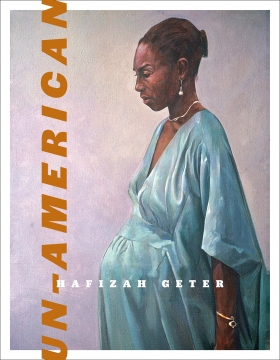
“Geter’s lines don’t so much hum as slice, visually cutting into the page like claws digging for answers in a ground that will not give,” writes reviewer Phillip B. Williams.
(review)
Her mother continued to hand her things: that lost dollar, a Chinese cookie fortune, one missing pearl earring.
(fiction)
from their beacon hands / glow worldwide welcomes and a thousand smiles.
(poetry)
The rose bushes lining the sidewalk leading to the front steps appeared like sentinels at the Mughal court, waiting for a decry from the Indian parent at the parapet.
(fiction)
“How and where women and minority groups get the shaft is only half of the lesson this book imparts,” writes Bean Gilsdorf.
(review)
ParaGard: [thank you student health/insurance] a type of long-acting, / reversible, contraceptive, intrauterine / device.
(poetry)
the city’s landmarks / are illuminated / by your stopover in my thoughts
(TCTC translations/poetry)
We’re whiter and more rural which means we don’t pick the president—we just narrow the view.
(poetry)
Many are drawn to martins covered with feathers that seem to absorb ash, stained with orange glass shards. (poetry)
You spend the winter telling me it’s almost summer.
(nonfiction)
Apparently to be a poet—dogmatic on the outside / and lacking conviction within / is a hell one can leave / but doesn’t.
(poetry)
Donald Ray Pollock’s Hillbilly Gothic peels back the sanitized “heartland” image of the Midwest, revealing the often-overlooked rural people. An interview by Jarrett Kaufman.
“Every book, like every child, stems from multiple ancestral lines. Fruitful books sprout new lines, branching into new familial territories,” writes Amy Hassinger.
(review)
I’ve socialized a couple times in the backyard. Masks on, masks off, nibble, nibble, sip, sip, masks on, masks off, sip, sip, nibble, nibble.
(nonfiction)
You’re going to call me racist with the name, Bianka? “White?” “Fair?”
“God’s Promise . . .”
(drama)
My friend was talking to her brother on Skype when a mouse–
(nonfiction)
I wanted to shout, but my tongue felt like the army slept on it. I wish I had a bittersweet Lick-M-Aid.
(fiction)
but the sea swoons / with delight in holy purity / but sand breaks the stone / that covers my face
(poetry)
Whilst searching through an unfamiliar room, / the guest against the bedstead sets abloom. / A blemished bruise that raise on his shank pain’s gloom.
(poetry)
Lexie Pitter is a newfound activist, bringing police brutality protests to Chicago’s North Side, where residents perceive police as benign protectors, as opposed to threats to the innocent. An interview by Avani Kalra.
“I’m a big fan of letting people enjoy things,” a Twitter user named Sherryis washingherhands…
“Stories of immigration, grieving, displacement, disaster, and language itself explode in this debut by Chicago-based writer Michael Zapata.” An interview by Samuel Schwindt.
I’ve never liked American reality TV because there’s so much hyperbole, yelling and arguing that reminds me of my childhood, that cramped home, the screaming matches, the constant fighting over money.
(fiction)
This is the day I am told I’m not essential. “I am too,” I say.
(nonfiction)
Moving beaters hacked and coughed like emphysema patients.
(fiction)
The space between the woman and the art flattened until she felt she was the art.
(fiction)
A trifecta of trilliums, a triplicity of trilliums.
(nonfiction)