
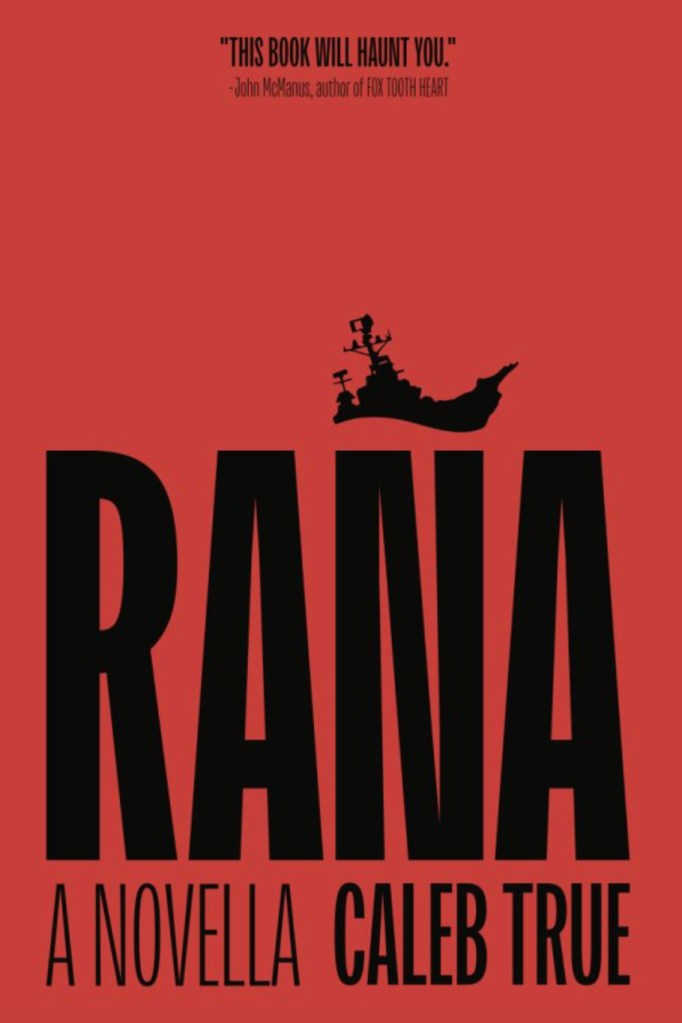
Note from the author:
RAÑA weaves the life story of a pugilist from Argentina and his surreal experiences in the Falklands (Malvinas) War, in which he serves, and with which he struggles for the rest of his life.
Heart, my heart,
so battered with misfortune
far beyond your strength,
up, and face the men who hate us.
—Archilochus

Rewind, fast forward—
The story of Eugenio Rafael Raña. Look at him: when he sleeps he kicks like a dog. He snarls in his sleep, flashing teeth. Dead center of a cycle, a cycle of anguished dreaming. On the one hand, all those bearing down on him, all the world; on the other: those he will bear down upon. To outsiders, the defining moment of his life is past. It was the South Atlantic War. He lies now in repose; he is at rest and sedate; sleep finds the only peace in him.
Fast forward, pause.
I am a champion of rubble! he cries at the ring of faces. I am a champion of the surface of the moon!

Eugenio Rafael Raña is short, but all the other men in Villa Ocho are short, so when he fights them he has no disadvantage of reach or advantage of infighting. In fact, his arms are quite long, queerly so. The way he carries himself after a fight, limping in circles and leering around at all the men who’d put down money. Baboon-like, no one dares point out. Raña fights with so much eagerness and so much abandon. He is no sportsman, and no one wants to box with a man who is not first and foremost a sportsman. Raña seeks no glory. He nurses his grievances as though in aggregate, in each and every bout; as though avenging the remorses of all his brothers in Villa Ocho (though he throws fists with them, too), his countrymen, the entire nation of Argentina. Think of it: small islands off the coast, and an Empire with long, long arms. Raña sees the baboon in Thatcher, and he takes his anger from the South Atlantic War, from defeat, home to Villa Ocho where it roils his thoughts and poisons his dreams.

There are those who speak up: a veteran of the South Atlantic War should not have to throw fists! No one agrees or disagrees, or responds in any way, and the words dissipate into the air, as obvious words always do, and life in Villa Ocho starts forward again as if from some collective emotional glitch; as if someone had simply pressed play.

For some time before Raña becomes a man of fists he works a job in the early morning on horseback in the pampas. Indigenous grasses, flaxen, bending and rippling in the breeze, a shallow sea for Raña’s horse. From the predawn hour until just before lunch he and other Villa Ocho men go in search of lost cattle. Curvature of land and tall grasses obscure them, and sometimes even their dark leather hides are like cloudshadow, fifty or sixty, or five or six hundred; hides like nimbus shading the surface of the earth.
One must squint, Raña’s boss tells him. One has to make sure it’s a cow, or several hundred cows, and not a mirage. Do you know what a mirage is?

But Raña isn’t stupid; he is quiet. Shattered, but not stupid. He will lose this job of squinting for cows and shadows only after he is quite bored of it, and the fleeting pleasure of planting a fist in his boss’s face has come to outweigh the lasting security of gaucho employment and its derisory compensation. A single perfect haymaker ends Raña’s tenure of horse, pampas, sun, and cloud, of rarified laughter and clean air, the ablutions of the altiplano. Gaucho life, in short. But it is a lovely haymaker, and that is all Raña can remember of the term in his life defined by regular waking hours and a sore crotch.
Upon seeing a man from the old job, a coworker, an upright kind of man with whom Raña got on, and hearing from him one of the old jokes:
Silence; nothing but silence.
Pause.
I don’t remember it, Mauricio.
Surely you do, Eugenio. We laughed for two days straight and came up with several versions of it. The version where the man lights a candle to find not his wife but a sheep? The version where the man lights a candle to find not his wife but his daughter? The version where the man lights a candle to find not his wife but his mother-in-law?
Silence.
The joke no longer stirs Raña. It summons the opposite of pleasure in him.
It is a terrible joke, Mauricio. We were tasteless men, scoundrels.
We were drunk!
Pause…
Play.
Okay, says Raña. I can see it.

Rewind—
As a child Raña could be seen running from house to house at the outskirts of Villa Ocho, playing at war. His young friends are with him, or not; sometimes they are his allies, often not. Great, desiccated pastries of cow dung as ordnance. If it is a day for wrath, tiny, knock-kneed Eugenio scales a drainpipe with a supermarket bag full of these and whips them at his friends. It is good practice for life, Raña thinks, looking back on his childhood and finding only a handful of memories worth finding. Perhaps, he hypothesizes, this is why the parents of those befouled children never punished him for this particular game. It’s too real. Life is too real, Raña thinks. He shakes his head in disbelief at his own life, once or twice each year, when he’s clear-headed enough to have an opinion about it.

Fast-forward—
To a time after schooling and before the war. Raña is not yet a man, and life is full of promises and enthusiastic trying, a still-unbroken string of successes. Raña lives in Buenos Aires stealing bicycles with a schoolmate of his from Villa Ocho, a young man named Bonifacio. There could not have been, in 1978, more than sixteen or so bicycles in all of Villa Ocho, and rarely if ever were these out in the open for boys like Raña and Bonifacio to notice. Buenos Aires, however, had thousands of bicycles. With a pair of cutters and the cycling outfit of a weekend rider, Raña and Bonifacio do well taking that which is not theirs and reselling it in another part of the city. Raña, wandering from bike rack to bike rack, lifting and dropping, checking locks, placing a moistened leaf on the chosen target for Bonifacio, who, dressing as an aficionado—spandex hugging his hairy brown thighs, jersey blowing about his ribcage—waddles up with wire cutters, quickly snips, replaces the cutters in his backpack, and rides away…
Their business prospers for months. In the end, it’s not the police who terminate their business, but a gang of rival bicycle thieves. They track down Raña and Bonifacio, and threaten mutilation.
Raña is quick to throw up his fists, but the gang of men take Bonifacio in their arms. One of them produces a knife, waggles it near Bonifacio’s soft neck.
All right, Raña concedes. We’re closed for business.
The right words to uncurdle the men. The cruel blade leaves Bonifacio’s jugular to rest again in the folds of a leather jacket.
Within a week Raña and Bonifacio abandon their lease and board a bus back to Villa Ocho. Along the way, Raña casts the wire cutters out the window.

The terror of returning home. What’s left for Raña in Villa Ocho?
Rewind—pause.
Replay the same scene a hundred times.
Raña’s mother on the foldout chair by the screen door in the kitchen. The sun has set, glows the hills. She sits sidewise to the screen door smoking a cigarette lit at the stove, watching the hills until the light’s gone.
A teenage Raña in the other room between television and sofa, crosslegged on the floor. The remote works the VCR, the VCR a tape—Raña’s favorite fight—Bonavena versus Ali. He can close his eyes even now, and see their dancing—
Play—
Ali dekes, lashes out. Bonavena takes it, catpaws back. Fast-forward, to the end: Bonavena’s nearly sleeping in Ali’s arms. Desperate embrace; he falls; he’s lost on the mat.
Don’t get up. Get up.
Again, Ali helps him to the abyss. Again. Pause. A world in a man. Stand to it; fall to him. Pause, before it’s all over. Tear yourself away, return to life. In the other room: Motion of hand, bloom of smoke.
Call to her: Mama! There’s nothing out there for you.
She blows smoke through the screen door. I can still look, sweetheart.
As if waiting for something—for someone.
Fast-forward—
Still, Raña thinks, gazing out the bus window, she’ll be waiting. Same stool, same cigarettes, same half-light. Smoke curling to the ceiling.
Nothing changes in Villa Ocho.

In the autumn of the twentieth century, Argentina surely is doomed, thinks Raña. From where, by whom, Raña cannot say. The air is thick with male doubt. Raña feels it all around him like hot breath. He confides this to Bonifacio on the bus ride home after their adventure in Buenos Aires. We are a part of that stink, whether we like it or not. Just like the thugs who ran us out of business, Raña says.
I don’t agree, says Bonifacio.
Let’s fight about it, then, says Raña. In this world filled with peace combat elevates a man.
There is no peace in this world, says Bonifacio.
If I suffered more, I should be stronger for it, says Raña.
I don’t mean exertion, says Bonifacio. I mean starvation, persecution, young death.
I don’t mean exertion, either, Bonifacio. You had better stop assuming what I mean…

Once or twice it occurs to Raña to look in books to find out about fascism, about women and men, about life. Homosexuals, vegetarians, Catholics. To look for something he knows not what—some idea about how his father might have been, had he had the chance to explain himself. Raña cracks the spines of Darwin, and of Las Casas, forces his way through the correspondence of San Martín. Are these heroes, he wonders? Old books are difficult, every page an age. Nonetheless, he wades. Suffice it to say Raña broadens slowly in the directions he seeks, straining against the discomforts of reading, of thinking, of being alone, of no one caring. He feels a kinship to dead men, feels near to them. To return to reality, to the present: sheer disappointment.
Bunching and unbunching his fists.
Squinting his eyes shut with all his power.
Clenching his toes in his boots.
Sitting on the bus, Bonifacio snoring on the seat next to him, Raña ablutes himself in this way: a baptism from within, a thin film of young man’s sweat blooming beneath his leather jacket.

Engine chortling, choking off. They roll to a stop halfway to Villa Ocho. The bus driver hauls himself up, opens the door.
Raña nudges Bonifacio. Wake up. Everyone’s getting out. Let’s have a drink.
Raña drinks Fernet straight. As a child he would mix it with Coca Cola, but adult pressures, failures, shortcomings, urgencies have blunted his patience.
What’s good in life, he says with the bottle in hand. Two glasses, a quick toast.
And little else. Chin chin.
Throwing it all back at once.

Back home in Villa Ocho, Raña sinks in with the old crowd, the only crowd; his gaggle of bad seeds. Not friends, per se, more an alliance of the friendless. A few have been hard at work studying the latest developments in political troublemaking. It’s a good time to hunt radicals, they say; to root out evils hidden in the University a short way up the road; to be a hero for the main.
The boys have with them a Castas book from their childhood showing the spectrum of skin color and corresponding stations of a nation in harmony: rightful roles for skin tones between very dark and pearly white. To a stone like Raña, such activism, if it can be called that, seems misplaced. Raña is no racist, hating only the rich, and the British, who seem rich, or act rich, or have been rich in the past, and pretend still to deserve their riches.
Raña asks his brothers what good they feel their so-called activism might do. They hasten to explain that Argentina has never endeavored scientifically to analyze its social makeup.
It hasn’t? Raña asks.
Scientifically, they say.
They fret, in Raña’s presence, about white decline, about dilutions in the blood.
And it’s the same, they insist, with the minds of the people. We must build a hierarchy of humanity, based on political leanings.
Leanings? Raña asks.
Leanings, they confirm.
Raña retorts: But you are not scientists.
Long ago, says one, sprawling languid on the couch with his rum, the scientists gave up on such noble matters, as they lacked the science, or the nobleness, to pursue them. He swigs from his bottle. It falls to us to take up the reins.
Ah, says Raña, the reins.

Fast-forward.
Raña is not an old man, but with an eternity of violence, insecurity, turmoil, and Fernet in him he looks sixty. He has lost every job he has ever had. He has already fought many men from the village in the streets behind bars for money. He has even fought his friend Bonifacio. He’s lost track of how many fights. It matters less and less—everything does. Through a crimson screen he sees only malevolent faces. One in particular: that of the great British explorer Sir Richard F. Burton, KCMG, FRGS, forkbearded and stoic and smoldering. The man appears as if from nowhere one night, as Raña boxes with a man he does not know for a paltry sum of money. Reeking in the tepid light of lanterns, the man who jumps this way and that grows the likeness of the explorer of the British Empire, the man who penetrated Mecca and Harar. Long arms from the tall man, they strike at Raña, clip him, box his ears like some schoolmaster. A rain of light before Raña’s eyes—a firefly aura. He is seeing stars. The heartbeat of popular music, discernible through the walls on the night air, disturbing the early morning quietude amid guffaws of men around him, the sick slugging blow, his own grunts and sniffs. Someone comes and separates Raña from his adversary.
A voice. Bonifacio’s.
Raña, are you still with us?
Swimming through the night.
Si, bring him to me again. Round six!
No one’s keeping track, Raña.
Where did the man go?
Bonifacio steps aside and there’s the Juanito again, what’s-his-name, nobody. Why is the fight so difficult this time? Who is this person? This was not the man who trained monkeys to serve tea in India. For a second his own mother flickers to mind, for it was she who showed Raña, when he was a child, books of the great British explorer. He, too, was a pugilist of the finest order, and a swordsman who dueled to maintain his honor.
Raña, snap out of it!
Raña looks for the man who spoke.
A stranger’s voice, gruff and demanding: I have money on you, boy—are you all done or are you going to cost me my rent this month?
Boy?
Raña lunges at the man, fists-first. Others hold him back.
He’s done, someone else says.

The doctors know Raña’s name at the ER. It is written on suture kits set aside for him. First they sew up the flesh around his eye sockets, then the bridge of his nose, always resplit, a scar on a scar. Raña murmurs while they sew him, half asleep and half-dreaming.
How’s that Raña?
More anesthetic?
Fuck it, he can’t hear you anyway.
Just put him under.
He reeks of filth.
Shut your mouth, he was on the Belgrano. Such a pity…

Pause here.
Do they know of Raña’s conflict? That he does indeed fight the war of the Falklands, The Malvinas War, in each and every bout against each and every drunkard, thuggie, and pissant who comes asking after the pugilist of Villa Ocho, the man with nothing left but his fists, the man called Raña?
It is true. But they don’t know that the great explorer Sir Richard F. Burton has come to settle over the mantle of every opponent. Raña could fight a child, a woman, a puma: still it would grow Burton’s long mustaches, still it would squint at him through Burton’s likeness, sunspotted, all creased flesh and crows’ feet; still, his opponent, whomever he was, would crouch into the old English stance learned at Trinity College behind the chapel, in the bell of a willow, the shade of a larch, against the pastel blush of blooming dogwood, swathed in a belt-clasped linen tunic, in what would be that man’s halcyon days, but also days of boredom in the vice of privilege. These things Raña can see, or thinks he can see, in the eyes of the explorer, in the ghost who haunts his fights and becomes the man to beat down: England itself, England incarnate between Raña and victory. Is it for Thatcher this man fights? Raña wonders, when his addled mind attempts to understand. To be sure, a genius of Burton’s caliber could never stomach England’s ruling conservatives. All fuss—it did not matter. Raña is no political mind; is, most of the time, of only half a mind about anything. He can’t count the concussions anymore, as they leave no scars by which to count.
For a while Bonifacio tries to help Raña, to see if he won’t seek some assistance for his alcoholism. Bonifacio thinks sobriety might improve Raña’s endurance in the ring. Sitting on the porch one morning, he broaches the subject; Raña bursts out laughing. In a swift motion that demonstrates he can still see through his swollen black-blue slits, Raña picks up his tumbler of rum and splashes its contents into the dust.
I am not addicted to this, says Raña. I am addicted to fighting. This, says Raña, waggling the empty glass between his thumb and forefinger, is for the pain.
Do you hurt right now? asks Bonifacio.
I hurt all the time, says Raña. I can transfer the pain to others, but only for a time. Then it returns to me, Raña says, his gaze meandering down the avenue. Then it returns to me.

Once or twice over breakfast Raña mentions the explorer Burton. Bonifacio has to stop Raña, who lets slip the name without preamble, and then—as the name is a pebble preceding an avalanche—launches into a grand soliloquy about the explorer and his insurmountable prowess, an intimidating, dominating polymath in all things…
Bonifacio cuts in.
Who?
Raña’s face, less damaged than usual, betrays an uncharacteristic subtlety of expression. Somewhere between confusion and disgust, he introduces Sir Richard F. Burton, KCMG, FRGS, to his old friend. The great explorer of the nineteenth century, says Raña, who penetrated Mecca as an infidel, who penetrated Harar, who discovered the Tanganyika Lake and—
All right, says Bonifacio. An explorer, leave it at that. What is he to you?
He is… Raña begins. He is… I idolize the great explorer. A boxer and a writer. He fought many duels, he overcame fever, served his country in war. I can’t say why I think of him. Perhaps it is because my mother showed me his books when I was a child.
What books?
Books, books, says Raña, who had to think hard to resurrect the names of the great explorer’s volumes. The Thousand Nights and a Night… Letters from the Battlefields of Paraguay… Vikram and the Vampire… These lived, in the happy flicker of Raña’s childhood, on the mantle above the fireplace. Only the Thousand Nights did Raña’s mother ever take down to share with him. The image of Burton in his mind—with full beard in a mossulman’s ankle-length dress and camel rider’s crop—came from A Pilgrimage, but Raña is not aware of this. He has no answers about that resolute mirage, and others—memories which remain with him, while others have gone. Raña says only this: My mother had a picture book of the Great Explorer, of his deeds and travels.
And…?
Bonifacio watches his friend struggle through memories, form words.
And… Raña touches his stubbly blue chin. And the explorer had these glorious mustaches, bushy mustaches like those of some conquistador but even greater, and…
Nothing more from that morning, from that scene. Raña resists confiding in his friend, and his friend feels this is but dribble, another bit of runoff from his friend’s mind, a river with one source but many mouths, a slow-moving river. Unlike Burton, unlike Speke and Grant, Bonifacio cannot waste his time charting every tributary in pursuit of the ultimate source, in pursuit of some answer. In Raña’s mind, a fictive colonial Africa lives on: all mystery and intrigue, caricature of the unknown. In Raña’s heart: cannibalism, animism, rumors of a primitive soul wandering the jungle.
Stop.
Purchase RAÑA at Bookshop.org.
✶✶✶✶

Caleb True is a writer, editor, critic, musician, and podcaster. He holds an MA in History from the University of Massachusetts and an MFA in Creative Writing from Old Dominion University. He is the author of the novel RAÑA (University of Tampa Press), On Ruben Slikk: A Manifesto on the Purpose of Art and the Value of Transgression (Dynamo Verlag), and Chansons Russes (Quetzalcoatl), a historical triptych of stories set in Soviet Russia. He has published short stories and essays in Sonora Review, Faultline, Yemassee, Whiskey Island, and many others. He is the founder and managing editor of Dynamo Verlag (est. 2015), a boutique publishing house specializing in textual work demonstrating genius, eclecticism, and originality.
✶
Whenever possible, we link book titles to Bookshop.org, an independent bookselling site. As a Bookshop affiliate, Another Chicago Magazine earns a small percentage from qualifying purchases.

